


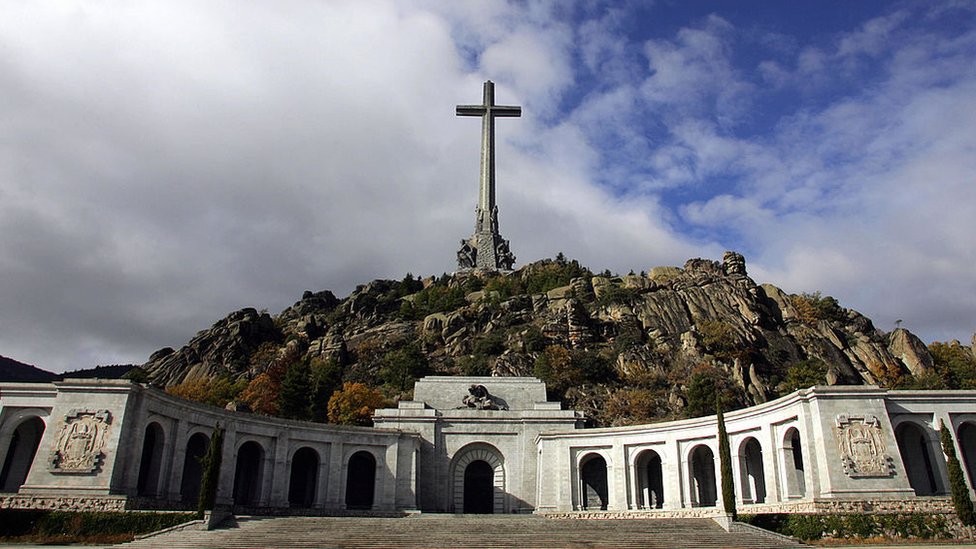
The National Court did not validate any agreement on the resignification of the Valley of the Fallen. The order only denied a precautionary measure, but a headline turned a precautionary ruling into a judgment that never existed.
The recent headline from Religión Digital, signed by Jesús Bastante —«Justice validates the Church-Vatican agreement for the resignification of Cuelgamuros»— constitutes a paradigmatic example of how a media outlet can attribute to a judicial ruling statements that it never makes. A minimally attentive reading of the order is enough to verify that the headline does not correspond at all with its content.
The Order 281/2026 of the National Court does not validate any agreement. It resolves exclusively a separate piece on precautionary measures and limits itself to denying the provisional suspension of the so-called Cobo-Bolaños agreement. The Chamber itself expressly recalls that its analysis is carried out «within the limited examination that this separate piece allows», that is, without addressing the merits of the case.
The legal difference is elementary. Denying a precautionary measure does not equate, even remotely, to declaring the challenged act lawful. The legality or nullity of the agreement must be decided in the judgment that ends the main proceedings, after a full examination of all the issues raised.
Nor is it true that the National Court has declared that Cardinal Cobo was competent to sign that agreement. The order only states that, in the limited precautionary examination, «there are no obvious grounds for absolute nullity» arising from the alleged lack of competence and that the case file data «do not allow support in that regard». This is a strictly provisional assessment, insufficient to turn it into a judicial declaration of competence.
The ruling also does not state that there is an agreement between the Government of Spain and the Holy See, nor that the Vatican has approved the resignification of the interior of the Basilica, nor that the content of the document complies with Canon Law or the fundamental right to religious freedom. All those statements belong to the narrative constructed by Jesús Bastante, not to the text of the order. It is enough to read the ruling to verify that none of them appear in its content.
The ruling itself is unequivocal: it only orders «to deny the suspension». Nothing more. It does not validate the agreement, does not resolve the appeal and does not anticipate the outcome of the future judgment.
In a matter as sensitive as religious freedom, relations between the Church and the State or the legal protection of a Catholic church, informational rigor is not an option, but an ethical and professional requirement. When a media outlet presents as judicially proven facts statements that the ruling does not contain, it ceases to inform in order to construct a false narrative.
From a moral and deontological point of view, this way of proceeding is especially serious. The journalist’s first duty is respect for the truth of the facts and fidelity to the content of the sources. Attributing to a judicial body pronouncements that it has never made violates that essential duty, leads the reader to a mistaken understanding of reality and undermines public trust both in the Justice system and in journalism itself.
Freedom of information requires independence, rigor and intellectual honesty. It does not protect attributing to a court statements that it has never made. When a journalist turns a precautionary order into an alleged judgment on the merits of the case, they cease to inform in order to influence the reader’s perception. This way of proceeding not only contravenes the most elementary principles of journalistic ethics; it ultimately harms precisely the person whose position it seeks to reinforce, namely Cardinal Cobo.
In this case, far from contributing to restoring the intense loss of credibility of Cardinal Cobo among numerous priests and faithful after the scandalous agreement signed with Minister Bolaños, this type of publication, usually signed by journalist Jesús Bastante in Religión Digital, fuels the impression that only through the distortion of the content of a judicial ruling can a narrative be sustained that the order itself refutes.
Falsehoods never truly serve anyone; sooner or later they end up harming precisely those they were intended to defend.