


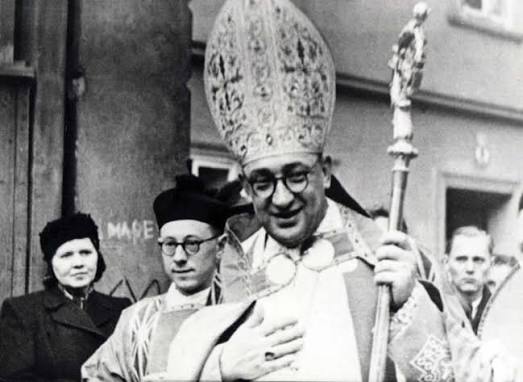
More than half a century after his death, the justice system of the Czech Republic will examine the full judicial rehabilitation of Cardinal Štěpán Trochta, one of the great symbols of the persecution suffered by the Church under the communist regime in the former Czechoslovakia. The procedure seeks to remedy the illegal internment to which he was subjected between 1950 and 1953, an episode that had never been reviewed by the courts despite the subsequent annulment of the political conviction that led to his imprisonment.
The Public Prosecutor’s Office submitted the proposal after examining the documentation preserved in the state archives and considering it proven that the then bishop of Litoměřice was unlawfully deprived of his liberty. The District Court of Litoměřice must now decide on the rehabilitation, although the date of the hearing has not yet been set.
Archbishop Stanislav Přibyl, apostolic administrator of Litoměřice, expressed his confidence that the process will allow the full restoration of the good name of one of the most emblematic bishops of the Czech Church during the 20th century.
Victim of two totalitarian regimes
The life of Štěpán Trochta (1905-1974) was marked by persecution under two totalitarian regimes. A Salesian of Don Bosco and doctor in Theology from Turin, he was detained during the Nazi occupation for his collaboration with the Czech resistance and deported to several concentration camps, including Mauthausen and Dachau, from which he survived with severe physical after-effects.
After the Second World War, Pius XII appointed him bishop of Litoměřice. However, the arrival of the communist regime once again placed him in the spotlight. As spokesman for the episcopate in negotiations with the new authorities, he rejected the State’s attempts to control the life of the Church and denounced the so-called Catholic Action promoted by the regime. Shortly afterwards he was placed under house arrest, isolated, and finally imprisoned on charges of “treason and conspiracy” in a political trial.
Although he was released thanks to an amnesty in 1960, he was forbidden to return to the governance of his diocese and had to work as a manual laborer for years. Only after the relative political opening of the late 1960s was he able to resume his episcopal ministry. In 1969, Saint Paul VI created him cardinal in pectore, an appointment initially kept secret due to the situation the Church was experiencing behind the Iron Curtain.
At his death in 1974, the then archbishop of Kraków, Karol Wojtyła —future Saint John Paul II— defied the restrictions imposed by the communist authorities and paid tribute to the cardinal, publicly describing him as a martyr.
A process of historical reparation
Trochta’s case adds to other decisions recently adopted by Czech courts to recognize the persecution suffered by prominent members of the Church during communism.
In February, Cardinal Josef Beran, former archbishop of Prague, was rehabilitated, while last June another court did the same with Archbishop Josef Karel Matocha, recognizing the illegality of his internment. In 2024, the priest Josef Toufar, who was tortured to death by the communist secret police, was also rehabilitated.
If the court in Litoměřice now approves the Prosecutor’s proposal, Štěpán Trochta will become the third high prelate to be judicially rehabilitated in the Czech Republic within the framework of the process of reparation for the victims of communist persecution against the Church.