


The purpose of this journal is not to recount my story, but to use it merely as a necessary starting point to understand the context in which these reflections on God, the Church, life, man, history, and society are born—reflections I intend to share in order to encourage other men to become part of “that small handful of men who have the courage to be untimely,” as Gilbert K. Chesterton put it.
In the first entry, I briefly explained that in the spring of 2023 I put my apartment in Barcelona up for sale, bought a ruined house that I turned into a small hermitage in Los Monegros, in the province of Zaragoza, and moved here in winter, a year and a half ago. The distance and travel time to go to confession, speak with my spiritual director, and attend Mass were enough to do it all in a single day.
The decision to take such a drastic step was not sudden. It was a long journey that at the time seemed very difficult to me, one I believe I did not seek, and which was ultimately liberating, because God’s timing is perfect, even if it does not spare us suffering (or precisely because of that).
I was a teacher of history and social sciences at a state-subsidized Catholic school in Barcelona that still carried the Catholic label, owned by a women’s religious congregation on the verge of extinction, where all the teachers and staff were already laypeople. Occasionally a Sister in a white blouse and blue skirt would pass through the reception area, but the only thing visible to someone unfamiliar with the school was that she was far too elderly to be working there. A priest friend had helped me secure the position once I obtained the necessary academic qualifications. When I landed this permanent job, I bought an apartment in the school’s neighborhood and began paying a mortgage that, God willing, I would finish paying off almost at retirement age.
In my mid-twenties, I was well settled—or so I thought. I liked the neighborhood and neighborhood life. I remember feeling happy. But, being a cradle Catholic from a “conservative” family, the decisions being made at this school run by pro-independence, progressive nuns began to seem increasingly inconsistent with the Catholic faith. It was not only the disastrous academic curriculum and the progressive decline in the level of the subjects taught, along with the obligatory left-wing ideology imposed by the “world,” but also the fact that in recent years the school had implemented—and announced at the beginning of the school year—the package of “sustainable goals” from the diabolical 2030 Agenda. At the same time, we were witnessing the development of Pope Francis’s pontificate, without which it would not have been possible for a “Catholic school” to adopt the objectives of the 2030 Agenda.
I suppose there are people who can live by compartmentalizing their work obligations and their practice of the faith. At least, that is what I seemed to perceive among my friends, almost all of whom had remained close since school, the club, and our university years in Pamplona, as well as from the parish. It was all the same environment—the idea of sanctifying oneself in the midst of the world through work, of being good, of giving witness to the Gospel in the world. But I felt increasingly alone, increasingly unable to maintain with them the usual conversations about the Church, society, and politics. I found myself more and more in disagreement with everything and everyone.
As a result of the growing unease this situation caused me, I began to seek solitude and silence with increasing desperation. At first it was external silence, which gradually became internal. My family and my girlfriend began dropping increasingly urgent hints about getting engaged and setting a wedding date; we had started our relationship relatively late, both at twenty-five, so we shouldn’t wait too long if we were sure we wanted to marry. But I felt increasingly distant from that reality, more uncomfortable with my life. Almost without realizing it, I began to push my girlfriend out of my life and started spending weekends at the guesthouse of Poblet Monastery. The Rule of Saint Benedict and its simple, clear path to holiness sank deep into my bones. As a historian, I was deeply impressed that communities had been living according to that rule for nearly fifteen centuries. That so many people had attained holiness in such an apparently simple way.
Needless to say, this triggered a deep crisis with my girlfriend that never recovered, though the agony seemed endless to me; her dramas and complaints began to intensify, but I could do nothing. I was already deeply immersed in the Benedictine ideal of prayer, study, and work. She finally left me on a Friday night in 2016 while we were calmly eating sushi. She had given up. On Saturday morning, as I had already booked, I went to Poblet Monastery to spend the weekend in its guesthouse and to participate in the liturgical prayer with the monks. I was 28 years old and felt a weight lifted off my shoulders. But I still carried many other burdens; the main one was the growing inability I felt to continue my work as a teacher in a school infested with ecclesial modernism, exultant over the pontificate of Francis, which I considered catastrophic.
As the good conservative I was, I now understand, the growing bipolarity between the staunch defense of the pope as the guarantor of ecclesial orthodoxy and the words and actions of that pope was causing me a short circuit. At first I thought the problem was Pope Francis and his constant missteps and his very un-Catholic opinions. But in the circles I moved in, people began, somewhat discreetly, to talk more about politics than about the Church, unable to justify the unjustifiable or deny the obvious: that the Church was in a profound crisis of confusion.
When I look back now, I find it hard to understand how I could process everything so slowly, how I took so long to see what was happening. It feels like a puzzle whose overall image is missing until all the pieces are in place. The fact is that, little by little, I began to spend almost every weekend and vacation at the guesthouse of Poblet Monastery. There I found peace, praying in silence. And I believe I was also avoiding facing the situation head-on, living compartmentalized between the school environment, the ecclesial situation, and the refuge of the monastery. In those years, I was deeply impacted by reading “The Spirit of the Liturgy,” which Benedict XVI had written as a theologian in 2001. The liturgy began to carry more and more weight in the way I lived my faith. I began to pray the Divine Office every day, especially Lauds and Vespers, but whenever I could, also Sext and Compline. But Ratzinger spoke of a way of celebrating the liturgy that did not correspond to the Masses I attended—not only those in the parish, but also the monastic Mass I attended at Poblet.
At the same time, I began to understand that community life was not for me. It is true that the monks spoke little, but I found the recreation hours and community outings uncomfortable. I believe they are a very good source of knowledge among the monks and help foster a true community; but perhaps they were not well “focused” there, or simply community life was not for me. So I began to inquire about the solitary religious life.
On top of all this, the Covid pandemic broke out and I was locked down, like everyone else, at home, with online meetings and classes. Everything was suspended in mid-air. And the churches were closed by order of the bishops. It seemed to me an act of treachery and the most anti-Christian action possible. I have great devotion to Saint Charles Borromeo and could only think of the contrast between what he had done when the plague outbreaks erupted and what the current hierarchy was doing. I was hurt, indignant, furious with the priests, the bishops, and the pope, who began preaching that we should all get vaccinated and spoke only of bodily health and nothing about the salvation of souls. It seemed shameful to me that my friends thought they were attending Mass by watching their parish priests record themselves celebrating and broadcasting on YouTube.
In March 2021 I attended the traditional Mass for the first time, and in a short time everything seemed to fall into place. I believe the difference between a conservative Catholic—full of good intentions and love for God and the Church, who sees everything with a sweet goodism and only detects “isolated problems” caused by the outbursts of progressives—and a traditional Catholic is the clear recognition that the Catholic faith and doctrine, developed organically over centuries after being divinely revealed, still exist, are the natural response to everything, and cannot be contradicted or altered. And that the inconsistencies and contradictions that have been occurring for nearly a century, but especially since the Second Vatican Council, stem from the takeover of the Church’s hierarchy by modernists surrendered to the world.
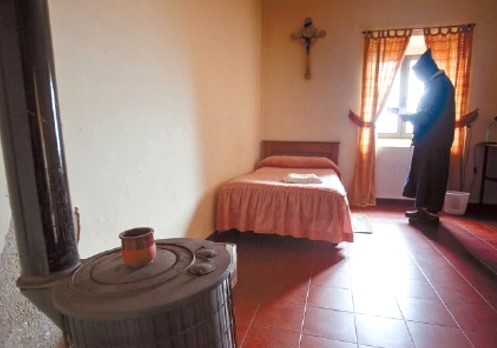
Finally, in the winter of 2023/24 I left the corrupting world and came to the desert. I call myself a hermit because I live alone in the desert with the aim of seeking God. I am not under the obedience of the diocesan bishop through any vows, nor do I belong to any spiritual family. In these times, I believe this is the way not to be canceled by an ecclesiastical official. I wear a simple gray tunic while inside the house/hermitage, but I wear trousers when I leave to run errands, shop, or attend Mass.
I cultivate the small plot of land that was once a patio and is now entirely a vegetable garden, and I have four chickens in the coop and a dog that stays outside during the day, alert to any unexpected visitors, and sleeps under the same roof as me at night. The coop is divided into two parts: the henhouse and a small woodshed where, during my first year in the hermitage, I also cut and carved pieces of wood that I later tried to sell at typical medieval markets and online. The work gradually changed over time, because that was very idealized and did not bring in the income I had hoped for. So I began to devote myself more to painting icons, restoring religious images, and doing translations from German into Spanish on commission.
The house is laid out like a Carthusian hermitage, but on a single floor and all open, except for the bathroom. There is a small kitchen/dining area, an oratory, a desk, the bed, a very rustic wardrobe, and a wood stove. Outside are the patio, the coop, and the woodshed. Everything is surrounded by the same very monastic-style wall. I have very little income, but also very few expenses.
I get up very early and pray all the Hours of the 1963 Benedictine Monastic Divine Office (as at the Abbey of Le Barroux, where I acquired the books during a visit), except Matins. It has been extremely difficult for me to get up during the night and fall back asleep. And most days I am unable to. I go to bed very early, at sunset in winter and around 9:00 p.m. in summer.
No more is needed. The Divine Office, Lectio, the daily rosary, and mental prayer. That is the main occupation: to spend my life as an offering to God, purging my sins, interceding for the conversion of sinners and the restoration of the traditional Mass, which immersed me in the most intense and profound life.
I also study. Again, it has been very difficult for me to acquire a routine of prayer, work, and study, but I am more stabilized in it now. We will have occasion to discuss this later, but it is not in vain that Saint Benedict does not permit the solitary life unless it follows many years of proven community life (“Thanks to the help of many,” he says, “one prepares to fight against the devil”). As for study, I am forming myself in the doctrine and faith of the Church of all time and, for some time now, I have been researching traditional Catholicism in Spain after the Second Vatican Council.
And I leave here very little. On Sundays and holy days of obligation to receive spiritual direction, go to confession, attend traditional Mass in Barcelona, and visit my parents and siblings. And occasionally to shop or handle administrative matters.
When I moved here at the end of 2023, I had the idea of approaching the bishop to be consecrated to the eremitic life. However, after long discernment on the matter with my spiritual director, I decided it was better not to, since consecrated persons and priests who try to live faithfully according to the Church and the liturgy of all time are persecuted, marginalized, and canceled today, following the demonic delusion of Francis—and now Leo—to put an end to tradition. Living this way gives me the freedom to serve God rather than men that I would not have if I were consecrated. It is the most “naked” life of a baptized person, which corresponds to the simple Rule of Saint Benedict that I try to apply to my life: to pray, to work, and to study.
Surely I made a mistake by entering the desert without prior community experience. That is why everything has been so difficult for me. In fact, 2025 was a year in which I had countless temptations to abandon. I didn’t have enough money, I couldn’t stabilize my routines, and I came to feel very alone.
But 2025 also had a very fruitful aspect: after months of frustrating visits to the town hall, I obtained the permits to add, in the same aesthetic, along one of the patio walls, a small annex of about 30 m² to have a chapel, with its altar attached to the eastern wall. And since then a priest friend occasionally comes here to celebrate the traditional Mass in catacomb mode. Most of the time it is just the two of us, although sometimes people who travel many kilometers to get here also attend. Next to the chapel I was able to build a small cell for the priest’s stays and occasional other visits. The patio is beginning to resemble a cloister, surrounded by three walls that contain the built structures and one that is only a wall separating it from the outside.
My spiritual director, a wise man with problems with his bishop, is a constant reference. Before him I have professed private vows of chastity, poverty, and obedience. Since I study the Church Fathers in depth, I know the lives of some of them and do not rule out that what happened to Saint Jerome might happen to me: with very little experience of common life, he went to the desert in Syria and in only two years the temptations of the flesh consumed him to such an extent that he had to leave (also influenced by the continuous controversies in which he found himself involved due to the schism of Antioch).
I am no longer young; I am closer to forty than to thirty, but I am very clear that the devil is always prowling around, roaring like a lion, seeking someone to devour; so I try to stay awake and firm in the faith.
Writing structures the mind and helps settle thoughts.
Note: This article is part of a series in which the author recounts his experience of eremitic life and his spiritual journey. To be continued.