


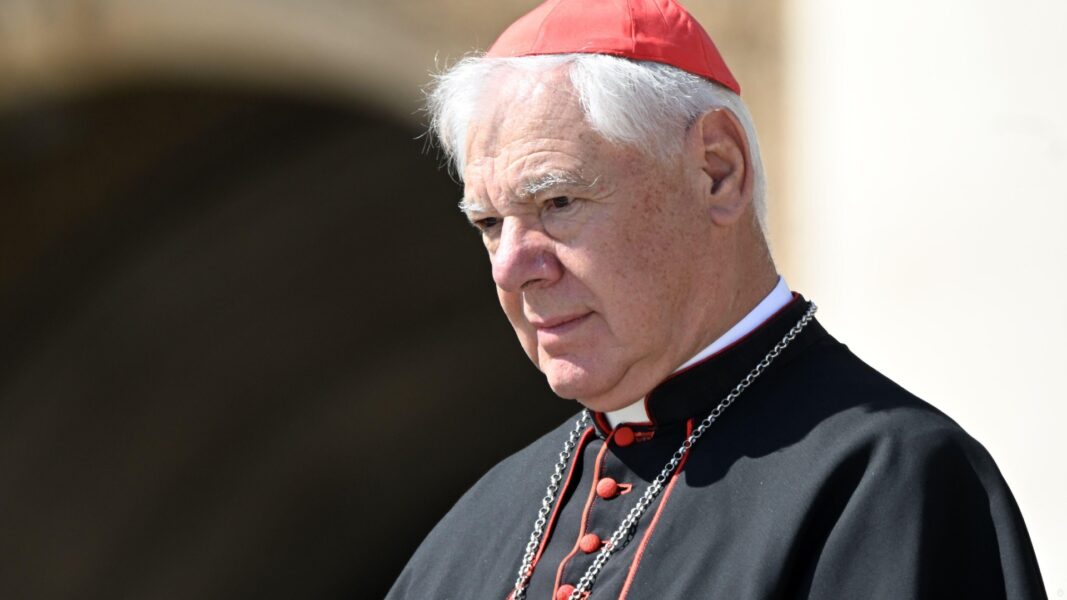
Cardinal Gerhard Ludwig Müller, prefecte emeritus of the Dicastery for the Doctrine of the Faith, has publicly contradicted one of the most controversial aspects of the Explanatory Note published by that same dicastery on 2 July regarding the canonical situation of the Priestly Fraternity of Saint Pius X (FSSPX). Against the Vatican document’s claim that confessions administered by priests of the Fraternity are invalid, Müller maintains that these sacraments are “valid, but illicit”.
The statements were made on 6 July during an interview given to the German Catholic television station K-TV, just four days after the publication of the Decree and the Explanatory Note signed by the prefect of the Dicastery for the Doctrine of the Faith, Cardinal Víctor Manuel Fernández.
The discrepancy is not minor. While the Explanatory Note expressly warned that “the sacrament of penance administered by them and the marriages they witness are invalid,” Müller offered a completely different interpretation of the juridical status of those sacraments.
Read also: The formula used by Tucho to excommunicate priests and laity lacks penal efficacy
“Confessions are valid, but illicit”
Directly asked about the validity of confessions administered by priests of the Priestly Fraternity of Saint Pius X, the former prefect of the Doctrine of the Faith replied without hesitation:
“Confessions are valid, but illicit. The power to forgive or retain sins is conferred through the sacrament of Holy Orders. Its exercise can only be restricted by the bishop or by the Pope, in accordance with the provisions of canon law.”
This statement directly contradicts the interpretation upheld by the current prefect of the Dicastery for the Doctrine of the Faith and coincides, in its practical conclusion, with the objections raised by various canonists, who have maintained that the Explanatory Note does not expressly revoke the faculties granted by Pope Francis allowing priests of the Fraternity to validly absolve.
Müller also did not endorse the Note’s claim regarding the invalidity of marriages celebrated by the Fraternity. He recalled that marriage arises from the consent of the spouses and mentioned exceptional situations in which the canonical form may be supplied. Although he advised against approaching priests of the FSSPX for the celebration of marriage because they are not in full communion with the Church, he avoided stating that such marriages are invalid.
Benedict XVI sought reconciliation
During the interview, Müller lamented the recent episcopal consecrations carried out by the Fraternity without a pontifical mandate and described them as a wound to the Church.
At the same time, he recalled Benedict XVI’s efforts to restore full communion with the Fraternity. The German cardinal stated that the Pontiff acted with “great generosity” when in 2009 he lifted the excommunications of the four bishops consecrated by Marcel Lefebvre, in the hope of overcoming the existing impasse and fostering reconciliation.
“Benedict XVI made the wise decision to allow the same Latin liturgy to be celebrated both in its ordinary form and in its extraordinary form,” Müller also noted, referring to the motu proprio Summorum Pontificum, which liberalized the use of the 1962 Missal.
Read also: Gänswein reveals Benedict XVI’s pain upon learning of Traditionis Custodes
The ancient rite “is not prohibited”
The prefect emeritus also defended the validity of the traditional liturgy and rejected the thesis that it had been abolished.
“The so-called ancient rite is not prohibited. It is permitted under certain conditions and is, of course, valid,” he stated.
He also acknowledged that the application of the liturgical reform following the Second Vatican Council was accompanied by numerous abuses.
“The application of the liturgical reform was marked by many abuses because many did not understand the spirit of the renewed liturgy and neglected its essential elements: the worship of God, the communication of salvation, and reverence before God,” he explained.
Nevertheless, he insisted that these abuses do not justify a rupture with the Church.
The unity of the Church passes through the Pope
Although he admitted that many faithful are drawn to the Fraternity because they believe that Catholic doctrine and liturgical tradition are preserved there with greater fidelity, Müller maintained that this fact is not enough to justify a situation of separation from Rome.
“Many may feel sympathy for the Priestly Fraternity of Saint Pius X because they believe that the Catholic faith and the liturgy are preserved there in the face of many abuses present in modernist circles. But that does not constitute a justification,” he stated.
The cardinal insisted that ecclesial unity does not depend on liturgical preferences, but on communion with the Successor of Peter.
“There may be errors in the Church, but there is no Catholic unity apart from the Pope,” he declared.
In that context, he expressly defended the legitimacy of the pontificate of Leo XIV.
“One cannot correct an abuse by using false means. That Leo XIV exists and is the true and legitimate Pope is something that no one can really call into question without calling their own Catholic faith into question,” he concluded.
A canonical debate that remains open
Müller’s statements make clear that the Explanatory Note published on 2 July has not closed the debate on the canonical situation of the Priestly Fraternity of Saint Pius X. The coexistence of two incompatible interpretations regarding the validity of confessions administered by its priests opens a scenario of legal uncertainty that will hardly be resolved without an official clarification. In this context, it is not ruled out that in the future the Dicastery for Legislative Texts or Pope Leo XIV himself may need to issue a statement to clarify the juridical scope of the Note and its relationship with the faculties granted by Pope Francis for the administration of certain sacraments.