


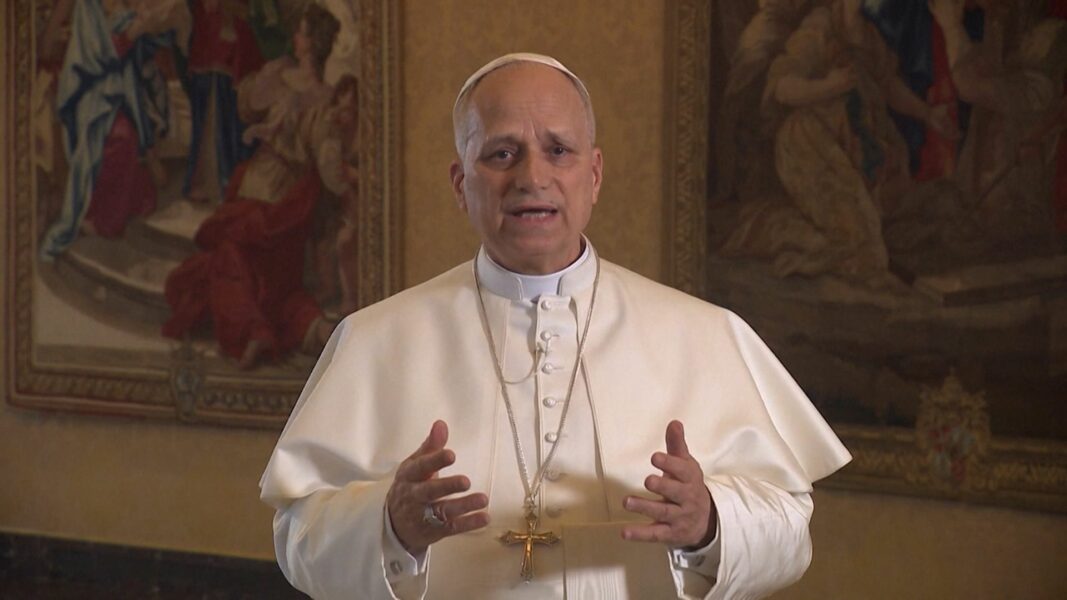
The National Eucharistic Pilgrimage of the United States concluded this Sunday in Philadelphia after traveling for more than a month through 18 dioceses along the country’s east coast. The initiative was organized to mark the 250th anniversary of American independence and brought together thousands of faithful in processions, eucharistic adorations, and liturgical celebrations. The closing Mass, held at the Cathedral Basilica of Saints Peter and Paul, was preceded by a video message from Pope Leo XIV.
The Pontiff congratulated the organizers and participants for a pilgrimage that, under the motto One Nation Under God, traversed much of the original thirteen colonies while praying “for the unity, renewal, and healing” of the country. “By taking part in this eucharistic pilgrimage, you continue this great legacy of faith,” he stated.
The Pope recalls the first Mass celebrated by Spaniards
In his message, Leo XIV wished to highlight that the Christian history of the United States began before the 1776 independence. He recalled that the pilgrimage started in St. Augustine, Florida, where on September 8, 1583, the feast of the Nativity of the Virgin Mary, Spanish explorers and settlers celebrated a Mass of thanksgiving after their arrival and later shared a banquet with the indigenous Seloy tribe.
“This historic event, together with many others, bears witness to the solid, though largely unknown, eucharistic heritage of the United States,” he affirmed. “This heritage, far from being forgotten, must continue to be a source of renewal and unity.”
A legacy of saints nourished by the Eucharist
The Holy Father recalled that this spiritual heritage has borne abundant fruit through the witness of the martyrs of New York and Georgia, as well as saints such as Kateri Tekakwitha, Elizabeth Ann Seton, Katharine Drexel, and John Neumann. He also mentioned the Venerable Fulton Sheen, of whom he stated that he “will soon be beatified.”
Likewise, he recalled that the pilgrimage was placed under the patronage of Saint Frances Xavier Cabrini, foundress of the Missionaries of the Sacred Heart and the first American citizen to be canonized. Days before the conclusion of the journey, Leo XIV had venerated a relic of the saint’s heart in Pavia, while the pilgrims visited the National Shrine of Mother Cabrini in New York, where her remains rest.
The Pope noted that the intense apostolic work of these saints would not have been possible “without the strength they drew each day from moments of silent prayer before the Tabernacle” and, quoting the encyclical Ecclesia de Eucharistia of Saint John Paul II, he recalled that the Eucharist is “the most precious possession the Church can have in her journey through history.”
Thousands of faithful accompanied the Blessed Sacrament
The pilgrimage began last May in St. Augustine and reached Portland, Maine, before returning to Philadelphia. A group of nine permanent pilgrims accompanied the Blessed Sacrament throughout the entire route, passing through cities, small towns, nursing homes, and shrines.
Among the most significant moments were the procession along Boston’s Freedom Trail, which gathered nearly 3,000 people; the passage of the Blessed Sacrament before the Washington Monument; the crossing of the Delaware River following George Washington’s 1776 route; and the visits to the shrines of Saint Katharine Drexel and Saint John Neumann during the final celebrations in Philadelphia.
The pilgrims also reported numerous encounters with people distant from the faith or non-Catholics, some of whom expressed a desire to return to the Church after encountering the eucharistic processions.
Continuity of the project
At the conclusion of his message, Leo XIV encouraged the participants to return to their homes trusting in God’s providence and to strengthen eucharistic life in their families, parishes, and communities.
The organizers have confirmed that the National Eucharistic Pilgrimage will continue in 2027 with the goal of covering all fifty states of the country in preparation for the next National Eucharistic Congress, scheduled for 2029.
Below we provide the full message of Leo XIV:
Dear brothers and sisters in Christ:
I am pleased to address you at the conclusion of the National Eucharistic Pilgrimage. As you know, pilgrimages are deeply rooted in the Judeo-Christian tradition and are often undertaken to commemorate significant anniversaries, bringing the community together in prayer. In light of this, it has been especially fitting to commemorate the 250th anniversary of the United States of America with a pilgrimage centered on Our Lord. As you traversed many of the original thirteen colonies, you prayed for the unity, renewal, and healing of the country under the motto “One Nation Under God.” These intentions are also very much in my heart. Therefore, I express my sincere gratitude to the United States Conference of Catholic Bishops and to all who have contributed to organizing this event, as well as to those who have participated in it in person or virtually.
This nation, united “under God,” has been imbued with a sense of faith that recognizes the sovereignty of God even before its formal constitution. Your pilgrimage began in St. Augustine, Florida, where on September 8, 1583, the feast of the Nativity of the Blessed Virgin Mary, Spanish explorers and settlers celebrated a Mass of thanksgiving after their arrival, followed by a banquet shared with the local Seloy tribe. This historic event, together with many others, bears witness to the solid, though largely unknown, eucharistic heritage of the United States of America. This heritage, far from being forgotten, must continue to be a source both of renewal and of unity.
With the blessing of Almighty God, this heritage has continued to bear fruit by leading new generations of American Catholics to Jesus Christ. The Lord also inspired certain men and women to bear radical witness to the Gospel. I think, for example, of the martyrs of New York and Georgia, of Saint Kateri Tekakwitha, Saint Elizabeth Ann Seton, Saint Katharine Drexel, Saint John Neumann, and the Venerable Fulton Sheen, who will soon be beatified. The route you have followed bears the name of another saint, Frances Xavier Cabrini, foundress of a religious congregation whose mission was to attend to the spiritual and material needs of poor immigrants. The intense apostolic activity of these holy men and women, and of so many others like them, would not have been possible without the strength they drew each day from moments of silent prayer before the tabernacle.
Brothers and sisters, by participating in this Eucharistic Pilgrimage you continue this great legacy of faith. Along the way there has been no lack of the celebration of Holy Mass, eucharistic processions, and adoration of the Blessed Sacrament, which have provided you with the strength and nourishment needed to continue your journey. Perhaps you yourselves have even experienced hunger for the “living bread come down from heaven” (Jn 6:51). Indeed, the true Body and true Blood of Our Lord Jesus Christ are the life of the pilgrim Church on earth. Saint John Paul II expressed this beautifully in his encyclical Ecclesia de Eucharistia: “The Eucharist, as the saving presence of Christ in the community of the faithful and their spiritual food, is the Church’s most precious possession in her journey through history” (n. 9). While the country commemorates the anniversary of the founding of its earthly homeland, I hope that this experience as pilgrims will also help you to fix your gaze on the heavenly homeland (cf. Heb 11:16) and remind you likewise that the Eucharist is an inestimable gift, our indispensable sustenance. It is precisely through the recognition and acceptance of this gift that the Church in the United States will find the strength to continue its charitable service to society, especially in the fields of education, healthcare, and basic social services, while carrying forward its evangelizing mission.
At the conclusion of this pilgrimage, I encourage you to place your lives under the loving providence of God as you return to your homes, and to cultivate a solid eucharistic life in your families, among your friends, and in your communities. Trusting that the Eucharistic Pilgrimage will bear abundant fruit in the United States of America, I commend you all to the maternal intercession of the Immaculate Virgin Mary.
And may Almighty God bless you all, the Father, and the Son, and the Holy Spirit. Amen.