


Throughout history, the Church has faced persecutions, wars, revolutions, schisms, and serious internal crises in which some have invoked the so-called “state of necessity” to justify extraordinary decisions. However, for the papal magisterium, the existence of an exceptional situation has never, by itself, constituted a sufficient reason to break ecclesial communion or alter the Church’s hierarchical constitution. The preservation of unity with the See of Peter has been regarded as an essential principle even in the most difficult moments.
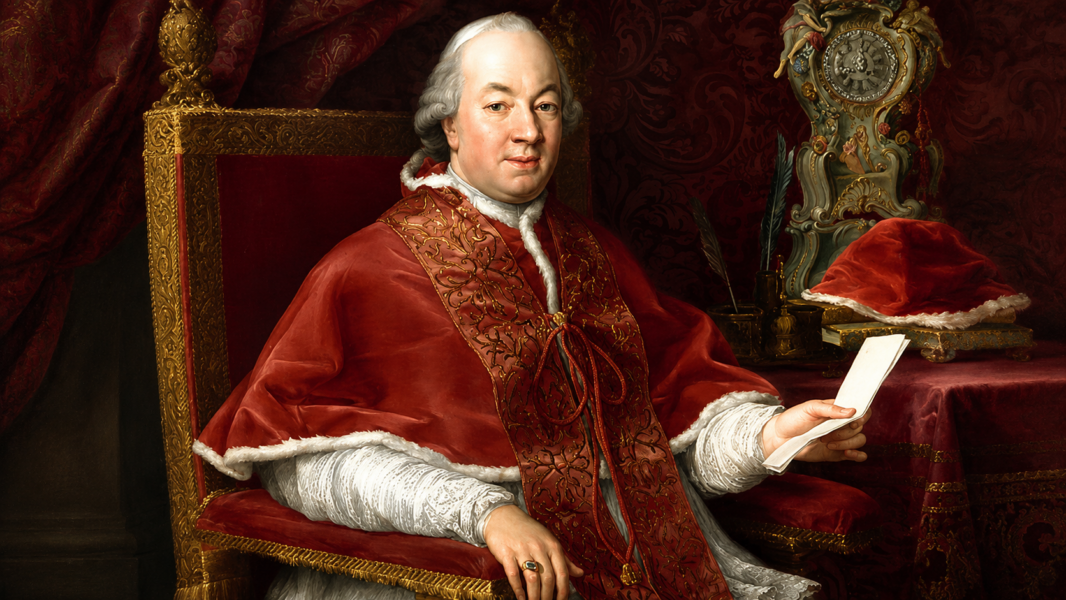
One of these historical precedents occurred during the French Revolution. While the new regime maintained that the country’s exceptional circumstances required a profound reorganization of the Church in France, Pope Pius VI responded with the encyclical Charitas, published on 13 April 1791. In it he rejected the idea that the emergency could legitimize changes imposed by civil authority on the Church’s structure and warned that such a path would lead to schism.
The Revolution sought to reorganize the Church from the State
The crisis began with the National Assembly’s approval of the Civil Constitution of the Clergy in July 1790. That legislation did not merely aim to reform certain administrative aspects of the French Church. It completely reconfigured its organization, reduced the number of dioceses, subjected the appointment of bishops to elections organized by the State, and required all clergy to swear fidelity to the new Constitution.
In practice, the revolutionary power assumed competencies that had previously belonged exclusively to ecclesiastical authority. The election of bishops ceased to depend on the Church and could even fall to votes in which non-Catholics participated. At the same time, many prelates and priests who refused to accept the new system were deprived of their positions and replaced by others elected in accordance with revolutionary legislation.
For the promoters of the reform, those measures responded to an exceptional situation. France was undergoing an unprecedented political transformation, and, according to the National Assembly, the Church had to adapt to the new organization of the State. Political necessity was presented as sufficient justification for introducing a new ecclesiastical structure.
Pius VI attempted to prevent the rupture
Rome’s response was neither immediate nor hasty. Pius VI explains in Charitas that, before issuing a condemnation, he tried to prevent confrontation. He wrote to King Louis XVI urging him not to sanction the Civil Constitution of the Clergy and sent instructions to several bishops to advise the monarch not to lend his authority to legislation that, he warned, would lead to error and schism.
The Pope also consulted the College of Cardinals and sought the opinion of the French episcopate. The response was largely unanimous. As the encyclical itself recalls, the vast majority of bishops rejected the new legislation, considering it incompatible with the constitution of the Church and with canonical tradition. Of the 131 French bishops, only four departed from that common position.
Meanwhile, the National Assembly hardened its stance. The oath to the Constitution became obligatory for the clergy. Those who refused were expelled from their dioceses and parishes, while the State proceeded to organize new episcopal and parochial elections.
The oath was not a mere administrative formality
One of the central aspects of the encyclical consists in explaining why Pius VI considered that oath unacceptable. In the Pontiff’s judgment, it was not a simple declaration of civil obedience, but the acceptance of a system that subordinated the Church to political power and broke communion with the Apostolic See.
For that reason, the Pope decreed the suspension of those who had taken the oath “purely and simply,” granting them a period to retract. In a particularly significant passage, he described that oath as “the poisoned source and the origin of all the errors” that were tearing the French Church apart.
Episcopal consecrations without a mandate from Rome
The rupture reached its climax when consecrations of bishops elected in accordance with the Civil Constitution of the Clergy began.
Pius VI devotes a substantial part of Charitas to recounting these events. He denounces that several bishops participated in consecrations carried out without a pontifical mandate and intended, in some cases, to occupy sees whose legitimate holders were still alive and continued to be the true bishops of those dioceses. For the Pope, those ceremonies constituted “illicit,” “sacrilegious” acts lacking all canonical legitimacy.
Consequently, he declared the elections of the so-called constitutional bishops null, affirmed that they lacked spiritual jurisdiction to govern the dioceses they claimed to occupy, and also suspended from the exercise of their ministry the bishops who had participated in those consecrations.
Necessity could not replace the Church’s authority
Pius VI’s reasoning did not rest solely on disciplinary norms. His argument was deeper. The Church’s hierarchical constitution could not be modified by civil authority, however extraordinary the historical circumstances might be.
In Charitas, the Pontiff recalls that the confirmation of bishops belongs to the Apostolic See and that no political authority can appropriate that competence. Likewise, he insists that the expulsion of a bishop by decision of the State does not deprive him of his ecclesiastical mission. The true pastors remained those who had legitimately received their jurisdiction, even if they had been exiled or persecuted by the revolutionary power.
Therefore, he exhorted the bishops to remain faithful to their dioceses, the priests to stay united to their legitimate pastors, and the faithful not to recognize those who had been introduced by the new regime in place of the legitimate bishops and parish priests.
Remaining united to the See of Peter
The encyclical concludes with a direct appeal to French Catholics not to abandon communion with Rome.
Pius VI recalls that unity with the successor of Peter is not an accessory element of the Church’s life, but an essential condition of her very identity. Therefore, he urges the faithful to keep away from the “intruders” appointed by the revolutionary power and summarizes his entire exhortation in a phrase of particular force: to remain united to the See of Peter, because “no one can be in the Church of Christ without being in unity with her visible head.”