


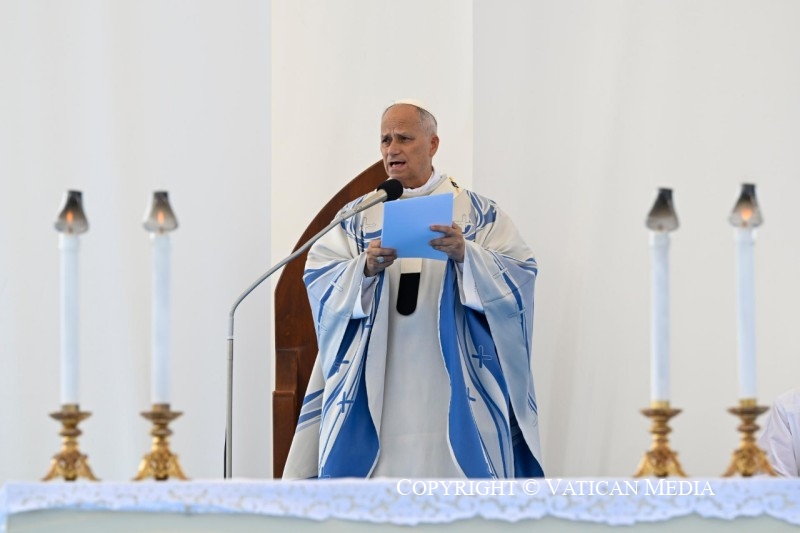
The pastoral visit of Leo XIV to Lampedusa concluded with the celebration of Holy Mass at the Arena sports field, where the Pontiff delivered a homily centered on the parable of the Good Samaritan and on the drama of migration in the Mediterranean.
Following in the footsteps of the journey made by Francis to the island in 2013, the Pope thanked the people of Lampedusa, the volunteers, and those who provide assistance to migrants, while affirming that “those who have died in this sea are victims both of decisions taken and of decisions not taken.” In his reflection, he appealed to Europe’s responsibility to develop policies capable of “welcoming, protecting, promoting, and integrating” migrants, defended that “religious affiliation must never become a reason for discrimination,” and urged the building of a “civilization of love” through proximity and mercy.
The following is the full text of the homily delivered by Leo XIV during the Holy Mass celebrated this Saturday in Lampedusa:
Dear brothers and sisters:
God is always the first to love us. The beauty of the sea, of this island, and of its faces is a reflection of that gratuitous initiative: love precedes us, surrounds us, and gathers us together. I am grateful to the Lord for being able to visit you, following in the footsteps of Pope Francis, who on July 8, 2013, wished to come to Lampedusa on his first journey as the Successor of Peter.
The apostles, as you know, sailed the Mediterranean and experienced the hospitality of the inhabitants of its islands and coasts, a crossroads of civilizations for millennia. The Gospel resounds where peoples meet, where people are welcomed, where their lives intersect, and where diverse cultures enter into dialogue. It falls silent, however, where each person makes an island of himself, where contact is avoided and exchange is interrupted. In this sense, the parable of the Good Samaritan, which has just been proclaimed, describes a story that continues (cf. Lk 10:25–37), and the Encyclical Fratelli tutti has helped us to reread it in the dramatic historical circumstances in which we are still immersed. The Word of God is always timely and leads us into a conversation from which we emerge transfigured. How, then, shall we respond to the love of the One who has loved us first?
Dear friends, today Lampedusa and Linosa find themselves on a dangerous road, like the one that descended from Jerusalem to Jericho (cf. v. 30). Here they have seen not just one, but thousands of human beings fallen into the hands of robbers who strip them of everything, beat them, and go away, leaving them half dead (cf. Lk 10:30). The sea has claimed the others, those who did not manage to reach where they hoped to go. Yet we feel their presence, which challenges us as much as that of those who have landed, in need of attention and help. Before any other intellectual consideration or ideological conviction, the encounter with the one lying before us, stripped of everything, calls for proximity. The Letter to the Hebrews has told us, “Remember those who are being mistreated, as though you yourselves were in their bodies” (Heb 13:3). This is the heart of the Gospel parable: we draw near, we become neighbors (cf. Lk 10:36-37)!
I have come to thank you, brothers and sisters of Lampedusa, for the proximity that many of you have chosen to practice. Once again, the miracle of compassion has taken place—“when he saw him, he was moved with pity” (v. 33)—an interior revolution that brings forth within us the “feeling” of God and expands our thoughts, our hearts, and our lives. I thank the volunteers, the associations gathered in the “Lampedusa Solidarity Forum,” the civil institutions, the Coast Guard, the mayors and the administrations that have succeeded one another over time; thanks to the deacons, the priests, the religious sisters, the doctors, the psychologists, the educators; thanks to the security forces and all those who, with or without the gift of faith, have chosen to love together. Yes, because among you love is organized—that love of which compassion, seeing the brother in the sea, is like the first tremor, the deep call to dare what one would never have thought possible. I greet the migrants who are here: they themselves have not merely received, but have often practiced solidarity on their journey, as the poor helping the poorer. Thank you, brothers and sisters, because nothing about your gesture of becoming neighbors can be taken for granted, nothing is automatic.
The parable tells us: love is always in freedom, and freedom is in decisions. There are also those who choose not to become neighbors and those who decide not to decide. The dead in this sea are victims both of decisions taken and of decisions omitted. Disregard for the common good and corruption in the places of origin, a global economic system that generates poverty and exclusion, fear that fosters prejudice and contempt, the thought that these problems do not concern us, the criminal calculations of those who profit from the drama of others, the slow and difficult passage from merely managing emergencies to developing organic and shared policies—all of this today reproduces the hurried “passing by” (cf. vv. 31.32) of the Gospel account.
In the parable, a priest happens to be there “by chance” (v. 31), and after him, a Levite. Both see, but pass by. Unfortunately, there is never lacking someone who fears being contaminated by coming into contact with others, thus denying—even in the face of suffering and death—the common origin in God, the infinite dignity of every human being, and the call to love without limits. It is time to recognize and affirm that religious affiliation must never become a reason for discrimination, as if faith had limits and were not, instead, a universal call to salvation. Where there were walls of separation, Christ has broken them down (cf. Eph 2:14). There is no love of God without love of neighbor, and there is no neighbor if I do not draw near. To stop, to be moved, to bend down, to weep before the pain of others—as Jesus did—means entering into the movement of love in which God has revealed himself.
Dear friends, whoever allows himself to be carried by this dynamic of compassion, of mercy, begins to live differently, to be a citizen differently, to work differently. Then the civilization of love, proposed by my saintly predecessors John XXIII, Paul VI, and John Paul II, can truly arise. Together with a great number of prophets and martyrs of the last century, they understood that only mercy, through new beginnings, can respond to the depths of the human heart and the horrors of war. Now, on the shoulders of these giants, we have entered a millennium in which to give spiritual, cultural, juridical, political, and economic shape to the civilization of love. May the immensity of the pain we witness make us embrace the radical nature of this call.
Like the Samaritan, we can change our plans and direction. We have more resources and opportunities than the Samaritan to give historical concreteness to hope. He “went to him and bandaged his wounds, having poured oil and wine on them. Then he put him on his own animal, brought him to an inn, and took care of him” (Lk 10:34). We too must recognize that “the civilization of love is not born of a single spectacular gesture, but of a sum of small and tenacious fidelities that confront dehumanization” (Encyclical Letter Magnifica Humanitas, 213). Of this, friends of Lampedusa, you are witnesses! Here, in confronting you, our time is better understood, and each one can verify the direction of his own life. “Of course, not everyone has the same power to influence reality […]. However, no one is exempt from responsibility. Each one has his own sphere of action, and there—not elsewhere—is he called to choose whether to feed the logic of force—even if only with indifference, cynicism, lies, and hatred—or to promote the logic of peace—with truth, sobriety, closeness, and care” (ibid., 212).
Therefore, from this edge of Europe in the Mediterranean Sea, the more than transcendent call that the phenomenon of migration directs to European society can be seen more clearly. Both in this aspect—and with regard to the ecological transition and the promotion of peace—Europe possesses a unique potential, derived from its history and culture, and therefore an equivalent responsibility. By its geographical position and institutional structure, Europe has the capacity—in this area—to address the crisis in an organic way, integrating first aid into a long-term strategic plan capable of welcoming, protecting, promoting, and integrating migrants, while at the same time working for development so that no one is forced to emigrate. All of this while safeguarding respect for the dignity of every person. This is a duty of public institutions, but also of all civil society and of the Church.
Sisters and brothers, as I recently said in Tenerife during the apostolic journey to Spain, also in Lampedusa the culture of welcome has a tourist vocation which, unfortunately, may feel threatened by the migratory routes and develop in indifference or even in opposition to their most dramatic aspects. For many, in fact, vacations only mean distraction, lightness, and carefreeness. It even seems that an invisible wall must be raised between the sea of the shipwrecked and that of the vacationers. Have the audacity to think differently. Little by little, with creativity, you will manage to ensure that everyone who comes to spend a period, even of rest, on this island, may become more human by measuring themselves against your charity, with what the sea has taught you, and with the encounters that have educated you. There is authentic rest where the meaning of life is rediscovered; there is true well-being when the economy is just and fraternal. In this economy, care for creation and social friendship are united in a synthesis that humanity seeks today.
The first reading has reminded us that by practicing hospitality, “some have entertained angels without knowing it” (Heb 13:2). Be, then, in small ways, a prophecy of what we can achieve together on a large scale. The first beneficiaries will be you and your families, overcoming the divisions and divergences that only charity can dissolve. May the parish, in particular, be a community in which, as in the school of the Gospel, we learn together to welcome, accompany, and integrate, in a style of communion.
We have here beside the altar the image of Our Lady of Porto Salvo, patroness of Lampedusa. Perhaps you know that Saint Augustine liked to describe human life as a voyage across a stormy sea and its destiny as a firm and safe harbor. Let us not be overcome by fear, but consider daily difficulties as a time of opportunity and witness. May your faith, dear friends, be intensified by these years of trial and generous commitment. May this venerated image speak to you again with the force of a time when those who transmitted devotion to you entrusted themselves to the Virgin’s intercession with radical sincerity. All of us have in God a safe harbor, of which every Christian community is called to be a reflection on earth. And to you, the community of Lampedusa and Linosa, may the breath of faith, hope, and charity never be lacking: “O’scià!” [Typical greeting of Lampedusa].