


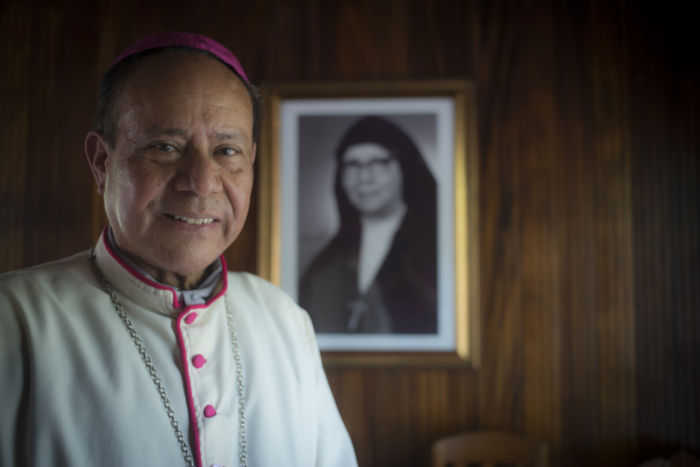
The persecution against the Catholic Church in Nicaragua has added a new episode. Just one day after being detained and subsequently released, the bishop emeritus of Estelí, Msgr. Abelardo Mata, 80 years old, was arrested again by the Nicaraguan police on June 30 and has remained under house arrest since then.
The new detention occurred when the prelate went to a clinic for a pacemaker check-up. The arrest came just twenty-four hours after he had presided over a Mass in which he prayed for the persecuted Church in Nicaragua, a celebration that various sources consider the trigger for the reaction of the regime of Daniel Ortega and Rosario Murillo.
The offensive was not limited to the bishop. Parish priest Francisco Morales, of the parish of the Holy Cross of Calvary in Estelí—where Mata celebrated the Eucharist—and deacon Wilfred Arauz Rodríguez were also detained. Both were later released, although they remain subject to restrictions imposed by the authorities.
Estelí, one of the main focal points of the persecution
Nicaraguan researcher Martha Patricia Molina, author of the report Nicaragua: a Persecuted Church, explained to ACI Prensa that Msgr. Mata no longer holds governance responsibilities in the diocese of Estelí, although he continues to collaborate pastorally when requested.
That was precisely why he went last Sunday to celebrate Mass in Estelí. However, according to Molina, the Sandinista dictatorship had expressly forbidden him to remain in that department of the country.
The researcher recalls that the diocese of Estelí has been one of the main targets of repression against the Church since the beginning of the political crisis in 2018, due to the regime’s animosity toward Msgr. Rolando José Álvarez, apostolic administrator of the diocese and one of the most visible faces of ecclesial resistance against the dictatorship.
Álvarez was sentenced to 26 years in prison before being expelled from the country in January 2024 and currently resides in Rome, where he continues to serve as bishop of Matagalpa and apostolic administrator of Estelí.
A persecution that changes its face
According to Molina, the regime’s repressive strategy has evolved in recent months. After a period in which arrests of priests decreased, the authorities have resumed this practice along with other forms of harassment.
These include police summons, interrogations, permanent surveillance of priests and parishes, and constant control of pastoral activity.
The researcher maintains that only about ten percent of the attacks against the Church become known, since fear of reprisals prevents many priests and laypeople from publicly denouncing what is happening. In her opinion, if there were full freedom to report, up to 400 complaints per day related to religious persecution could be recorded.
A diocese without a bishop and with less than half its clergy
The situation of the diocese of Estelí reflects the impact that the persecution has had on ecclesial life in Nicaragua.
According to Molina, the diocese currently operates with only 42% of its clergy, due to the forced exile of numerous priests, the death of others, and the restrictions imposed by the regime. The priests who remain in the country must assume pastoral care of parishes that were previously served by several priests.
This is compounded by the prohibition on celebrating priestly and diaconal ordinations in Estelí, a measure that also affects the dioceses of Matagalpa, Jinotega, and Siuna. None of these four ecclesiastical jurisdictions currently has its resident bishop, as all have been expelled from the country or live in exile.
Concern for Bishop Mata’s health
The new detention of Msgr. Mata has raised particular concern due to his delicate state of health. The 80-year-old bishop requires periodic medical check-ups for the pacemaker he has implanted.
Arturo McFields, former Nicaraguan ambassador to the Organization of American States, called on the international community to remain vigilant regarding the prelate’s situation and warned of the risk of keeping a person of advanced age with health problems in custody.
The exiled Nicaraguan priest consulted by ACI Prensa also stated that the regime’s actions reflect the fear still aroused by the figure of a pastor who, despite his age and the limitations imposed, continues to be a reference point for numerous faithful.
Call to the international community
Following the news of the new detention, Félix Maradiaga, president of the Freedom for Nicaragua Foundation, demanded the immediate release of Msgr. Mata and the rest of the clergy arbitrarily detained.
Maradiaga also urged international organizations, Western democracies, and human rights defense organizations to denounce the new repressive escalation against the Catholic Church.
“Nicaragua cannot normalize a dictatorship that imprisons priests, silences pulpits, and persecutes the faith,” he stated, while recalling that the Church has historically represented one of the main voices defending the Nicaraguan people against abuses of power.