


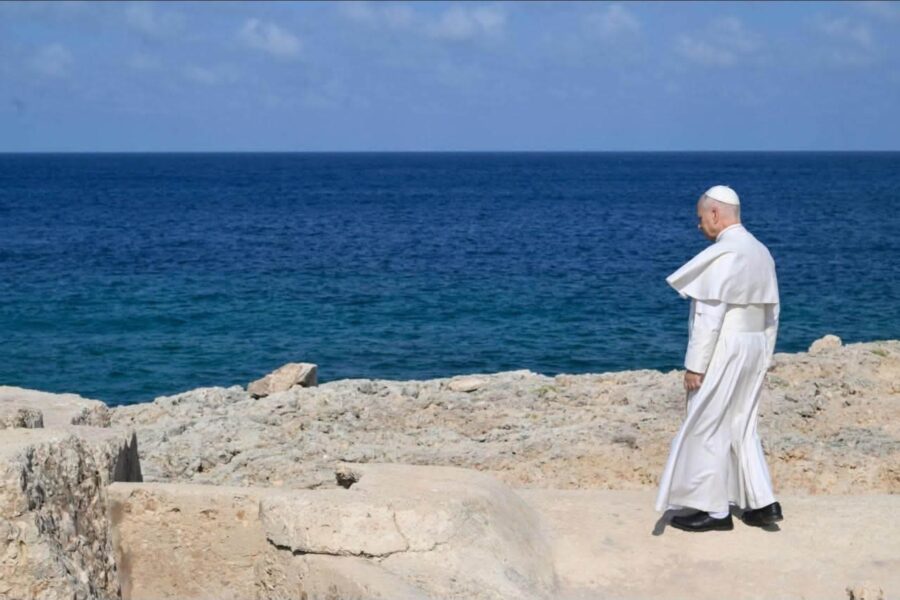
Leo XIV visited the island of Lampedusa this Saturday, July 4, thirteen years after Francis chose this enclave in the central Mediterranean as the destination for his first trip outside Rome. The visit, lasting just three and a half hours, had a distinctly pastoral character and was devoted entirely to the memory of migrants who died at sea and to the local community that welcomes them.
The Pontiff landed at 9:00 a.m. from Ciampino and first went to the island’s cemetery, where he laid a floral offering on the graves of several migrants, many of them unidentified. There he paused in prayer before the tomb of Yusuf, a six-month-old Guinean baby who died in 2020 aboard the Open Arms NGO vessel while awaiting a medical evacuation that arrived six hours after it had been requested.
From the Gateway of Europe to the “Pope Francis” pier
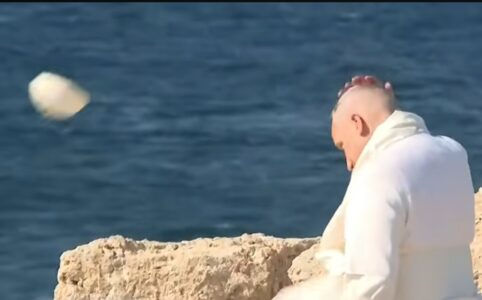
The second stop was the Gateway of Europe, Mimmo Paladino’s monument dedicated to those who lost their lives on the crossing. After a brief meeting with a migrant family, Leo XIV walked alone through the sculpture and descended to the rocks to gaze at the Mediterranean; a gust of wind carried away his zucchetto in one of the day’s most talked-about moments.
At Favaloro Pier, the landing point for those rescued at sea, the Pope blessed the plaque that from today gives the pier the name of his predecessor. “It is a sign of the bond my predecessor established with your community and with our migrant brothers and sisters,” he said before local authorities, assuring them: “The Pope has been close during this demanding time for you. And today I am here to tell you that the Pope continues to accompany you, supports you and encourages you.”
Mass before the Virgin of Portosalvo
The day culminated with Holy Mass in the island’s sports field, presided over by the image of the Virgin of Portosalvo, patroness of seafarers. At the end of the celebration, the Pope received as a gift a 70-centimeter lighthouse carved from wood of migrant boats, the work of the same Lampedusan carpenter who made the Lampedusa Cross in 2013, which Leo XIV will take with him to the Vatican. After greeting authorities, sick children and volunteers, he began his return to Rome shortly after 12:30 p.m.
Thirteen years after Francis
The visit deliberately follows in the footsteps of Francis’s trip on July 8, 2013, when the Argentine Pope denounced the “globalization of indifference” from this very island. The Archbishop of Agrigento, Msgr. Alessandro Damiano, noted the day before that the journey “closes a circle” begun in June with Leo XIV’s visit to the Canary Islands, where the Pontiff urged human traffickers: “Stop, be converted.”
According to UNHCR data, nearly 2,800 migrants landed in Italy in June and 14,388 since the beginning of the year, 30% fewer than in the same period of 2025; more than half arrived in Lampedusa. Deaths, however, have risen: 1,397 people died or went missing in the Mediterranean in the first half of 2026, compared with 851 the previous year.
A July 4 laden with symbolism
The chosen date did not go unnoticed: the first American Pope in history spent the 250th anniversary of U.S. independence at Europe’s main migration frontier, just one day after calling for “moderation” in American public discourse and recalling that “successive waves of immigrants” shaped that country’s future. The visit also comes two weeks after the European Union approved new migration rules that expand detention powers and provide for deportation centers outside EU territory, a context in which the papal gesture has been read in Rome as a message addressed to both Washington and Brussels.