


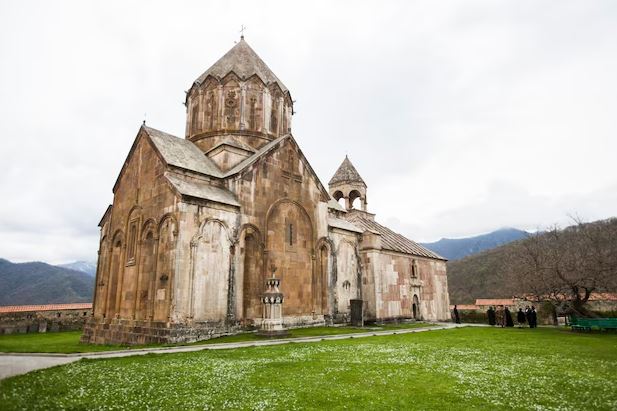
The displaced Armenian community of Nagorno Karabaj has expressed its deep disappointment over what it sees as the lack of a firm response from the Holy See regarding the destruction of Christian heritage in the region and the situation of the thousands of Armenians who had to abandon their homes following Azerbaijan’s military offensive in 2023.
In an interview given to The Pillar, Beglaryan Artak, former human rights defender and former State Minister of the self-proclaimed Republic of Artsakh, stated that “Azerbaijan has managed to prevent the Vatican from supporting the protection of our rights and, especially, of our cultural heritage.”
“We deeply respect the Catholic Church, but we are disappointed by its silence regarding cultural heritage and the rights of the Christian people, because we have also been subjected to ethnic cleansing for being Christians,” he affirmed.
More than 6,000 Christian monuments under Azerbaijani control
Beglaryan, founder and president of the organization Artsakh Union, dedicated to defending the rights of the former inhabitants of Nagorno Karabaj, explained that the region is home to more than 6,000 historical monuments, mostly churches, monasteries, and Christian cemeteries, making it one of the largest concentrations of Christian heritage in the world.
Among them stands out the Gandzasar monastery, built in the 13th century and considered one of the main symbols of Armenian Christianity.
According to his denunciation, since Azerbaijan regained control of the territory, several churches have been demolished or vandalized. He also accuses the Azerbaijani authorities of attempting to erase the Armenian identity of these temples by presenting them as belonging to the ancient Caucasian Albania.
Discontent over the relationship between the Vatican and Azerbaijan
The criticism also extends to the growing institutional relationship between the Holy See and Azerbaijan. In recent years, the Heydar Aliyev Foundation, chaired by Mehriban Aliyeva —wife of President Ilham Aliyev— has funded major restoration projects of the Vatican’s artistic heritage, valued at hundreds of millions of euros.
This collaboration has been met with concern by numerous Armenians, especially after the Holy See awarded Mehriban Aliyeva the Order of Pius IX in 2020, one of the highest pontifical decorations.
Vatican diplomacy opts to maintain dialogue
From the Roman Curia, a cardinal who spoke on condition of anonymity defended the Holy See’s traditional diplomatic prudence.
“The philosophy of the Holy See is to keep channels of dialogue open with everyone,” he explained, noting that the Vatican maintains relations with both Armenia and Azerbaijan in the hope of playing a positive role when opportunities for mediation arise.
This strategy was recently reflected in the visit to Baku by the Prefect of the Dicastery for Interreligious Dialogue, Cardinal George Koovakad, who was received by President Ilham Aliyev and conveyed the good relations existing between both parties. During the meeting, the Azerbaijani leader invited Pope Leo XIV to visit the country.
Shortly before, the Pontiff had received in audience Aram I, Catholicos of the Great House of Cilicia of the Armenian Apostolic Church. Officials from the Armenian Patriarchate indicated that they wish to preserve the good ecumenical relations with the Holy See and avoid letting differences over the Caucasus conflict damage the ties between both Churches.
Read also: Armenian Catholicos Aram I proposed to Leo XIV the convening of a “Third Vatican Council”
A heritage at risk
For representatives of the displaced Armenian community, the concern goes beyond the political conflict. They believe that the preservation of one of the oldest sets of Christian heritage in the world is at stake and regret that the international community, including the main Christian institutions, has not reacted with greater firmness.
“We saw no tangible support from the Christian world, and that support should have come, above all, from the Catholic Church, which is the largest and most influential Christian institution in the world. That is why we feel deep frustration at its passive attitude,” concluded Beglaryan.