


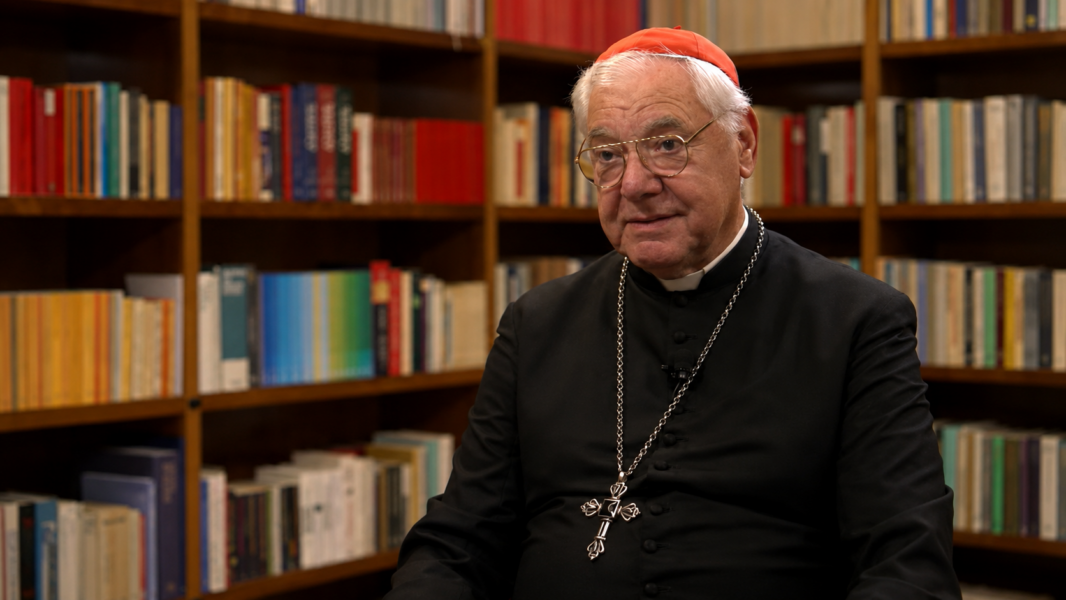
Cardinal Gerhard Ludwig Müller has defended that the conflict between the Holy See and the Priestly Fraternity of Saint Pius X (FSSPX) should not be confused with the debate over the traditional liturgy. In an interview given to EWTN News In Depth, the prefect emeritus of the Dicastery for the Doctrine of the Faith maintained that the real problem is the Fraternity’s refusal to submit future episcopal consecrations to the authority of the Roman Pontiff.
“These are two completely different issues. One is a matter of the dogmatics of the faith and the other is a form of the liturgy,” the German cardinal stated.
Müller thus reiterated an idea he has defended on several occasions: attachment to the traditional Latin Mass cannot be identified with an attitude of rupture with the Church or with rejection of the Second Vatican Council.
“At this moment I see no possibility that they will correct their course”
The cardinal expressed pessimism regarding the possibility that the Fraternity would renounce the episcopal consecrations scheduled for July 1 at the seminary in Écône.
“At this moment I see no possibility of a conversion on their part,” he replied when asked about the situation created after the FSSPX’s announcement.
The statements come after Müller himself proposed during the extraordinary consistory a doctrinal response to the profession of faith sent by the Fraternity to Pope Leo XIV and the College of Cardinals, as well as studying the creation of a structure inspired by the former Ecclesia Dei Commission to welcome priests and faithful who might eventually leave the Fraternity if a formal rupture with Rome occurs.
“Ordinations without the Pope are contrary to the will of God”
Although he clearly distinguished the liturgical question from the doctrinal conflict, Müller recalled that “Ordinations without the Pope are absolutely impossible; they are contrary to the will of God.”
The cardinal maintained that those who proceed to ordain bishops without a pontifical mandate will incur excommunication and stressed that this is not a subjective judgment but a consequence derived from the very nature of the Church and the episcopal ministry.
The comparison with the Donatists
During the interview, Müller drew on one of the great schisms of antiquity to illustrate the current situation of the Fraternity.
“They should learn from the example of the Donatists,” he said.
Donatism was a schism that arose in North Africa in the fourth century and ultimately broke communion with the Church, one to which Saint Augustine devoted a large part of his episcopal ministry. Müller also recalled that Leo XIV belongs to the Order of Saint Augustine, thus drawing a parallel between the saint who combated that schism and the Pope now facing the crisis with the FSSPX.
The cardinal further added that Saint Pius X—patron of the Fraternity—“will pray against those who abuse his name.” With that statement, he contrasted the figure of the pontiff who defended the authority of the Roman Pontiff and combated the doctrinal errors of his time with the path now being taken by the Fraternity.
The liturgy is not the problem
Müller wanted to make it clear that the use of the traditional liturgy does not constitute the origin of the conflict, stating that “many people of good will prefer the traditional Latin Mass,” expressly distinguishing that liturgical choice from the refusal to recognize the authority of the Roman Pontiff.
He insisted that appreciation for the traditional liturgy cannot become an argument to justify a rupture of ecclesial communion and again criticized bishops who have restricted or prohibited its celebration, describing those decisions as “authoritarian.”
Rome’s and the Fraternity’s response
The emeritus prefect’s statements come just days before the consecrations announced by the FSSPX and after the prefect of the Dicastery for the Doctrine of the Faith, Cardinal Víctor Manuel Fernández, warned that proceeding with them would constitute “a schismatic act.”
Pope Leo XIV himself recently acknowledged that he was considering making one last appeal to the Fraternity before the consecrations, although he noted that the main obstacle remains the rejection of certain fundamental elements of the Second Vatican Council.
Read also: Leo XIV is the first Pope who does not even receive the FSSPX. A historic rebuff
For its part, the FSSPX maintains that the future consecrations will not entail a rupture of communion with Rome. On June 24 it sent the Pope and the College of Cardinals a Declaration of Catholic Faith spanning 28 pages in which it reaffirms its adherence to Catholic doctrine, the traditional liturgy, and its interpretation of the doctrinal questions debated since the Second Vatican Council.
“They should not participate in the Masses of schismatic priests and bishops”
Asked about the faithful who regularly attend the Fraternity’s celebrations, Müller replied that if the consecrations are ultimately carried out and a schism occurs, “they should not go and cannot participate in the Masses of schismatic priests and bishops.”
The cardinal concluded by recalling that being Catholic entails accepting not only the great dogmas of the faith—such as the Trinity, the Incarnation, or salvation in Jesus Christ—but also the sacramental nature of the Church, which he defined as “the visible presence of the Body of Jesus Christ” and not simply as an institution for religious or social activities.