


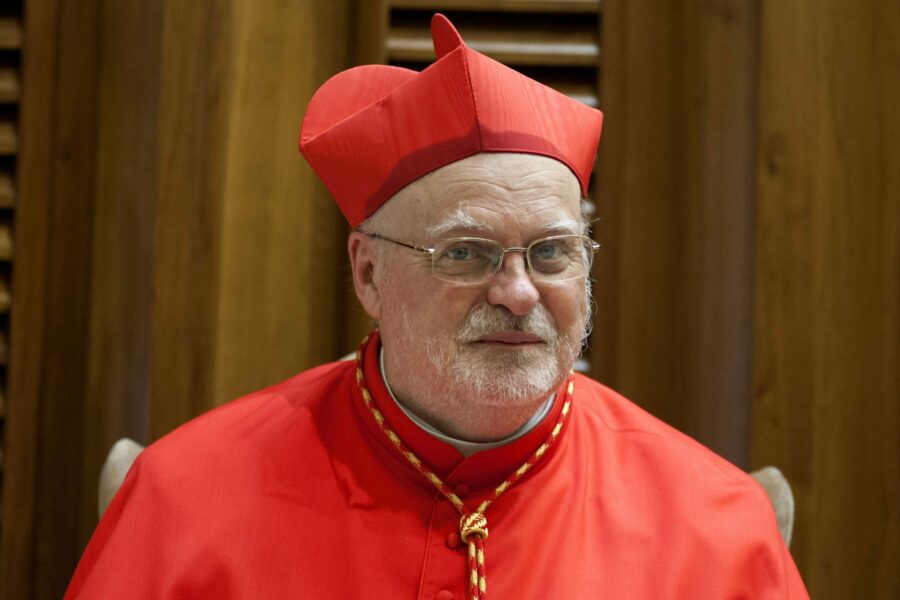
The publication of an extensive investigation conducted over two years by a group of faithful from the Diocese of Stockholm claims that there is a pattern of arbitrary decisions, lack of transparency, and internal retaliation that would justify an apostolic visitation by the Holy See. The diocese rejects the accusations and considers the document “not serious.”
The investigation, originally published in Swedish under the collective pseudonym “Thomas More” and recently translated into English, has been the subject of an extensive report by journalist Diane Montagna. According to her, the work relies exclusively on first-hand testimonies, documentation, and statements collected over two years from hundreds of priests, religious, and faithful of the diocese. Various sources consulted by the journalist describe the portrayal of the situation as “very accurate,” while the diocesan curia denies the validity of the report.
The call for an apostolic visitation comes at a particularly delicate moment. Cardinal Anders Arborelius, aged 76, is approaching the usual retirement age, and the Church in Sweden awaits the appointment of his successor. For the authors of the report, an investigation ordered by Rome would help clarify the internal functioning of the diocese before the episcopal transition.
An alleged “power vacuum” in the curia
The report claims that a “power vacuum” has been created in the diocesan administration, allowing a small group of officials to consolidate a decisive influence over governance decisions. According to its authors, this core group has acted against priests or faithful considered inconvenient or disloyal, generating a climate of fear, especially among part of the diocesan clergy.
“We are desperate,” states one of the priests cited in the investigation, describing an atmosphere of fear in which many presbyters avoid expressing criticism for fear of retaliation. The authors say they have repeatedly raised their concerns both with the diocese and with Cardinal Arborelius himself, without receiving a response.
The case that forms the focus of the first volume of the investigation is that of Father Tobias Unnerstål, whose trajectory is presented as the most significant example of the irregularities denounced.
The priest removed without formally knowing the complaint
Father Tobias Unnerstål was parish priest of Christ the King in Gothenburg from 2007 to 2022. During those fifteen years, the parish experienced notable growth in faithful, vocations, and conversions. The regular celebration of the Traditional Mass attracted numerous young families, and the priest also promoted a project to establish an Oratory following the model of St. Philip Neri—an initiative that had received written support from Cardinal Arborelius and the vicar general in 2020 and was reaffirmed just days before his removal.
The situation changed in February 2021, when a seminarian—now a priest of the diocese—filed a complaint against him for alleged emotional, psychological, and spiritual abuse.
According to the report, the procedure followed by the diocese violated from the outset the safeguards provided by canon law. Although the complaint should have been notified to the priest so that he could respond, the document was never delivered to him. In April 2021, he was summoned to a meeting with the vicar general, where only some excerpts of the accusation were read to him. To this day, the investigation maintains, he has never been able to access the full text or formally know the evidence used against him.
The accusations mainly referred to three episodes: the organization of altar service when the complainant was an altar boy, financial assistance given at the seminarian’s own request, and a photograph taken during a pilgrimage years earlier. The vicar general himself acknowledged during the meeting that there was no accusation of inappropriate sexual conduct between them.
Even so, the priest claims he was given an alternative: admit the accusations or face suspension from ministry. He initially accepted that interpretation, although he later fully withdrew that admission, arguing that he had acted under pressure and that the conclusions drawn from each incident were erroneous.
A campaign to prevent the Oratory
The investigation pays special attention to the role played by Birgitta Gelotte, a former parish collaborator and friend of the complainant.
According to the report, years before the complaint she had already spread accusations against Father Tobias among various priests, labeling him an alcoholic and homosexual—claims that several witnesses consider false. In a private letter written in July 2021, Gelotte herself would acknowledge that she decided to intervene when she learned that the priest intended to found an Oratory in Gothenburg.
“I knew I had to do everything possible to prevent it,” she wrote, according to the report.
In the same document, she also states that for years she worked to convince the seminarian to reinterpret his relationship with the priest until he shared her view of the facts. For the authors of the report, these statements seriously call into question the origin of the complaint and the way it was constructed.
Removal, restrictions, and victory in court
In January 2022, Cardinal Arborelius informed the priest of his departure from Christ the King parish. The announcement was publicly presented as a new appointment to coordinate pastoral care linked to the Traditional Mass throughout the diocese, although a few days later progressive restrictions began to be imposed on him.
First, he was prohibited from working with minors and young people; later he was removed from ordinary pastoral ministry, although he continued to celebrate the Traditional liturgy and attend to some religious communities. His former parishioners responded with a support campaign that gathered hundreds of signatures and testimonies describing him as a close, dedicated priest responsible for the spiritual rebirth of the parish.
In November 2024, the situation took a new turn when the cardinal decreed his suspension and revoked all his ministerial faculties. The priest appealed the decision both through canonical and civil channels.
The lawsuit filed before the Swedish courts concluded in June 2025 with a ruling in favor of the priest. The diocese accepted the claims made in the lawsuit, leading the court to annul the dismissal and order it to pay approximately 240,000 Swedish kronor in compensation and legal costs.
The report criticizes the fact that the official statement issued by the diocese after the ruling omitted that it had lost the judicial proceeding and presented the outcome as a simple termination of the employment relationship in accordance with Swedish law.
The Dicastery declared the suspension invalid
The case later reached the Dicastery for the Clergy.
On May 5, 2026, the Roman body concluded that the suspension imposed in November 2024 had been adopted without following the proper canonical procedure and declared it invalid.
Nevertheless, the Dicastery maintained various restrictions on the priest’s ministry for three years, relying on documentation that, according to the investigation, has never been provided to the individual concerned. The decree prevents him from publicly celebrating Mass—except alongside the local ordinary—preaching, and hearing confessions, although it also establishes that the diocese remains obliged to guarantee his economic support regardless of the civil compensation already received.
The authors of the report consider it especially serious that the limitations continue to be based on documents that the priest has never been able to know or refute.
The contrast with his successor
The investigation contrasts the treatment received by Father Tobias with that of the priest appointed to replace him at Christ the King, Father Pär-Anders Feltenheim.
According to the report, this priest had accumulated for decades numerous complaints related to his behavior toward young people and his manner of exercising ministry. The authors maintain that several of these complaints had previously been investigated by diocesan officials and had led to pastoral restrictions.
Despite this, he was appointed parish priest of one of the most important communities in Sweden. Only in 2025 was he discreetly removed from his duties following new accusations related to his online activity. The diocese publicly presented his departure as a sabbatical year motivated by exhaustion, without reference to the internal investigations that, according to various sources cited in the report, had actually prompted his removal.
The diocese rejects the accusations
Consulted by Diane Montagna, Monsignor Jorge de Salas, episcopal vicar for legal affairs of the Diocese of Stockholm, flatly rejected the conclusions of the report.
He stated that the investigation was “anonymous,” the result “of much anger,” and “not serious,” repeatedly emphasizing this qualification during the telephone conversation. Regarding Father Tobias’s case, he maintained that the diocese had carried out “an adequate investigation,” although he added that its content pertains exclusively to the diocese and the Vatican.
A crisis that Rome must assess
The case of Father Tobias does not constitute an isolated episode but the manifestation of a mode of governance that has allowed a priest to be removed without fully guaranteeing his right of defense, while other clerics with problematic records continued to hold pastoral responsibilities.
The Holy See has not yet announced the opening of any apostolic visitation. However, the international dissemination of the investigation and the proximity of Cardinal Arborelius’s succession place the Diocese of Stockholm under growing scrutiny. If Rome decides to intervene, the case could become one of the most significant investigations into episcopal governance in recent years in Northern Europe.