


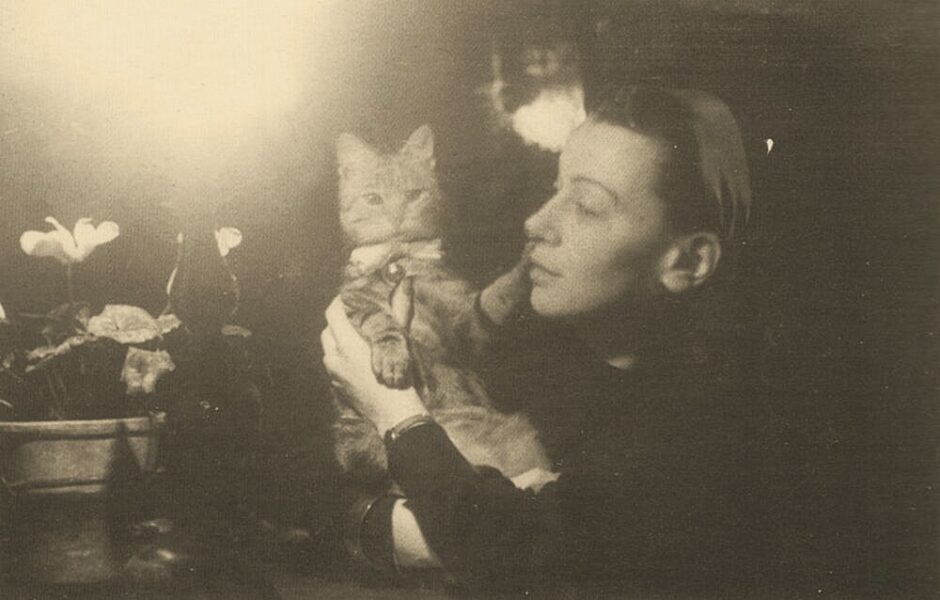
Yes. It was a laywoman who drafted the Breve Examen Crítico de la Misa that Cardinals Bacci and Ottaviani took responsibility for signing before Paul VI in 1969. But it was not the work of a lone gunman; rather, it was a meticulous team effort that we will reflect on today and tomorrow, along with this Italian writer’s conversion to the Catholic faith, continuing with the stories dedicated to the people who literally gave their lives fighting to preserve the Church’s tradition during the harsh decades that followed the Second Vatican Council.
To get to know Cristina Campo, we will focus on three sources, which I recommend you read in full for their beauty and rawness: the biography written by Cristina De Stefano; the chapter Jean Madiran devotes to her in the first volume of his “History of the Forbidden Mass”; and the article by Fr. Gabriel Díaz Patri included in the work “The Latin Mass and the Intellectuals,” by Joseph Shaw.
Decidedly, the post-conciliar period is the hour of the laity who awoke in the turbulent times after the Second Vatican Council: precisely what the Council had asked for. Although it was not exactly this kind of laity that the conciliar revolutionaries had in mind.
Cristina Campo was born in Bologna on 29 April 1923, daughter of the musician Guido Guerrini and granddaughter of the even more famous composer Ottorino Respighi. She was baptized Vittoria María-Angélica Marcella Cristina. Thus, her name was Vittoria Guerrini; but Cristina Campo was the best known of the various pseudonyms with which she signed her literary works.
Her health was always fragile due to a congenital heart malformation that prevented her from leading a life similar to that of other children; for this reason she spent the first years of her life in the park of the Rizzoli Hospital in Bologna and was educated at home, without following a normal schooling process.
Her family moved to Florence, where she spent her childhood and adolescence. Later she described herself, in a letter sent to Msgr. Marcel Lefebvre, in these words: “A very delicate daughter of pure and upright parents, but without a deep religious education (my mother, a musician, was Christian in soul and life, yet scarcely knew the religion; my father, a composer and writer, did not find Catholic practice until the eve of his death (…). I had none of that. My parents, with great good sense, sent me to an English school run by nuns; but, unfortunately, I received even less Christian education there than at home. Later, born to write, I frequented intellectual circles. I have known many extraordinarily noble and generous souls, but as for ‘moral health put to every test,’ that was something very little known…”
From a very early age, Cristina possessed what she called a “mystical temperament,” which intensified through reading certain authors—above all the Austrian writer Hugo von Hofmannsthal: “she, like ‘her Hofmannsthal,’ had an unusually keen sense for spiritual patrimonies and a continual anguish, indeed a terror, that those goods might perish,” as her friend Ernesto Marchese would recall. And also Simone Weil. She discovered both in the 1940s.
In Florence she frequented circles of writers and intellectuals, yet in her youth there was no trace in her of the Catholic faith in which she had been baptized, beyond an eclectic mysticism. It was in Rome that her spirituality took clearer shape. She moved to the Eternal City with her parents, for reasons of her father’s work, in 1955, when she was 32 years old. That same year she wrote to her friend, the writer and musician Margarita Dalmati: “And with God we keep circling one another, like two knights armed with lances seeking the right point to strike.” And in another letter from the same year she confessed: “Truly it is difficult to be a poet, that is, an instrument of mediation, without an exact faith.” “I try at times—a force drags me—but of God I know nothing.” At that time she was reading texts on comparative religion and the lives of the saints. She felt the circle of the Divine Beloved closing in around her.
In Rome she met the psychiatrist Ernst Bernhard because of an agoraphobia that had begun in Florence three years earlier. The first question he asked her in therapy was: “What is your stance toward your tradition?” The individual’s relationship with his or her own tradition would become a recurring theme in her letters and a constitutive element of her thought. Little by little, she saw in religion an answer to the problems of modernity, which, precisely because of the loss of ancient traditions, is no longer able to transmit to man a spiritual orientation, a sense of his existence.
In 1958 she met a brilliant young intellectual: Elémire Zolla. They quickly established a “community of life and thought” that, at first, meant intensifying that search and drawing closer, although over time their relationship would become the great obstacle on her path. While the relationship with Zolla transformed her life, there was a fundamental difficulty on the road to faith: Zolla was married. It was a civil marriage and the relationship had quickly failed, but at that time there was no divorce law in Italy, and even an ecclesiastical annulment would not have allowed Zolla to remarry. Campo and Zolla, moreover, fit together perfectly and enriched each other because, as Fr. Gabriel Díaz Patri explains, they were like opposite poles: she impetuous, he distant; she focused on a few recurring themes, he eclectic and restless.
It is not known exactly how Cristina Campo’s conversion took place: “the moment when everything comes together and is reconciled.” It seems to have been a slow path that unfolds over the years, a period of new beginnings; some friends spoke of “a return,” because she had always felt drawn to the things of the spirit. Others, such as Fr. Paul Augustine Mayer, a Benedictine monk of the Abbey of Saint Anselm in Rome who came to know her deeply, spoke of a profound break with a past that she would henceforth remember as “very stormy.”
Her biographer Cristina De Stefano notes that “Cristina Campo’s conversion to the Catholic religion is a secret story, difficult to decipher (…). It is not known exactly how that conversion occurred.”
For years she had felt a growing interest in the Catholic religion, she was curious about the liturgy and fascinated by sacred places. In the period before her conversion, she used to visit Subiaco with her parents. She was drawn to the abbeys, to those silent places where Western monasticism was born. “I drove 60 km with a fever—up there, toward dusk, the deserted sacred cave—the gorges, the sacred wood, the frescoes half in shadow. Like a dream about to vanish, to which one says: not yet.”
On 19 March 1964 she went for the first time to the Abbey of Saint Anselm, on Rome’s Aventine Hill, residence of the Abbot Primate of the Order of Saint Benedict and seat of the Pontifical Liturgical Institute, where monks from all over the world lived and still live to study in Rome. She was accompanied by her mother and Zolla. She would clearly remember that date, perhaps because her conversion took place precisely that same day. And if not then, at least around that time. Later she would write: “It was a grand moment, that of Vespers, for me; seven years have passed. Like Adam in Eden. Something I scarcely dare recall, so heartrending is the thought of not having corresponded at all to those divine encounters ‘in the evening breeze.’” In 1966 she wrote: “Many conversions are known to be due to preaching, but the spark can be kindled by a single perfect liturgical gesture; there are those who have converted upon seeing two monks bow deeply together, first before the altar, then one before the other, and then withdraw to the depths of the choir stalls.” She confided to her friend Giuseppina Azzaro that she had had a true and proper revelation, in “a moment that illuminated everything with meaning.”
Without doubt, between 1964 and 1965 something spoke to her, reaching her from infinite distances. She spent hours in the churches. She would sit to meditate in the monastery of Tre Fontane; she attended Vespers at Saint Anselm, perhaps without knowing that thirty years earlier, in 1937, Simone Weil had sat in those same stalls.
At that moment an event occurred that would deal a hard blow to her life: on Christmas Eve 1964, her mother died suddenly. The funeral took place in the crypt of Saint Anselm, in a discreet ceremony. This unusual authorization and other indications seem to confirm that during that year 1964 she had not only frequented Saint Anselm regularly, but had also maintained contact with the monks.
The following months were especially hard. As she wrote in a letter in June 1965: “For eleven months my main work (not to say the only one) was that of nurse. A terrible fall (…) condemned my father to almost uninterrupted suffering, to continual and multiple dangers, to a condition of unstable equilibrium that sometimes borders on the daily miracle. It is useless, even if it were possible, to describe to you the effect of a situation that has destabilized many relationships, touched so many mysteries, established a completely new geometry in my thoughts as well as in my days. The Book of Tobit… I have just begun to read it in depth. Added to this (I use the minimum of words; misfortune teaches ‘minus dicere’) is the outbreak of a spiritual revolution that has completely metamorphosed the little routine that remained of my existence. But this story admits no narration at all.”
Cristina De Stefano considers that this profound and painful loss of both parents within such a short time surely accelerated her conversion: “what is certain is that between 1964 and 1965 something speaks to her, something that reaches her from infinite distances. Despite the pain, or perhaps precisely because of the pain.” She spends hours in the churches, listens to Vespers at Saint Anselm.
But just at that moment, also, that world she had just discovered, which had radically conquered her and had become her refuge in this time of trial, that which she probably felt as the point of arrival of her spiritual and intellectual journey, her “promised land,” was threatened.
On 8 December 1965, after three years of work, the Second Vatican Council was closed in Rome. Its impact on public opinion was vast. From the beginning, Cristina saw two opposing coalitions forming among the conciliar fathers: the modernizers, above all Germans, French, and Canadians, and the conservatives, among whom the Latins predominated. The conclusions, summarized in four Constitutions, were moderate, but in the following years they were applied in a modernizing sense, which meant the posthumous victory of this party. The most evident example is the liturgy. Although the Council had ordered the preservation of Latin, admitting the use of national languages only in specific cases, the modernizers created a Council for the implementation of the liturgical reform in order to carry out their line: to make the rite more comprehensible, to move from Latin to the vernacular, seeking to involve the faithful more. In less than four years Latin disappeared from the Mass. Little by little Gregorian chant was set aside. An entire world disappears: the Rorate of Advent, the Gloria of Palm Sunday, the Exsultet of the Easter Vigil, the Dies irae of the Mass of the Dead, the Te Deum of thanksgiving, the Parce Domine for public misfortunes. Cristina Campo, who had discovered the beauty of the Latin liturgy precisely in those years, felt terrified.
In that year of 1965, when she was 42 years old, the first Masses in the vernacular began to be celebrated in Italy and the devastating scope of Paul VI’s liturgical reform, which culminated in the Novus Ordo Missae, began to become evident. Cristina Campo was shaken by it and developed a growing love for the traditional Mass.
After her conversion, the sentimental relationship she had maintained since 1959 with Elémire Zolla became unstable, although it never ended. Zolla was married and was an esotericist; Cristina Campo was an impetuous seeker of truth. He wanted to de-Catholicize her; she wanted to convert him.
Fr. Gabriel Díaz Patri takes up the book Cristina Campo o l’ambiguità della Tradizione by Fr. Francesco Ricossa in order to try to understand the complexity of Cristina Campo’s figure and the history of her conversion: “as Fr. Ricossa rightly points out, when examining the spiritual itinerary of the writer—Fr. Díaz Patri narrates—for her it was as if on one scale of the balance weighed her struggle for the Roman Mass and on the other a tendency toward Gnosticism, nourished by her relationship with Zolla. But, Ricossa concludes, ‘Cristina Campo contributed to saving the Mass: let us hope that this generous battle contributed to the salvation of her soul.’”
Note: The articles published as Tribuna express the opinion of their authors and do not necessarily represent the editorial line of Infovaticana, which offers this space as a forum for reflection and dialogue.