


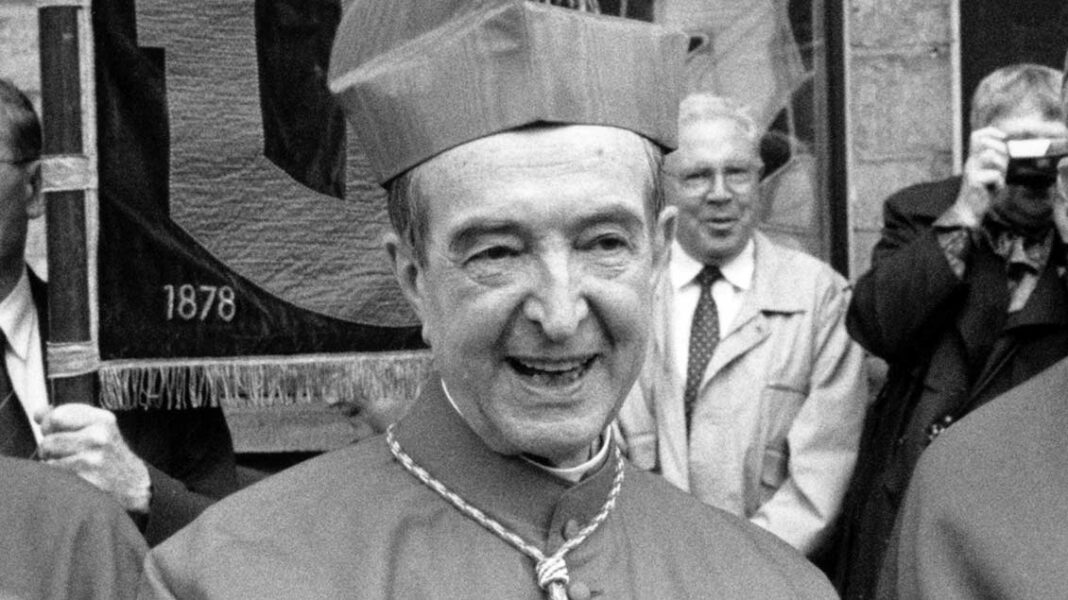
The investigation opened in Germany into the allegations of sexual abuse against Cardinal Franz Hengsbach (1910-1991), first bishop of Essen, has taken a new step with the publication of an interim report that considers three complaints of sexual violence against minors to be “well-founded and plausible.”
The study also questions the response that both the Diocese of Essen and the Archdiocese of Paderborn gave for years to the first reports received about these incidents.
The report was prepared by three independent research institutes—the Institute for Research and Project Consulting (IPP) in Munich, the Dissens Institute in Berlin, and the Research Centre for Contemporary History in Hamburg—commissioned in 2024 to clarify the known allegations against the man who for decades was one of the most influential figures in the German episcopate.
Read also: Did Cardinal Hengsbach have a son? The Diocese of Essen investigates a new lead
Three complaints present a high degree of credibility
The researchers examined twelve complaints of sexual violence against minors attributed to Hengsbach. After analyzing the available documentation and testimonies, they conclude that three of them show a high degree of consistency and historical coherence.
The first places the events in the mid-1950s. According to the report, a 16-year-old girl would have been repeatedly forced to perform sexual acts while Hengsbach served as a priest in the Archdiocese of Paderborn.
The second complaint dates from the 1960s and refers to a teenage girl of about thirteen who stated she had been subjected to touching under her clothing.
The third case goes back to the 1980s. According to the investigation, a thirteen-year-old girl who had just received Confirmation was called to the sacristy after the ceremony, where the then cardinal allegedly carried out sexual touching and made inappropriate comments.
The researchers consider that these three cases share common elements, including the exploitation of religious celebrations to isolate the victims and the use of episcopal authority as a means of control.
Complaints relating to male minors are also being investigated
The report also includes four other complaints involving male minors. Although the researchers maintain differing assessments of the strength of these testimonies, they recommend that all of them continue to be investigated.
Furthermore, the study rules out, for lack of evidence, other accusations linking Hengsbach to alleged episodes of extreme ritual or satanic violence, although it notes that any new information must be examined rigorously.
The investigation questions the handling of the complaints
One of the most significant aspects of the report is the reconstruction of how the first complaints were handled.
According to the researchers, already in 2011 the Archdiocese of Paderborn received the testimony of a woman who reported having been abused by Hengsbach when she was sixteen. The case was reported to the Vatican, which did not open any proceedings, and also came to the attention of the then bishop of Essen, Franz-Josef Overbeck.
However, the complaints were not subjected to a thorough investigation at that time. Overbeck himself acknowledged errors in the handling of the information in 2023 and publicly asked for forgiveness.
Only after a new complainant came forward in 2022 did the diocese decide to reopen the case and make the allegations public in September 2023.
From emblematic figure of the Ruhr to an abuse investigation
Franz Hengsbach was appointed in 1958 as the first bishop of the newly created Diocese of Essen and led the local Church for three decades. In 1988 he was created a cardinal by Saint John Paul II and became one of the best-known figures in the German Church, especially for his closeness to the working-class world of the Ruhr and his intense public activity.
At the same time, he stood out for his firm doctrinal positions on issues such as priestly celibacy and the defense of Catholic doctrine against certain theological currents that emerged in Germany during the 1970s and 1980s.
The publication of the first allegations in 2023 marked a radical shift in the public perception of his figure. That same year, the statue dedicated to the cardinal in front of Essen Cathedral was removed, and various institutions began to review the tributes and honors that bore his name.
The report now presented constitutes an intermediate phase of a broader investigation that will continue to examine both the abuse allegations and the possible knowledge Hengsbach may have had of other cases that occurred during the years he led the Diocese of Essen. With this new step, the German Church continues to deepen the clarification of one of the most sensitive cases affecting one of the historical figures of its episcopate.