


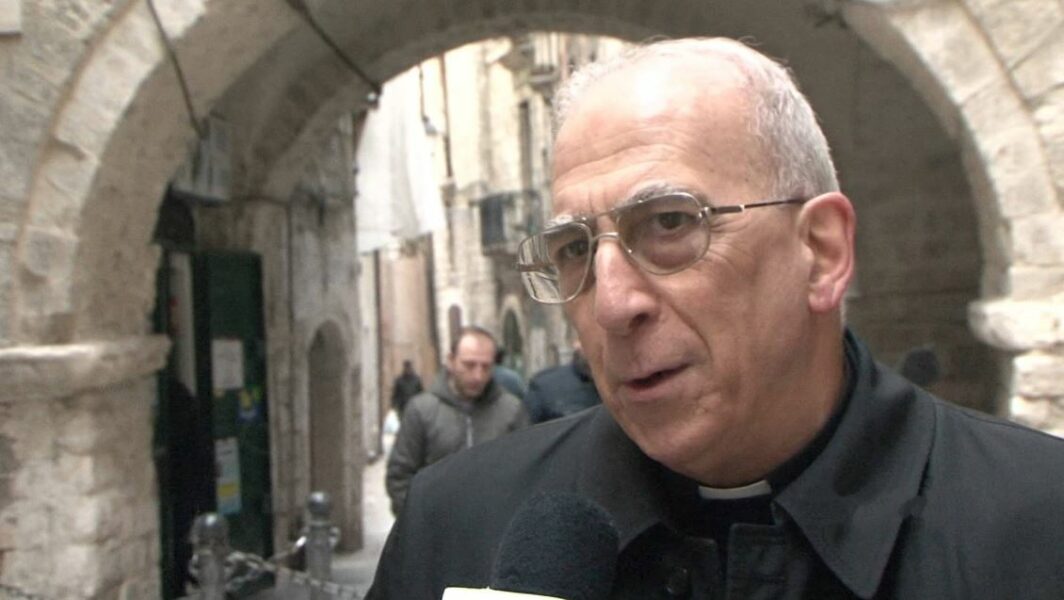
At the doors of the consistory convened by Pope Leo XIV, the Italian priest and theologian Nicola Bux has addressed an open letter to the Pontiff in which he asks him to promptly confront some of the most delicate issues that have marked the life of the Church in recent years. The missive, published by Vaticanist Edward Pentin, is written in a filial tone, yet it does not conceal the urgency that, in the author’s view, matters such as the relationship with the Priestly Fraternity of Saint Pius X, the restrictions on the traditional liturgy, the lack of response to the dubia raised by several cardinals during the pontificate of Francis, or the doctrinal drift of the German Synodal Way require.
Bux, a close collaborator of the then-Cardinal Joseph Ratzinger and later a consultant to various dicasteries of the Holy See during the pontificate of Benedict XVI, believes that the new Pope has a historic opportunity to heal the Church’s internal divisions. In particular, he urges him to resume the path of reconciliation opened by Benedict XVI with the Priestly Fraternity of Saint Pius X before it carries out new episcopal consecrations without a pontifical mandate.
Below we offer the full translation of the letter:
Most Holy Father:
With sentiments of deep and filial devotion, I venture to address this heartfelt appeal to Your Holiness, after having had the grace of collaborating first with Cardinal Joseph Ratzinger and, subsequently, with the Holy Father Benedict XVI, before dedicating these last thirteen years to prayer, sacrifice, and a discreet yet constant work for the unity of the Church.
The Church is the bridge between God and humanity, of which the Pope is the pontifex; indeed, she is synonymous with the peace that Christ has indicated as her horizon: to build the Church is nothing other than to build peace; to separate these two realities is to undermine the mission of the Gospel. Therefore, I implore Your Holiness to continue in this sole direction, to resolve in truth—and only in truth—the many “polarizations” that run through the ecclesial body. Now that we have gained experience in dialogue with persons and groups outside the Church, should we not also, and above all, engage in dialogue within our own household, doing everything possible so that none of those brothers and sisters whom the Lord has entrusted to us may be lost?
Referring in particular to the grave decision announced by the Priestly Fraternity of Saint Pius X, I beg you to extend once more the “bridge” conceived by Benedict XVI through the Motu Proprio Summorum Pontificum and, consequently, through the lifting of the excommunication. Considering the reality of so many bishops who, with balance, have achieved liturgical harmony in their own dioceses, Your Holiness could set an example by granting the whole Church the possibility of celebrating, alongside the new rite, the ancient Roman rite, while at the same time reaffirming the validity of the liturgical reform and the inviolability of the Second Vatican Council, as well as of all other ecumenical councils.
As for the German Synodaler Weg, I implore the Holy Father to make clear that the “synodal way” cannot deliberate on matters of doctrine, morality, and sacramental practice, and that pastoral action cannot be separated from them; otherwise, the so-called “accompaniment” will never lead to the necessary conversion, for the sinner would not be turned away from sin but, on the contrary, would be confirmed in it and even reach its institutional recognition. Your Holiness has already stated that certain divisive issues “cannot be the object of deliberations or decisions by a particular Church,” but you are surely aware that this grave fracture could spread to other episcopates. The Church is truly inclusive only if those who wish to enter receive sacramental initiation and those who wish to return follow the penitential path.
Finally, Your Holiness, I implore you to remove another obstacle to truth and communion: the lack of response, or the insufficient response, to the Dubia presented by the cardinals on the doctrinal and pastoral questions that arose in the recent synods. Many faithful throughout the world await that response, not in the form of an interview—interviews reduce the words and magisterium of the Pope to one opinion among many—but through a document of equal or greater authority.
The faithful need to be confirmed in the truth, stability, and substantial immutability of the faith, because the Holy Spirit cannot deny what He has inspired in the Church throughout its two thousand years of history. The faithful need to rediscover, with Saint Irenaeus, that Christ brought all newness by bringing Himself, and that no other newness is to be expected, except the ever-new proclamation of the Gospel of Christ.
The faithful must be able to hear from the Successor of Peter, after more than a decade of confusion, that the Holy Spirit truly makes all things new, but in the sense that He leads them to their definitive fulfillment (novus), in harmony—and not in contradiction—with all that He has inspired until now.
By virtue of the indispensable prerogative of the munus petrinum, I implore Your Holiness to declare clearly what is truth and what is error, so that the whole Church may conform itself to your word. Your Holiness has rightly said that following Christ requires conversion and “that we must seek ways to build our unity on Jesus Christ and on what Jesus Christ teaches.” Well then, Holy Father, the only way we know to achieve this consists precisely and solely in upholding the truth. I beg you to act promptly, Holy Father. Let us not allow the latent schism to become irreparable.
We pray for Your Holiness with the firm hope that, within the Consistory, you may initiate and lead a fruitful reflection on these most urgent questions.
In Christ Jesus,
Fr. Nicola Bux
June 24, 2026
Feast of the Nativity of Saint John the Baptist