


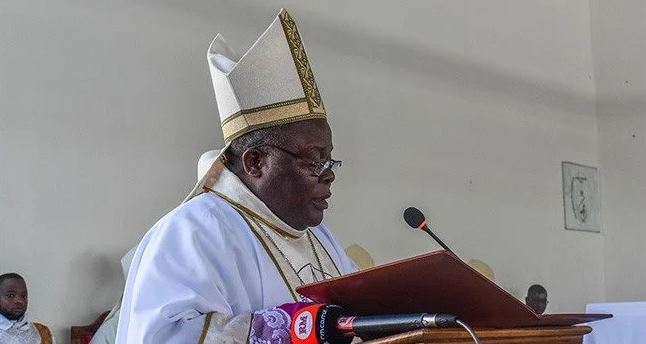
More than two weeks after the assassination of Mozambican bishop Osório Citora Afonso, authorities continue to investigate the crime without yet clarifying who ordered his death or what the motives were. Meanwhile, voices close to the prelate are beginning to question the official version and point to possible political, economic, and even ecclesial interests behind the murder.
According to Vida Nueva, religious sister María Gómez-Lechón, a missionary in Mozambique for decades, described the bishop as an uncomfortable figure for numerous sectors of power due to his denunciations of corruption, social injustices, and certain entrenched structures both in society and within the Church itself.
A bishop assassinated in cold blood
Osório Citora Afonso, a member of the Missionaries of the Consolata and bishop of Quelimane since 2025, was found dead on June 6 at the episcopal residence. He was 54 years old.
According to the investigations, the attackers managed to bypass the residence’s security system and took his life using an AKM assault rifle. From the very beginning, authorities treated the case as a homicide.
The prelate’s death caused deep shock in the African Church. In addition to leading the diocese of Quelimane, Afonso served as administrator of Beira and held the position of secretary general of the Episcopal Conference of Mozambique.
A critical voice against corruption and abuses
Those who knew the bishop agree in highlighting his firm commitment to justice and transparency.
Religious sister María Gómez-Lechón stated that Afonso openly denounced abuses of power, political corruption, and certain economic interests present in the country. His interventions were especially forceful regarding the situation in Cabo Delgado, the troubled northern region of Mozambique marked for years by jihadist violence and instability.
However, his criticisms were not limited to the political sphere. According to the missionary, the bishop also decisively addressed internal Church problems, including financial irregularities and governance structures he considered detrimental to the ecclesial mission.
This stance earned him respect among many of the faithful, but also enemies both inside and outside ecclesiastical circles.
Suspicions about the official version
One of the aspects raising the most questions is the hypothesis initially considered by some investigators, according to which a priest could be directly involved in the crime.
Gómez-Lechón finds this explanation unconvincing. In her view, both the weapon used and the planning of the operation point to a much more complex operation than the isolated action of a single person.
The religious sister maintains that behind the assassination there could be organized structures with sufficient logistical capacity and resources to carry out an attack of this nature. Therefore, she does not rule out that some suspects may have been used as secondary pieces within a broader plot.
“A martyr for justice”
Suspicions that the murder may be linked to the bishop’s pastoral and public activity have also been shared by people who worked closely with him.
In statements to the missionary agency Fides, Father Stefano Camerlengo, former superior general of the Missionaries of the Consolata, described Afonso as “a martyr for justice.”
The priest recalled that the bishop frequently insisted on the moral obligation to denounce injustices and not remain silent in the face of abuses of power. He also portrayed him as a pastor committed to reconciliation, dialogue, and the Church’s social responsibility.
An investigation still open
Mozambican authorities have questioned various people connected to the bishop’s circle, including a diocesan priest and several employees of the episcopal residence. Forensic analyses and other inquiries have also been ordered to clarify the facts.
For the time being, none of the hypotheses have been officially confirmed, and investigators have not disclosed what the motive for the crime might be.
The death of Osório Citora Afonso adds to the long list of pastoral agents and African religious leaders who have suffered threats or attacks for denouncing corruption, violence, and social injustices. As the investigations move forward slowly, in Mozambique there is growing demand for a full clarification of who ordered the killing of one of the country’s most influential and respected bishops.