


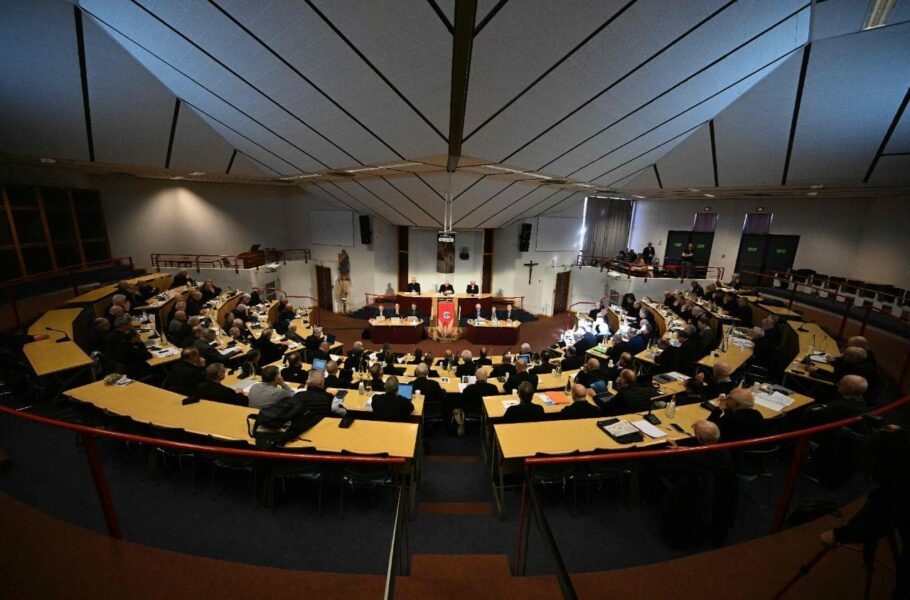
The bill that seeks to legalize euthanasia and assisted suicide in France returns this week to the National Assembly for a third parliamentary reading. In light of the reopening of the debate, the French bishops have called for a novena for life that will take place between June 22 and 30, the scheduled date for the vote on the text, and they invite Catholics to pray that the dignity of every human life be respected.
In a message released on the occasion of the start of this new legislative phase, the French episcopate recalls that “life is not cared for by ending it, but by accompanying it attentively to the end” and asks the faithful to unite spiritually in defense of the sick, the elderly, and the most vulnerable persons.
Read also: France closes the door to a referendum on euthanasia weeks before a decisive vote
France reopens the debate on euthanasia
The legislative initiative now returning to the National Assembly contemplates the legalization of both euthanasia and assisted suicide, a possibility that until now has provoked strong opposition from the Catholic Church and numerous healthcare professionals.
Since the beginning of the parliamentary process, the French bishops have insisted that the response to suffering cannot consist in deliberately causing the patient’s death, but rather in offering human, medical, spiritual, and affective accompaniment that truly meets their needs.
The bishops draw on the words of Leo XIV
In their message, the French bishops explicitly evoke the recent address given by Leo XIV before the Spanish Cortes Generales. The Pope then recalled that “the defense of human life is neither a partial issue nor a confessional interest: it is a civilizational goal.”
The Pontiff also added that every human life must be protected from conception until its natural end and affirmed that the moral greatness of a nation is shown in its capacity to accompany and protect those who face situations of greater fragility.
For the French bishops, these words take on special relevance in the current context, as Parliament prepares to debate once again a law that could profoundly alter French society’s relationship with illness, dependency, and death.
A novena to ask for the protection of every human life
The initiative promoted by the French Episcopal Conference proposes nine consecutive days of prayer with specific intentions dedicated to the sick, healthcare professionals, families, people living alone, and the parliamentarians themselves who will vote on the law.
The bishops invite participants to accompany each intention with the recitation of the Our Father, the Hail Mary, and the Glory Be, asking that the Holy Spirit enlighten consciences during the parliamentary debates.
The first intention is directed precisely to the French deputies so that they may guide their decisions “along the path of life” and so that the dignity of every human person may be recognized, protected, and respected.
More than a legislative issue
For the Church in France, the debate opened around euthanasia and assisted suicide goes beyond the strictly legal sphere. What is at stake is not merely a legal modification, but the very conception of the human person and the way a society chooses to respond to illness, dependency, and suffering.
The reopening of the parliamentary debate also comes at a time when Europe is marked by the expansion of legislation favorable to euthanasia. While some governments present these measures as new individual rights, critics warn that they ultimately alter the fundamental mission of medicine and weaken the protection of the most vulnerable persons.
Read also: Government celebrates five years of euthanasia after more than 1,600 deaths caused
With this novena, the French bishops seek to remind us that a truly human society is measured by its capacity to care for, accompany, and protect those who suffer, not by the ease with which it offers mechanisms to hasten death.