


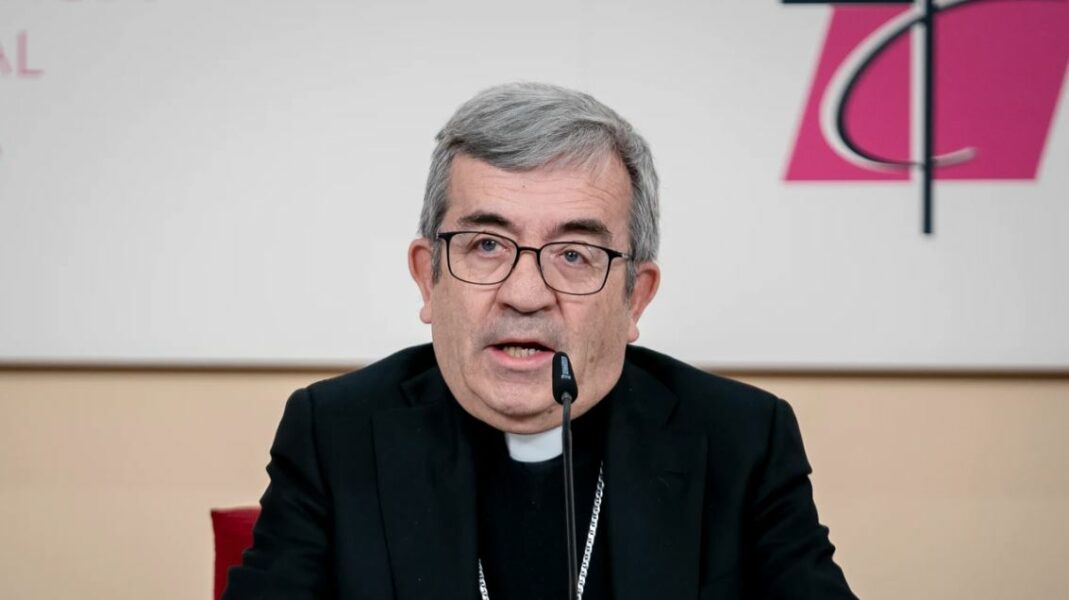
There is a literary genre that Rome cultivated with mastery and that the Church, for centuries, viewed with the prudent distrust of one who knows the human heart: the panegyric. Pliny the Younger elevated it to art before Trajan, and since then we have known that there is no more effective way to diminish a man than to begin magnifying him aloud. The official account of the Archdiocese of Valladolid seems to have rediscovered the genre this week, albeit with a variant that not even the imperial flatterers would have conceived: here the panegyrist and the one being praised share the same payroll.
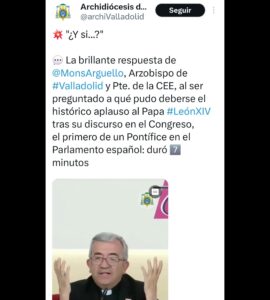
It is worth noting what truly happened, beyond the applause. It is not that a third party, moved, celebrated the archbishop’s wit. It is that the press apparatus of the archbishopric itself took to the network to announce to the world the “brilliant response” of its titular. Sender and praised are, administratively, the same house. The calf and the goldsmith, fused in a single tweet. One imagines the community manager—that courtier of our time, whose function has come to consist of searching each morning for an unprecedented superlative for the boss—hesitating between “brilliant” and “genial” and resolving, in Solomonic fashion, that both could fit throughout the week.
And what did the brilliance consist of? Asked about something perfectly concrete—what caused the ovation for Leo XIV—Msgr. Argüello replied, according to what his own diocese invites us to admire, with a succession of hypotheses: “What if we believe that mystery exists? What if the wonder of the Catholic can touch the heart…?” The question was about a cause; the answer was a volley of conditionals. What is presented to us as Socratic depth is, technically, not answering. Socrates asked in order to disarm another’s false certainty; here one asks in order not to have to affirm anything of one’s own. A maieutic of one who has wisely decided not to get wet, and whom his subordinates applaud precisely for that.
A special mention is due to the star datum, the one the diocese highlights with an emoji—“it lasted 7 minutes”—as if the transcendence of a speech were measured in units of palm per second. The chronometry of applause is an aesthetic register that the twentieth century taught us to recognize: the standing ovation, the minutes on one’s feet, the metric of adhesion. That an episcopal see should quantify glory in minutes of clapping portrays it better than any gloss. And there is a detail that the hagiographic haste overlooked: while Valladolid sings seven minutes, Vatican News itself was content with “more than five.” Either someone rounds upward, or even the prodigy of the palms does not withstand a cross-check of sources. We knew that faith moves mountains; we did not know that it also adds two minutes to the stopwatch.
What is melancholy is not the vanity—vanity has always existed, and will continue to exist—but its domicile. That the institution which for twenty centuries preached vanitas vanitatum, which buried its popes reminding them sic transit gloria mundi, should today devote its communicative energies to giving itself “likes,” is a sign of the times more eloquent than many encyclicals. The president of the Episcopal Conference, called to embody a certain gravity, converted by his own press services into viral content: clip with subtitles and crest in the corner.
So yes, Monsignor: what if mystery exists? Granted. But allow his diocese, now that we are formulating hypotheses, one last one, perhaps the boldest of all: what if, at some point, an ecclesiastical press office resisted the temptation to applaud itself? That would indeed be a brilliant response. And it would have, moreover, the rare virtue of being true.