


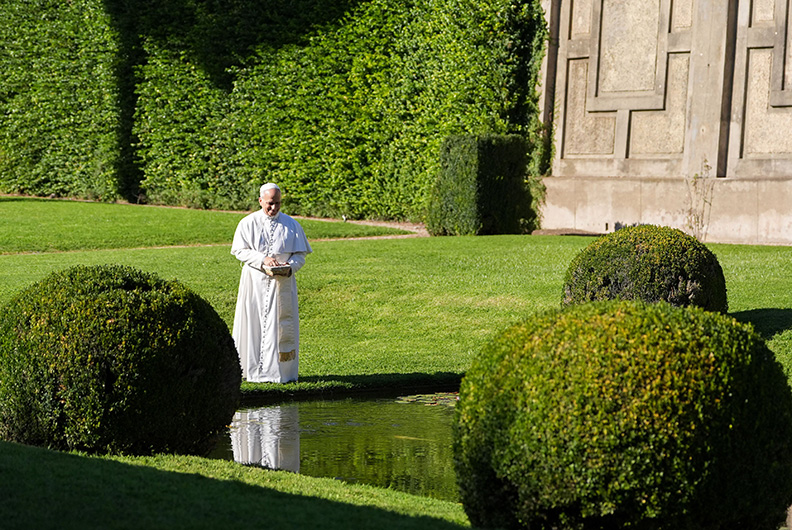
He carried this out during the closing of the first Borgo Laudato Si’ Dialogues, an international forum held in Castel Gandolfo that brought together for three days business leaders, academics, institutional officials and ecclesial representatives to discuss artificial intelligence, sustainability, global leadership and social transformation.
The event took place at the Borgo Laudato Si’, the project originally promoted by Pope Francis within the pontifical gardens of Castel Gandolfo to turn the principles of the encyclical Laudato si’ into concrete initiatives in formation, sustainability and the circular economy.
The first major international forum of the Borgo Laudato Si’
The so-called Borgo Laudato Si’ Dialogues constitute the first edition of a gathering that aspires to become a permanent platform for dialogue between the Church, the academic world, businesses and various international actors.
The forum, held between 17 and 19 June, was organized in collaboration with the Centro de Formación Superior Laudato Si’, the University of Notre Dame, Deloitte Switzerland and Handshake Strategies. Participants addressed issues such as artificial intelligence, population aging, sport as a diplomatic tool and the challenges of global sustainability.
The initiative forms part of the growing activity developed around the Borgo Laudato Si’, a project inaugurated by Francis in Castel Gandolfo and which Leo XIV has decided to maintain and strengthen from the beginning of his pontificate.
“We live in a time of spiritual and cultural blindness”
In his address, Leo XIV took up several of the ideas set out in his encyclical Magnifica humanitas.
The Pope stated that contemporary society is going through a stage marked by a profound “spiritual and cultural blindness,” aggravated by the attempt to build the future while disregarding historical memory and the roots that have shaped civilizations.
According to him, there exists a “false pragmatism” that invites a break with the past as if it were possible to inaugurate a kind of new creation detached from all historical experience. That attitude, he warned, can lead to a dangerous collective amnesia that prevents learning from the tragedies of the twentieth century.
From the Tower of Babel to the New Jerusalem
The most striking image of the speech came when the Pontiff contrasted two models of civilization.
On one side, the “Tower of Babel,” symbol of a society built on the idolatry of profit and the marginalization of the weakest. On the other, the “New Jerusalem,” presented as an authentic civilization of love in which the economy, politics and culture are oriented toward the service of the human person.
“We are called to contribute to the building of the New Jerusalem,” the Pope affirmed, warning that the obsessive pursuit of profit can foster increasingly deep processes of dehumanization.
One of the major initiatives inherited from Francis
Created by Francis in 2023 as a laboratory of integral ecology within the Pontifical Villas of Castel Gandolfo, the project combines formation, environmental sustainability, the circular economy and educational activities inspired by Laudato si’.
Far from being sidelined after the change of pontificate, Leo XIV has visited the complex on several occasions and has publicly supported its initiatives, turning it into one of the spaces where he seeks to articulate some of the central concerns of his magisterium, especially those related to ecology and social responsibility.
At the conclusion of the meeting, the Pope encouraged participants to become “humble builders of the New Jerusalem” and asked them to continue working to promote a society capable of offering recognition, care and hope to every person, especially those at risk of being excluded by the economic and technological processes of the contemporary world.
We now leave you with the words of Leo XIV:
Dear brothers and sisters:
Good morning and welcome.
Two days of intense work at the Borgo Laudato Si’ in Castel Gandolfo have just concluded. You have gathered to take part in the first edition of the “Borgo Dialogues”—as Cardinal Baggio has just explained—the first step of a process intended to renew and reimagine moral leadership in a world that today seems fragmented and forgetful of its own historical roots.
And, brothers, you have discussed important issues that also concern the Catholic Church: artificial intelligence and its relationship with humanity, aging and vitality, sport and diplomacy, and the future of sustainability. You have responded to the desire I recently expressed in my Encyclical Letter Magnifica humanitas: “to enter into dialogue with all men and women of our time, together with those who share in the events, questions and aspirations of humanity. We wish to identify, together with them, new paths for the common good and the promotion of a dignified life for all” (n. 2).
In that same document I also stated that “we live in a time of remarkable spiritual and cultural blindness. A false pragmatism invites us to cut the roots of memory, as if it were possible to inaugurate a kind of ‘new creation’ detached from the past; even those who invoke great moral principles can fall into this historical nihilism, deceiving themselves into thinking that the atrocities of the twentieth century can no longer be repeated” (n. 204).
Your dialogues have been built on the Catholic Church’s vision of synodality, listening from the ground up while at the same time promoting global unity. You are experts, leaders and professionals from different parts of the world, working in various fields, with a variety of skills, experiences and visions. And, despite this diversity, all of you are deeply committed to the ecological, social and economic transformation of the world.
Faced with the temptation to build the “Tower of Babel,” which represents the idolatry of profit at the expense of the most vulnerable and increases the risk of dehumanization, we are called to contribute to the building of the New Jerusalem, the civilization of love, in which love is the sole guiding principle of economic, political and cultural life.
“The civilization of love is not born of a single, spectacular gesture, but of a sum of small and tenacious fidelities that raise a barrier against dehumanization. That is why it is worth pausing to consider some aspects of how, each in our own sphere, we can collaborate in its construction” (Magnifica humanitas, n. 213).
This is precisely what you have done in the magnificent setting of the Pontifical Gardens of the Borgo Laudato Si’, allowing the beauty of creation—and of the Creator—to inspire you to combine local knowledge with global responsibility and to drive a process aimed at forging the courageous leadership so necessary today.
Thank you for your openness and willingness to take part in this process, which will bring you together again in other important contexts and which opens paths for new advances.
May the Lord bless your efforts and grant you the grace to be humble builders of the New Jerusalem, the city of God, which offers living water to the thirsty and provides care, recognition, kind words and hands capable of tenderness to every human being.
Thank you.