


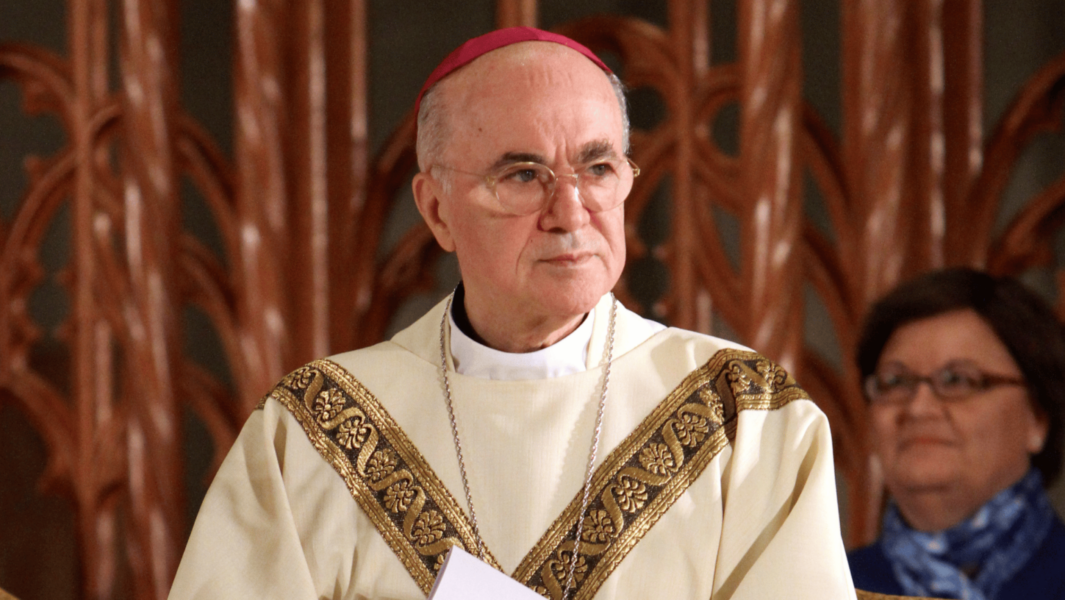
Archbishop Carlo Maria Viganò has made public the letter he addressed to Leo XIV on January 25, 2026, several months after denouncing the cancellation of an audience that, according to him, had initially been approved by the Pontiff. The publication of the document comes after the former apostolic nuncio to the United States recounted the events related to that request for a meeting and criticized the decision not to receive him at the Vatican.
In the text, Viganò reviews his service to the Holy See, questions the legitimacy of the excommunication imposed on him, reiterates his criticisms of the pontificate of Francis and of the Second Vatican Council, and requests that Leo XIV review his canonical situation. The prelate maintains that his positions do not constitute an act of schism and asks the Pope to examine the doctrinal and ecclesial arguments he sets forth in the letter.
Below we reproduce in full the letter published by Archbishop Carlo Maria Viganò:
Your Holiness,
With this letter I wish to place before your consideration the most important events of my personal and ministerial life, so as to allow you to know me and to situate the intentions that move me.
I was born on January 16, 1941, in Varese, into a deeply Catholic family, thanks to which I was able to grow in the daily practice of the faith, receive a solid higher education, and mature in my priestly vocation. I was ordained a priest on March 24, 1968, and, after a brief period of parish ministry in Pavia, I was invited by the then Substitute of the Secretariat of State, Archbishop Giovanni Benelli, to enter the Pontifical Ecclesiastical Academy, where I was admitted in October 1971.
I have served five Pontiffs: in the Nunciatures of Baghdad, Kuwait, and London; then, from January 1978, in the Secretariat of State for more than ten years as secretary to three Substitutes; finally, as Permanent Observer to the Council of Europe and the European Parliament in Strasbourg (1988-1992). After my episcopal consecration, received at the hands of John Paul II, I was sent to Nigeria as Apostolic Nuncio (1992-1998), and was later called to the Secretariat of State with the office of Delegate for Pontifical Representations (1998-2009). In 2009, Pope Benedict XVI appointed me Secretary General of the Governorate, and in 2011, Apostolic Nuncio to the United States of America, a post I held until 2016.
It was in my capacity as Delegate for Pontifical Representations that I found myself handling the informational processes for promotions to the episcopate—both in the Curia and in the nunciatures—and the most reserved and delicate cases concerning bishops and cardinals, among which was the dossier on Theodore McCarrick and other homosexual prelates. My action in this sphere earned me removal from the Secretariat of State and my transfer to the Governorate as Secretary General, where Pope Benedict entrusted me with combating mismanagement and the extensive network of financial corruption. Even in that case, although I had brought the Governorate’s balance sheet, within a year and a half, from a deficit of 15 million euros to a surplus of 35 million, and although the Pope wished to promote me to the Presidency of the Pontifical Council for the Economic Affairs of the Holy See, I was removed from the Roman Curia and sent to Washington as Apostolic Nuncio. My actions displeased persons who at that time were very powerful and capable of prevailing over the will of Pope Benedict.
In 2016, upon reaching exactly seventy-five years of age, Bergoglio ordered me to leave the Nunciature in Washington and forbade me to return to the Vatican, where John Paul II had permanently assigned me an apartment. He likewise forbade me to reside in the Roman residence for retired nuncios, specially arranged by Pope Benedict. Before his death, Bergoglio also had my Vatican citizenship and passport revoked; he prevented me from enjoying the health care provided to members of the Diplomatic Service, despite the fact that I have always paid my contributions regularly. Bergoglio ordered the removal of my vehicle from the Vatican Vehicle Registry and blocked the renewal of the Vatican driver’s license I had held uninterruptedly since 1973, causing me serious inconvenience and, in effect, condemning me to house arrest.
After making public in August 2018 the shocking testimony concerning Theodore McCarrick and the extensive network of corruption and complicity within the Roman Curia—in which Jorge Mario Bergoglio himself was directly involved—I lived for some years in secret locations, as Cardinal Raymond Leo Burke advised me. This was arranged in view of the threats I had received and the fact that my immediate predecessor in Washington, Nuncio Pietro Sambi, had met his death under highly suspicious circumstances, after having had sharp confrontations with then-Cardinal McCarrick when informing him of the measures taken by Benedict XVI to counter his crimes as a serial abuser.
The corruption, blackmail, deceptions, and betrayals I have had to face have led me to question the deep origins of the disastrous state in which the Catholic Church finds itself.
Looking back to the years of my formation at the Lateran University (1960-1964) and the Gregorian (1965-1969), I had to recognize that, even before the conclusion of the Second Vatican Council, the ideological orientation of the entire cursus studiorum—and of the teaching body—was already marked by the new conciliar teachings, although they had not yet been approved. I well remember how, in the Roman seminaries, clerical discipline gave way to anarchy on all fronts, and how the superiors themselves encouraged clerics to attend the conferences of the “new theologians”: I refer to those who, until a few years earlier, had been viewed with justified suspicion by the Holy Office, such as Küng, Ratzinger, Rahner, Schillebeeckx, Congar, and with them that underworld of modernists who would soon infest the chairs of the universities and positions of responsibility in the Vatican and in the dioceses. And as has always happened with all subversive operations, the climate of general change, of continuous reforms, and of enormous mutations was artificially created from above.
From my privileged vantage point as secretary to the Substitute, I witnessed the hemorrhage of thousands of priestly and religious vocations, while those priests who did not wish to follow the new conciliar course or abandon the Tridentine Liturgy were ostracized, treated as heretics, excommunicated or suspended a divinis, deprived of their salary, or left to die in solitude.
Re-reading those events and reforms with today’s disillusioned gaze and with the experience drawn from other similar facts—including the management of the Synod on the Family that led to Amoris Laetitia and, above all, the ongoing synodal revolution—I could not fail to see in all of this a mind that had already prepared the subversive action which would soon show its most devastating effects.
The conciliar revolution followed a very precise script under a single direction. Everything had to appear perfectly legal and in keeping with the ordinary practice of the Church: each promulgated document had to allow an orthodox interpretation to reassure the conciliar Fathers, and a heretical interpretation to be exploited later. Those documents reveal the true objectives of those who deceitfully used a Council to impose doctrinal, moral, and liturgical errors already condemned by the Roman Pontiffs.
During the long years of my ministry at the service of the Apostolic See, my unconditional obedience to the Pontiffs and my total absorption in the tasks entrusted to me did not allow me to understand the revolution underway. How could I have imagined the subversion and betrayal that were being carried out? How could I have believed that the supreme Authority of the Church and the entire Episcopate could have become accomplices of the most insidious enemies of Christ, whom St. Pius X had identified in the modernists?
The “retirement” that occurred in 2016 allowed me to devote prayer, study, and meditation to these grave problems. Thus I have come to realize that the Second Vatican Council, while retaining the characteristics of an Ecumenical Council, was desired with the intention of being used to revolutionize the entire ecclesial edifice and subvert it in each of its components: in doctrine, in liturgy, in discipline, in canonical norms, and especially in its hierarchical constitution. It was the very architects of Vatican II who defined it as “the 1789 of the Church” and considered this subversive experiment as the Council par excellence, thereby demonstrating its heterogeneity with respect to all other councils and to the perennial Tradition of the Church.
Both Jorge Bergoglio and the post-conciliar popes have proudly claimed their ideological continuity with Vatican II in order to carry out and legitimize each of their “reforms.” Significantly, the entire post-conciliar magisterial corpus establishes a new paradigm sanctioned by the Council. Its fluid doctrines—continually evolving, as is the Hegelian synthesis underlying them—are in evident rupture with the bimillennial Magisterium of the Church prior to Vatican II.
The Council has favored and contributed to the de-Christianization of the West and to the establishment, in the civil sphere, of a new order in accordance with the plans of Freemasonry. The plans of the lodges are well known, and we know the means that would have been adopted to achieve the proposed objectives: it was a matter of infiltrating the Catholic Church and attacking it from within.
The discussion on Vatican II and the coup in the Church have led me, in relatively recent times, to rediscover the Traditional Rite. The abandonment of the Mass of Paul VI marked a new stage in my episcopal ministry. Together with the Tridentine Mass (which was the Mass of my priestly ordination), I discovered a submerged universe of priests, religious, and seminarians who were persecuted and marginalized. I considered it my apostolic duty to listen to their cry for help, offering them a response that would restore renewed confidence in that Church by which they felt betrayed and expelled.
This led me to establish the Exsurge Domine Foundation, doing everything necessary to guarantee the means of subsistence—spiritual and material—and an authentically Catholic ecclesial identity to those who, because of their fidelity to Tradition, have been unjustly affected by the Bergoglian terror. Among them are the members of the Priestly Fraternity of the Family of Christ, born and first recognized within the sphere of Ecclesia Dei, and then brutally destroyed and cancelled. Its members have been victims of a terrible persecution—which you cannot ignore—on the part of the current archbishop of Ferrara, Gian Carlo Perego, and of the Holy See itself. To these clerics, who turned to me after having been abandoned without support, and to the candidates for the priesthood who have joined them, I am assuring my paternal care.
My denunciation of the apostasy of the conciliar and synodal church and of its rupture with Tradition, together with the well-founded doubts concerning the legitimacy of Bergoglio’s “pontificate”—which I have in conscience confronted with the conviction of fulfilling the mandate of a successor of the Apostles—have earned me an unjust, illegitimate, and ideologically motivated excommunication. This canonical sanction, although I consider it null, entails grave ecclesial, institutional, and personal repercussions that deeply sadden me, and which appear jarring when compared with the impunity enjoyed by cardinals, bishops, and priests who are notoriously heretical and corrupt.
Among these I cannot fail to mention Eleuterio Vásquez Gonzales, known in Chiclayo as “Father Lute,” accused of having sexually abused several young victims. The Holy See recently granted “Father Lute” a dispensation from the clerical state without a regular canonical process, leaving him effectively unpunished; meanwhile, the canon lawyer for the victims, Monsignor Ricardo Coronado Arrascue, was removed from his legal functions, reduced to the lay state, and investigated for defamatory accusations. The case was documented and detailed for me by Monsignor Coronado himself. This case repeats the same modus operandi of Bergoglio already adopted with McCarrick and reveals an aberrant administration of justice by the Holy See.
Faced with the excommunication illegitimately imposed on me, I claim not to be a schismatic! By the grace of God, I am and will remain a devoted son of the Holy Roman Church and a faithful subject of the Roman Pontificate. I firmly believe in Apostolic Communion and recognize the Petrine Primacy. I likewise recognize the necessity of belonging not only to the invisible Mystical Body, but also to the institutional and visible ecclesial body. Together with me, on the bench of the accused of the former Holy Office, have been summoned all the Popes of history up to Pius XII.
I have asked myself several times the reason for the persecution I must face in the final phase of my earthly life, and whether my conviction of acting rightly and according to the will of God may have been mistaken. But, however much I try to examine my actions, as if I were standing before Christ the Judge at the moment of passage, I find nothing morally incorrect. My accusers limited themselves to carrying out a sentence already written, in order to exclude, by means of a “canonical” expedient, one who had denounced the infidelity of the Catholic hierarchy, proclaiming the Truth without restraint. A voice—mine—that could not simply be silenced because no one had ever been able to corrupt or extort me.
The officials of the former Holy Office have not been able to refute a single one of the arguments I have set forth. It was enough for them that I dared to criticize Vatican II and Jorge Mario Bergoglio to condemn me to excommunication for the crime of schism, precisely when it is my love for the Papacy and for the permanent Magisterium of the Church that exposes me to this ruthless attack by the Vatican. I have never intended to separate myself from Apostolic Communion, nor to disobey the Vicar of Christ, nor to found a “parallel church,” as some have accused me of wishing to do. On the contrary, I believe that I could not have served the Papacy and the Holy Church better than by speaking and acting as I did, facing the sufferings that resulted from it in a spirit of union with the sufferings of the Divine Redeemer.
I address you as an elderly archbishop, out of love for Our Lord and in fidelity to the Holy Church. I address you to express to you the torment of seeing the Catholic Church eclipsed and disfigured by those who occupy and wield power over her. I cannot understand how, after the disastrous experience of Jorge Bergoglio, you not only do not wish to condemn his errors and scandals, but do not miss any opportunity to reaffirm your total continuity with them, in the name of a “synodal church” that adulterates the hierarchical structure and the monarchical nature that Our Lord willed to give to His Church, and destroys her entire doctrinal edifice.
I cry out to another Leo, to the great Pope Vincenzo Gioacchino Pecci, in the paradoxical situation of knowing that he would find my words shareable and worthy of praise, while the Bergoglian church has judged them worthy of a schismatic. What has happened in the Catholic Church in the course of a few decades that I find myself condemned, and with me all the pre-conciliar popes? Quomodo facta est meretrix civitas fidelis? (Is 1:21).
The faith I profess, the Tridentine Mass I celebrate, the councils and magisterial acts I embrace, the Tridentine Profession of Faith and the anti-modernist oath that I have repeated so many times are common to the whole Church and unite me to her. Of this One, Holy, Catholic, Apostolic, and Roman Church, immutable in doctrine and morals, I call myself a son and devoted servant. Of that Papacy, likewise immutable, which is the Roman Papacy to which I am obedient, for in the voice of the Vicar resounds the Truth of the Good Shepherd who gives His life for the sheep (Jn 10:11).
The authority of the Holy Keys must open the doors of the heavenly Jerusalem to the just and exclude from them the reprobate, not the contrary. This authority emanates from Our Lord (Rom 13:1) and is vicarious of His authority. It is not possible that it be used to legitimize what He condemns, much less to condemn what He has ordained. For this reason, I cannot obey one who, constituted in authority, refuses in turn to be subject and obedient to the supreme Authority of God.
I think of the words of St. Paul: “But though we, or an angel from heaven, preach a gospel to you besides that which we have preached to you, let him be anathema” (Gal 1:8). From what Church am I separated? And what authority condemns me? That of the Vicar of Christ or that of one who preaches a gospel different from the one received from Our Lord?
I leave this letter in your hands so that you may know the reasons for my positions and my action, with the hope of being able to urge you to a profound examination of conscience and to a conversion of heart, mind, and will, as necessary as it is urgent, recalling the words of Our Lord: “Simon, Simon, behold Satan hath desired to have you, that he may sift you as wheat: But I have prayed for thee, that thy faith fail not: and thou, being once converted, confirm thy brethren” (Lk 22:31-32).
I ask you to exercise your supreme authority to confirm the brethren in the faith. I ask you to confirm me in the faith: please do so. Or tell me where I am wrong and in what I contradict the Deposit of Faith that you must guard and on which Catholic unity is based. It is on the profession of the true faith that I must be judged: tell me then in what I contradict the Catholic faith and I will amend myself.
However, there are no arguments that legitimize my excommunication: it has been imposed on me illegally in order to destroy my person and my action in defense of Catholic Truth; a sanction motivated, not least, by the implacable hatred of Jorge Mario Bergoglio toward me. An injustice that demands reparation for the grave harm caused to my person and to the cause of the Holy Roman Church.
I trust that you will wish to grant me an audience, after the cancellation of the one that had been granted to me for last December 11. I will then be able to communicate to you in person some matters of the utmost importance relating to my apostolic ministry and to the need to assure it continuity and a future.
From now on, I reiterate my unconditional intention to fulfill every obligation imposed on me as a successor of the Apostles,
in Christ the King,
+ Carlo Maria Viganò
Titular Archbishop of Ulpiana, Apostolic Nuncio
Viterbo, January 25, 2026
On the Conversion of St. Paul the Apostle