


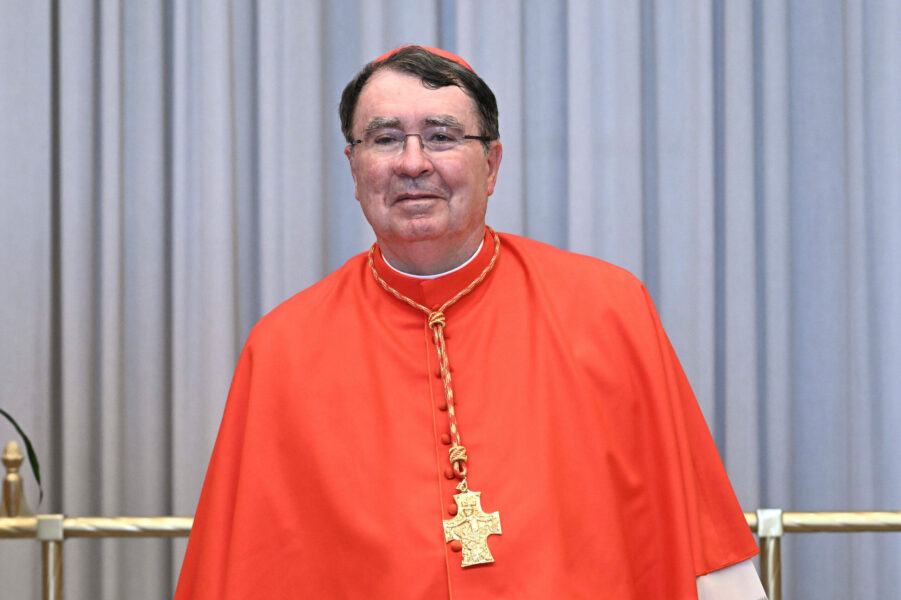
About to conclude his mission as apostolic nuncio in the United States after nearly a decade in the post, Cardinal Christophe Pierre has given an extensive interview in which he reviews some of the main events of his diplomatic career, reflects on the legacy of Pope Francis, assesses the pontificate of Leo XIV and shares his vision of the situation of the Church in the United States and the current international context.
In a conversation published by the National Catholic Register, the French diplomat, who will return to Rome to take on new tasks in the service of the Holy See, recalled that for much of his mission in Washington he set himself a very specific task: “For most of my mission, my task was to explain Pope Francis to the United States and to explain the United States to Pope Francis”.
A life in the service of Vatican diplomacy
Pierre leaves behind a diplomatic career of nearly half a century, with postings in such diverse countries as New Zealand, Mozambique, Zimbabwe, Cuba, Brazil, Haiti, Uganda, Mexico and the United States.
During those years he faced particularly complex situations, from the AIDS crisis in Africa to political violence in Burundi and negotiations to guarantee religious freedom in Mexico. Since his arrival in Washington in 2016, he has traveled across much of the United States to get first-hand knowledge of the reality of the dioceses and to assist the Holy Father in the appointment of new bishops.
Recalling this period, the cardinal especially highlighted the welcome he received from American Catholics. “I have visited most of the dioceses. I have been four or five times to Alaska, Hawaii, California, Florida… The beauty and diversity of the country are extraordinary,” he said.
Aparecida and Francis’s vision
For the cardinal, the Aparecida Document, drawn up by the Latin American episcopate in 2007 and whose drafting was marked by the participation of the then-Cardinal Jorge Mario Bergoglio, holds great importance.
According to Pierre, when he arrived in the United States he discovered that many Church leaders barely knew that text, which he considers fundamental for understanding the pontificate of Francis.
“In Aparecida, the bishops saw the break in the transmission of the faith and values, the fragmentation of society and the challenges of modernity. They understood that it was necessary to begin again from Christ,” he explained.
For the cardinal, the meeting was “a turning point of this century” and made it possible to develop a new evangelizing reflection that later found continuity in the apostolic exhortation Evangelii Gaudium.
Leo XIV, in continuity with Francis
Pierre also referred to the current pontificate, rejecting any interpretation of a rupture between Francis and Leo XIV.
“When one listens to the Holy Father, one sees total continuity with what Francis began,” he assured.
The cardinal highlighted Leo XIV’s insistence on the Second Vatican Council and stressed that the next consistory will be devoted precisely to reflecting on Evangelii Gaudium, one of the most important programmatic documents of the previous pontificate.
In one of the most striking statements of the interview, he described the new Pontiff as “above all, a Latin bishop,” despite having been born in the United States, because of the profound influence his pastoral experience in Latin America has had on his vision of the Church.
He also described both Francis and Leo XIV as prophetic figures. “The prophet is the one who proclaims the Gospel in today’s world. Leo does not want to become a politician. He wants to proclaim the good news of Christ,” he said.
The U.S. Church and the risk of ideologization
Throughout the conversation, Pierre revisited some reflections he had already made in the past about ecclesial life in the United States.
The nuncio considered that for years part of American Catholicism had been excessively conditioned by the logic of political confrontation.
“In a way, Catholicism in the United States became a kind of political party,” he noted. In his view, the risk of any ideology lies in reducing the complexity of reality to a single set of ideas and ultimately seeing the adversary as an enemy.
However, he also wanted to highlight the positive aspects of the North American Church. “I do not know of any other country where the contribution of Catholics to society is so extraordinary,” he said, referring to the network of parishes, hospitals, universities and educational works built by generations of the faithful.
The cardinal also expressed a particularly positive assessment of the U.S. Catholic education system, which he considers one of the great historical achievements of the Church in the country.
The Viganò case, an issue he still does not understand
Among the most difficult moments of his time in Washington, Pierre mentioned the crisis caused by his predecessor, Archbishop Carlo Maria Viganò, who in 2018 called for the resignation of Francis and was later excommunicated.
Although he avoided going into the controversy, he acknowledged that he still does not understand the decisions taken by the former nuncio.
“I respect him, but I remain bewildered. I cannot understand the position of this brother of mine,” he confessed.
The cardinal explained that he continues to regard Viganò as a brother in the episcopate and admitted that this episode has been one of the most painful experiences of his ecclesial career.
Peace, diplomacy and differences with Washington
In the final part of the interview, Pierre addressed the international situation and confirmed that he recently held conversations with officials from the U.S. Department of Defense.
According to him, there are significant differences between the diplomatic vision of the Holy See and some orientations of U.S. foreign policy.
The cardinal insisted that the main message of Leo XIV since the beginning of his pontificate has been the defense of peace. “The first word Leo XIV used from the balcony was ‘peace,’” he recalled.
Referring to current conflicts, he rejected the idea that war can become an instrument of negotiation. “One does not go to war to negotiate. One negotiates to avoid war,” he said.
Pierre also expressed his concern about what he sees as a growing tendency to privilege force over dialogue in international relations, an evolution that, in his view, contrasts with the diplomatic tradition historically defended by the Holy See.
After nearly ten years in Washington, the cardinal leaves the United States convinced that the Church’s mission remains to proclaim the Gospel in an increasingly polarized world, always keeping open the paths of dialogue and the pursuit of peace.