


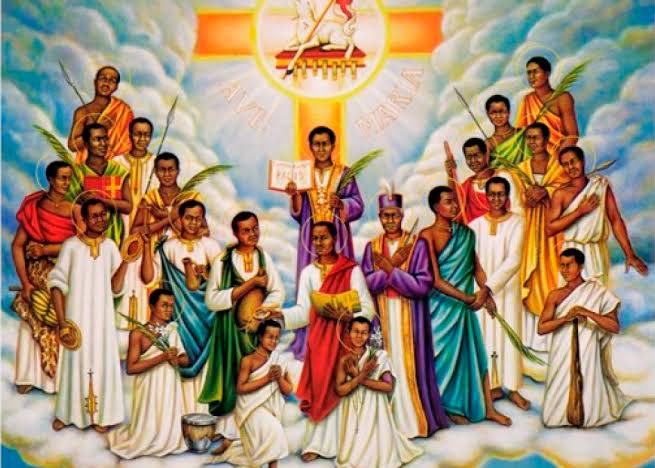
The Church celebrates each year the memory of the Uganda martyrs, a group of young Christians killed between 1885 and 1887 for refusing to abandon their faith and submit to the demands of King Mwanga II. Their witness remains one of the most striking pages in the history of Christianity in Africa.
In an article published by Catholic Exchange, historian and writer Theresa Civantos Barber recalls the circumstances surrounding the birth of the Church in the African kingdom of Buganda and the testimony of those who were willing to face death rather than betray Christ.
The arrival of Christianity in Buganda
During the second half of the nineteenth century, European explorers, traders, and missionaries began arriving in various regions of Africa. In the kingdom of Buganda, located in present-day Uganda, Muslim, Protestant, and Catholic influences coexisted for several years.
King Mutesa I allowed Christian missionaries to enter his territory starting in 1875. Both Catholics and Anglicans began evangelizing and achieved numerous conversions among the inhabitants of the kingdom and members of the royal court.
The situation changed with the accession of Mwanga II, who succeeded his father while still very young. Missionaries described the new monarch as an impulsive and unpredictable person who viewed with growing concern the spread of Christianity among his closest collaborators.
The assassination of Joseph Mukasa
One of the first conflicts erupted in 1885 after the murder of Anglican bishop James Hannington, ordered by Mwanga himself.
Joseph Mukasa Balikuddembe, a prominent member of the court who had converted to Catholicism, openly reproached the king for that decision and reminded him that his father would never have acted in such a way.
The monarch’s reaction was immediate. On November 15, 1885, he publicly accused Joseph of treason and ordered his execution.
According to testimonies collected by the missionaries of the time, Joseph faced death by proclaiming his faith and forgiving those who were about to execute him. He was beheaded, and afterward his body was burned.
The persecution of the young Christians
Far from halting conversions, the death of Joseph Mukasa prompted many young people at the court to approach the missionaries to receive religious instruction and request baptism.
Many of them were pages who served the king directly. Christian teaching clashed with certain customary practices of the court, including the sexual abuses Mwanga inflicted on several of these adolescents.
The young Christians’ refusal to participate in such conduct increased the monarch’s hostility toward the new religion.
In May 1886, upon discovering that several of his pages were being instructed in the Christian faith, Mwanga decided to act decisively.
“We will never cease to be Christians”
The king gathered the young people of the court and demanded that those who were Christians identify themselves publicly.
According to contemporary chronicles, he asked them if they were determined to remain Christians. The response was unanimous.
“We will never cease to be Christians, whatever the outcome,” they replied.
After that declaration, several of them were condemned to death and sent to Namugongo, the usual place of royal executions.
The martyrdom of Charles Lwanga and his companions
The group was led by Charles Lwanga, a catechist and the person responsible for several of the young converts.
The condemned were forced to travel for several days along the road to the place of execution. Some were killed during the journey.
On June 3, 1886, Charles Lwanga and eleven other companions were burned alive in a large pyre prepared by the executioners.
The accounts of the witnesses highlight the serenity with which they faced death. As the flames advanced, they continued praying and encouraging one another.
In total, twenty-two Catholics were killed during that persecution and later recognized by the Church as martyrs.
A testimony that lives on
The Uganda martyrs were canonized by Saint Paul VI in 1964, during the Second Vatican Council, becoming one of the most important symbols of the growth of Christianity in Africa.
Their story continues to be remembered not only for the violence of the persecution they endured, but also for the firmness with which they defended their faith.
As the Catholic Exchange article emphasizes, the young men did not die for political or colonial reasons, but for a religious conviction they considered superior to their own lives: the certainty that Christ deserved to be followed even at the cost of martyrdom.