


By Monsignor Jason Gray
Catholics around the world commemorate Corpus Christi today, a feast that celebrates the real presence of Jesus in the Eucharist. But Corpus Christi holds special meaning for American Catholics this year. The Catholic Church has seen “historic” rates of conversions in parishes across the country, while Americans’ belief in the real presence and reverence for the Eucharist steadily increase.
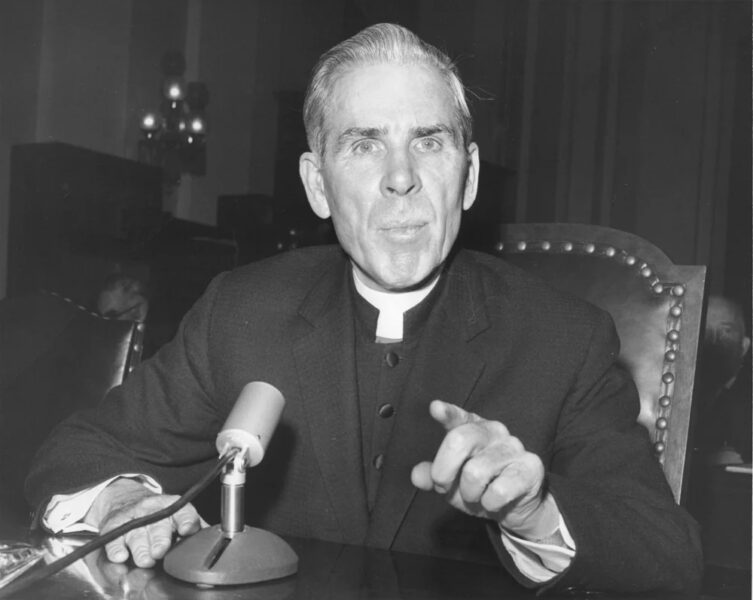
This year, the Catholic Church will also formally declare Archbishop Fulton J. Sheen “Blessed,” one step away from becoming the first U.S.-born bishop to be canonized a saint. Sheen’s love for the Eucharist and his promotion of the real presence should inspire all Catholics to prioritize God in our daily lives in the same way.
Before his death at age 84, Archbishop Fulton Sheen made history as a renowned evangelist, an Emmy-winning television personality, a best-selling author, and a promoter of the Church in the poorest mission territories around the world. Yet Sheen acknowledged that the true source of his strength was not his intellect, his charisma, or his fame.
It was his daily holy hour before the Blessed Sacrament.
Catholics believe that the Eucharist is truly the body, blood, soul, and divinity of Jesus Christ. They ground this belief in the Bread of Life Discourse in John 6, where Jesus calls himself the “bread come down from Heaven” and says that “whoever eats my flesh and drinks my blood has eternal life.”
Even some of Jesus’ earliest followers could not accept this teaching. Thinking that Jesus was promoting something akin to cannibalism, they murmured that “this teaching is very hard” and “who can listen to it?” Many walked away, Scripture tells us, or left him altogether.
Yet instead of retracting his teaching, Jesus reaffirmed it. It was this precise moment that planted the first seeds of betrayal in Judas Iscariot, whom Jesus refers to as a “devil.” Satan recognized the power of the Eucharist from the beginning.
The devil hated the Eucharist so much that he incited Judas to betray Jesus right after the Last Supper, where Jesus instituted the sacrament of the Holy Eucharist. The devil, of course, failed to undo what Jesus had begun. Although Jesus was crucified, he rose and ascended into Heaven, yet Catholics believe he remains with us in the consecrated Eucharistic hosts.
Sheen’s recognition of this truth was an integral part of his life and success.
When he was ordained a priest, Sheen committed himself to making a continuous holy hour before the Blessed Sacrament every day. He kept this promise until the day he died, despite his busy life and many pressing responsibilities.
Why? Because Sheen recognized that if the Eucharist is truly the body and blood of Jesus Christ, then everything must be centered on it, and not the other way around.
Whether traveling, doing missionary work, or preparing his television program (which had 30 million weekly viewers), Sheen demonstrated by example that we must never take our personal relationship with Jesus in the Eucharist for granted.
Even while traveling, Sheen made sure to find churches with Eucharistic adoration. Once, he accidentally got locked inside a church in Chicago while praying, but he found a way out, just as he had found a way in. The lesson? There is always a way to make time for God.
When Sheen taught at The Catholic University of America, he stopped each day in the chapel of Caldwell Hall to tell the Lord that he loved him. And when Sheen retired to his apartment in New York, he converted a room into a chapel. Even in his later years, he continued to pray before the Eucharist. That was where he died, in his chapel, at age 84.
Sheen’s life embodied the transforming power of prayer. He told many stories of people whose lives were transformed by committing to prayer: priests who saved their vocations through prayer, laypeople who began attending church more regularly to see Jesus, even Protestant ministers who began committing to an hour of daily prayer.
For Sheen personally, the daily hour he devoted to prayer was always the best part of his day.
It taught him to take a break from preaching and other work, to sit in silence, allowing Our Lord to touch his soul. Sheen said the holy hour is best when we listen to Jesus more than we speak to him. We may be tempted to tell Jesus what we want. Yet we benefit more if we let Jesus tell us what he wants.
This prayerful silence taught Sheen more about Christ than decades of theological study. His daily holy hours also taught him to order his priorities correctly, while giving him the peace and joy needed to do God’s work of bringing souls to Heaven.
He powerfully shows us that all of us, no matter who we are, have time to devote a moment of daily prayer to God. He reminds us that the Bread of Life Discourse was Jesus’ invitation to be near him in the Blessed Sacrament. Sheen never stopped responding to this invitation: on his knees, in the chapel.
The secret to Sheen’s joy, clarity, and evangelizing power was not fame or intellect, but the silent hour he spent each day before the Eucharist. His prayerful witness reminds us that the Eucharist is a gift worthy of our time and devotion.
On Corpus Christi, Catholics should follow Sheen’s example by returning to the Eucharist with renewed faith, reverence, and love. In a restless world seeking meaning, peace, and purpose, Jesus still waits for us in the tabernacle, just as he always has.
About the author
Monsignor Jason A. Gray, J.C.D., is a priest of the Diocese of Peoria, Illinois, and serves as executive director of the Archbishop Fulton J. Sheen Foundation. Msgr. Gray has worked on the cause for canonization of Archbishop Fulton Sheen since it opened in 2002, and in 2011 he directed the investigation into the miracle attributed to Fulton Sheen’s intercession.