


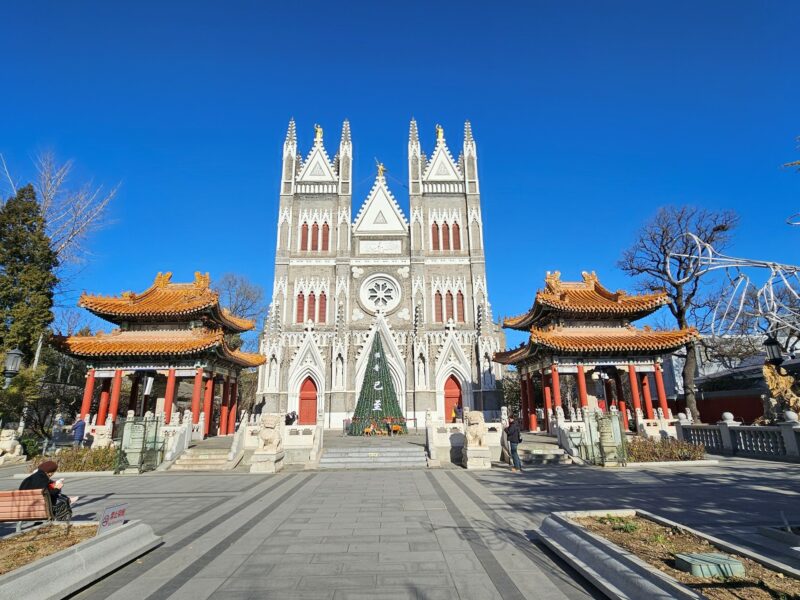
The ideological control campaign driven by Xi Jinping’s regime has taken a new step with the entry into force, on 1 July, of a law that will require religious communities to strengthen Chinese national identity and actively promote adherence to the political principles of the Communist Party. The measure directly affects the Catholic Church recognized by the State and is already being disseminated in parishes and ecclesial communities in various regions of the country.
According to the specialized magazine Bitter Winter, priests from the Chinese Catholic Patriotic Association recently took part in events held in Inner Mongolia to explain to the faithful the content of the new Law for the Promotion of Ethnic Unity and Progress, which numerous observers consider a new tool to accelerate the “Sinicization” of religions.
Priests promoting regime slogans in parishes
The images released by Bitter Winter show priests distributing leaflets about the new legislation in the courtyard of a church in Inner Mongolia, a region especially sensitive due to the presence of ethnic minorities and the tensions that have arisen in recent years because of the cultural assimilation policies promoted by Beijing.
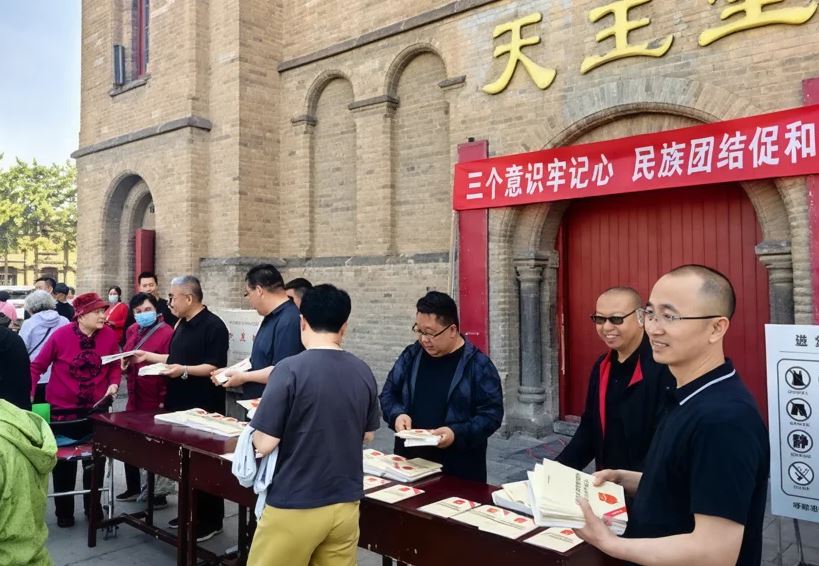
During the event, the clergy explained the Communist Party’s guidelines on ethnic matters and encouraged the faithful to develop what the authorities call “national, civic and legal consciousness.”
According to the publication, the message conveyed was unequivocal: parish life, the formation of believers and the activity of Catholic communities must fully align with the State’s political priorities.
The Chinese Catholic Patriotic Association itself has become one of the main drivers of this campaign, distributing materials in support of the new regulations and promoting activities aimed at strengthening the faithful’s adherence to the Party’s objectives.
The new law makes Sinicization a legal obligation
Although the authorities present the law as an initiative intended to foster national unity and equality among the 56 ethnic groups recognized by the State, international organizations and human-rights defenders maintain that its true purpose is to legally consolidate the assimilation policies promoted by Xi Jinping.
The regulation incorporates into Chinese law the strategy of “Sinicization” of ethnic and religious minorities, a program that seeks to subordinate cultural, linguistic and spiritual identities to a homogeneous national identity defined by the Communist Party.
In practice, this means strengthening the use of Mandarin, reducing the presence of minority languages and requiring religious institutions to actively collaborate in building a single national consciousness.
“Religion must adapt to socialism”
One of the most controversial points of the new legislation directly affects religious communities. Article 46 establishes that religious organizations, seminaries and places of worship must promote awareness of the Chinese national community, persevere in the Sinicization of religions and guide believers and religious leaders toward adaptation to socialist society.
The regulation also requires fostering patriotism and contributing to religious and social harmony according to the parameters set by the Communist Party.
The United States Commission on International Religious Freedom (USCIRF) has defined the religious Sinicization promoted by Beijing as the “complete subordination of religious groups” to the regime’s political agenda.
Catholics from ethnic minorities in the spotlight
The consequences of the new regulations could be felt especially in regions where ethnic minorities maintain a strong cultural and religious identity.
These include Inner Mongolia, Xinjiang, Yunnan and Guizhou, territories where the authorities have for years been promoting increasingly aggressive cultural and linguistic integration programs.
In Inner Mongolia, the scene of the recent event denounced by Bitter Winter, protests against the reduction of Mongolian-language education have been frequent in recent years.
The region also has a significant Catholic presence, the result of missionary work carried out during the 19th century.
Within this context, the authorities require the faithful to adopt the so-called “five identifications” promoted by Xi Jinping: identification with the Chinese motherland, the Chinese nation, Chinese culture, the Communist Party and the so-called “socialism with Chinese characteristics.”
The agreement between Rome and Beijing returns to the center of debate
The new ideological offensive once again places at the center of discussion the agreement signed between the Holy See and China in 2018 on the appointment of bishops.
The pact, whose terms remain confidential, was renewed for a third time in 2024 and will remain in force until 2028.
Its defenders argue that it has helped reduce divisions between the official and underground Churches, allowing all bishops to enjoy simultaneous recognition from both Rome and Beijing.
However, its critics believe that the agreement has given the Communist Party growing influence over the internal life of the Church and has not halted the pressure exerted against Catholics who resist subordinating their faith to the political interests of the regime.
With around ten million Catholics divided between the official and underground Churches, China remains one of the most complex scenarios for religious freedom in the world. The entry into force of this new law now threatens to deepen even further the tension between fidelity to the Church and the demands of a State that claims an increasingly absolute ideological adherence.