It is advisable to begin by explaining what we are talking about, because the matter starts with a murky procedure and ends up resembling a political stance. Every apostolic journey carries a little-known custom outside the profession: the Holy See Press Office provides accredited journalists with a working dossier, prepared by the Dicastery for Communication, that gathers everything the correspondent may need to cover the tour. Schedule of events, religious context of the country, historical data and, of course, portraits of the authorities the Pope will meet. It is behind-the-scenes material, not intended for publication, but it fulfills a decisive and silent function: it sets in advance the framework through which newsrooms around the world will interpret everything that happens on the ground. Whoever writes that dossier writes the first impression. And in journalism the first impression is almost always the only one that sticks.
This has been revealed by María Rabell García, Rome correspondent for El Debate, and the fact deserves to be recorded in full, because it is the key to the scandal: the booklet the Holy See has distributed for the journey of Leo XIV to Spain, from 6 to 12 June, will not be read by four Spanish Vatican correspondents who attend daily Mass. It will be read by the special envoys of the major media outlets from all the planet’s relevant countries, literally on board the papal plane or deployed on the ground. It is the widest and most influential audience that exists for shaping the image of a ruler. And to all of them, as a bloc, with the Church’s seal and in advance, the Holy See has handed a profile of Pedro Sánchez written in the tone of a propaganda pamphlet. Not an information sheet. Pure propaganda. The Vatican has decided to whitewash the autocrat Sánchez before the world’s press, to launder his image in the only forum no Moncloa press chief could ever buy. That is the news. And it is of a gravity that admits no euphemism, softening or mitigating context.
Because for a Spaniard who knows the fabric, reading that booklet is not reading a profile: it is witnessing a betrayal. The Holy See does not describe a president; it whitewashes an autocrat. An autocrat subjected to an unprecedented judicial siege in Spanish democracy, whose innermost circle—his number two in the party, his former trusted minister, his own brother, his wife—parades through the courts, and whose method of government has consisted, without disguise, in colonizing institutions, fusing State and party, pardoning his allies, gagging checks and balances and treating Justice and the free press as enemies to be brought down. That character, and no other, the Church’s communications apparatus presents to the entire world as an impeccable progressive reformer, victim of others’ injustices. It does so, moreover, on the eve of a visit in which the Pope will set foot in a country where millions of Catholics—the very people filling the churches Leo XIV comes to pack—resist precisely the project of that man, suffer his hostility and pay his bill. That Rome should choose precisely this moment to give him international luster is not clumsiness, nor oversight, nor misunderstood neutrality: it is enlistment. The Holy See has sided with power and against its own. And for the Spanish Catholic who resists, that has an exact name: the Church has shot them in the back.
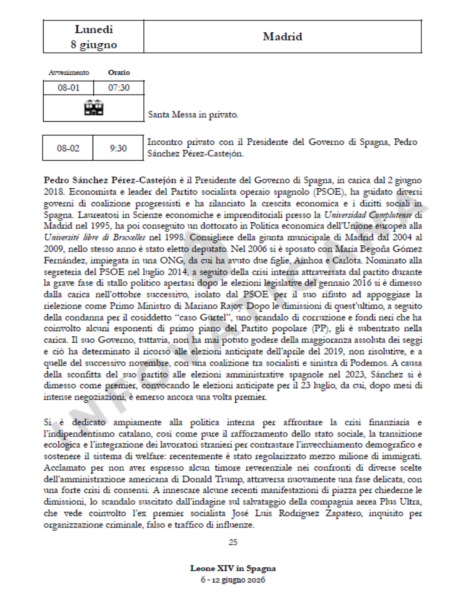
The text covers its back before it begins, and it is worth reading the entire clause, because it gives itself away. It states, in its original Italian, that the booklet “is a working instrument of the Dicastery for Communication, which integrates information of various kinds and origins, and has no official character.” And immediately afterwards it clarifies what that rider is for: “Any differences with the actual development of the Apostolic Journey are not to be considered ‘news’ of note.” Read it slowly, because the trap is laid bare there: the warning is designed to cover schedule and program changes, not to shield a political portrait. The document itself confesses the scope of its disclaimer, and that scope does not come anywhere near a laudatory profile of a head of government. That an event starts ten minutes late has no official character; that the Holy See’s communications organ states that Sánchez “has relaunched social rights in Spain” and distributes it with its seal to the world’s correspondents does have official character, whether a footnote denies it or not. The clause does not describe the document: it exonerates it. And exonerating oneself in advance is the confession that someone inside the apparatus knew the content would not withstand being signed. The alibi is written before the offense.
Because the content is indefensible. According to El Debate, the document describes Sánchez as the leader who has “relaunched economic growth and social rights in Spain.” It is worth translating what those “social rights” the Vatican celebrates without blinking actually are in the character’s real record. They are, notably, the euthanasia law—the first in Spanish democracy—and the current campaign to enshrine abortion as a “constitutional right” and shield it from any future majority. This is not a partisan ideological reproach: it is a flagrant documentary contradiction. The same ecclesial apparatus that in 2024 promulgated Dignitas infinita—where euthanasia and abortion are listed by name among grave violations of human dignity—now distributes worldwide a text that presents exactly those two policies as a management achievement worthy of applause. No hermeneutic can close that gap. Either Dignitas infinita says what it says, or the dicastery that should safeguard its doctrine contradicts it on headed paper and at thirty thousand feet. Both things at once are impossible, and the booklet forces a choice. The Vatican has chosen, and it has chosen the executioner of dignity over the doctrine it claims to guard.
There is more, and worse, because the praise coexists with a silence chosen with surgical precision. Sánchez’s government has distinguished itself by its recurrent attacks on the Spanish Church, almost always wielding the argument of abuses as a battering ram: commissions, reports, inflated figures and a political narrative that has turned clerical pedophilia into ammunition against the institution. Of all that, in the profile, there is no trace. The dicastery that should be the first to know that record—because it has suffered it in its own house—omits it completely and portrays the adversary as a model statesman. The Church not only blesses the one who strikes it: it writes his press release, translates it and distributes it to the international press corps so the world will applaud the executioner. It is hard to imagine a more abject servitude or a more complete surrender.
The piece reaches its most revealing—and most indefensible—point when it apportions blame, because the booklet does not silence corruption: it distributes it with an unequivocal criterion. It mentions, in so many words, the “Gürtel case” as a “scandal of corruption and slush funds” that affected the Popular Party, and attributes Sánchez’s current “severe crisis of consensus” to the scandal of the Plus Ultra bailout, “which involves the former socialist prime minister José Luis Rodríguez Zapatero, under investigation for criminal organization, falsification and influence peddling.” All the corruption in the narrative therefore has an owner, and the owner is always someone else: the PP and Zapatero. Of the judicial siege surrounding Sánchez himself—his number two in the party, his former trusted minister, his brother, his wife, all passing through the courts—there is not a single line. More than that: the document names Begoña Gómez only once, and does so to present her as “an employee at an NGO,” with no trace of her status as a person under investigation. We are not, therefore, facing a general prudishness toward the courts, but a targeted whitewash: the cases that damage rivals are cited, even detailed, and those pointing to the protagonist are erased without exception. That is not what an information profile does: it is what an image-management office does. And the fact that the office, in this case, is the Dicastery for Communication of the Holy See does not soften the maneuver: it lends it a moral authority no Moncloa press chief could buy with money.
The migration section closes the picture and lays bare its logic. The document praises Sánchez’s immigration policy as a tool “to sustain the welfare system” and underlines, according to El Debate, that “he has recently regularized half a million immigrants” in the face of demographic aging. Note the anthropology that underlies this, because it is exactly the inverse of the one the Church claims to profess: the immigrant does not appear as a person endowed with inviolable dignity, but as raw material to square the population pyramid and pay pensions. It is, word for word, the utilitarian reduction of the human being that the magisterium claims to combat. And it is not an innocent slip, because the same cabasario, when describing the Canary Islands stages of the journey, places Cáritas at the center of the scene: it is the entity that, according to the text, “aided the shipwrecked” in the port of Arguineguín, and its diocesan director is among those who will receive the Pope. The same Church that manages reception on the ground—with a network of ecclesially based or affiliated entities that live on public funds tied to that reception—is the one that, in the same booklet, applauds the regularization that feeds that network. The enthusiasm for the “half million regularized immigrants” is not, therefore, a disinterested opinion floating in a vacuum: it has material recipients with payrolls. That this instrumentalization should come signed—sorry, unsigned—by the Vatican should trouble above all those who invoke the dignity of the migrant only when it serves to disqualify the domestic adversary.
There remains the geopolitical gesture, in case color was still missing from the picture. The president is “acclaimed,” the text says, “for not having expressed any reverential fear” toward the Trump administration. The Holy See, which has made diplomatic equidistance an almost dogmatic doctrine, here distributes to the international press an openly partisan assessment of a head of government vis-à-vis a foreign head of state. Whether one agrees with the jab at Trump is beside the point; that is legitimate to debate in an opinion forum. What is serious is the who and the where: an explicit geopolitical alignment, slipped into the working material the Church hands to journalists as if it were just another objective datum.
It is worth recalling, at this point, who is responsible for all this, because responsibility cannot be blurred in an institutional fog. To begin with, the libretto is not anonymous: it carries a signature. It was “prepared by” a writer with a first and last name, under the seal of the Dicasterium pro Communicatione, which rules out from the outset the excuse of impersonal oversight or a distracted intern. Behind it is a concrete hand and, above it, a chain of command that culminates in the Dicastery for Communication—the one still headed by Paolo Ruffini until next November, when he will be replaced by laywoman Montserrat Alvarado—which has placed in the hands of correspondents from half the planet the narrative those journalists will use to interpret every gesture in the coming days. Nor is it the excess of a lone official: the Pontiff himself received Sánchez in the Apostolic Palace on 27 May, days before the journey, as the same document records. It is not a logistical detail or a blunder: it is the fixing of the frame, carried out from the very center of the Vatican apparatus. When Leo XIV and Sánchez meet on Monday in Madrid, a large part of the room will already have read that they are facing a progressive reformer, defender of social rights and unjustly hounded by causes that are not his own. The framing was not imposed by Moncloa: it was given away by the Church itself, free of charge and in advance, on a global scale.
And there lies the real scandal, which is not one of protocol but of coherence, and coherence is the only thing that sustains the credibility of an institution that claims to speak to the world in the name of a truth. A pontificate that fills its mouth with human dignity allows its communications apparatus to canonize, from on board, before the journalism of half the planet, an autocrat who has legislated against that dignity and has made the Spanish Church an adversary to be beaten. It is not a slip: it is a choice. The machinery that guards the Church’s message has decided whom it serves, and it does not serve the faithful who fill it nor the truth it claims to keep: it serves power, the concrete power that today governs Spain against them. And then, when embarrassment surfaces, it takes refuge in the claim that the booklet is not its own. That clause—“it has no official character”—is the only honest thing in the document: it acknowledges, unwittingly and against its will, that not even the Holy See itself dares to sign what it has written. It writes it, distributes it around the world and disclaims it. It knows what it is doing, knows whom it benefits and knows it is wrong. That is why it does not sign it. To the Spaniards who these days await the Pope with open hearts, Rome sends this message in the journalists’ luggage: your executioner pleases us.