


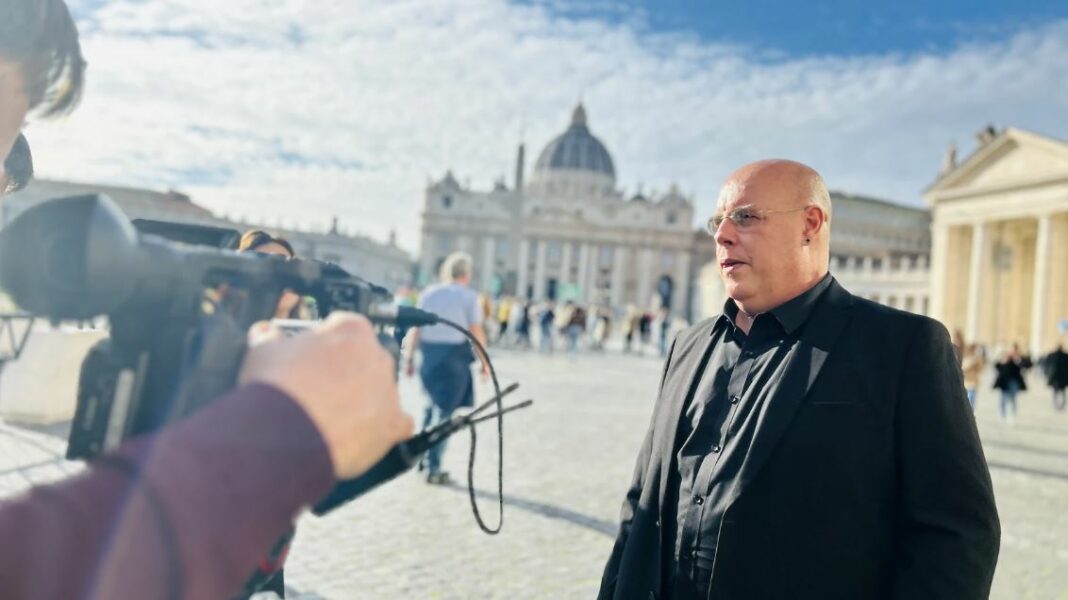
It makes sense to begin by understanding exactly what José Enrique Escardó has said and why it matters, because we are not dealing with just another critic of Jordi Bertomeu. Escardó is the first public whistleblower on Sodalicio violence—since the year 2000—the most visible survivor of the case and the voice that has led the victims for a quarter of a century. He is also the man who in 2025 came out to defend Robert Prevost against accusations of cover-up in Chiclayo, calling them “absolutely false” and attributing them to a Sodalicio campaign to prevent him from becoming Pope. And finally, he is part of the same group of victims that not long ago asked Rome to support the commissioner. When someone with that track record publicly breaks with Bertomeu, we are not witnessing a criticism: we are witnessing the collapse of the endorsement that morally legitimized the entire process.
The break, moreover, is explicit and goes to the bone. Escardó maintains that Pope Francis assured him he would sign whatever he asked regarding Bertomeu, and that the commissioner, knowing this, “at no time accepted even the slightest suggestion from a victim”; that he does “whatever he wants”; and that what he wants is “to make himself known in order to be promoted in the Church while deceiving the victims.” The charge is not theological or doctrinal: it is operational. He accuses him of not listening precisely to the man who embodies the “listening channel.” It is worth setting aside the rhetorical underbrush—Escardó calling the Church “the most corrupt institution on Earth” is hyperbole from a harmed party that each person can weigh as they see fit—because the concrete reproach survives without it, intact: the manager of the reparation instrumentalizes those he claims to repair.
And there is still something more devastating. Reaffirming himself as the first whistleblower, Escardó states that the suppression of the Sodalicio “has been only nominal,” that the structure continues to operate “under other names and front men” and that the hearings and reparations are “buckets of cold water to calm some victims and deceive public opinion.” It is, word for word, the diagnosis that media outlets like this one have been documenting for months—the patrimonial network remains intact, Figari is alive and supported, no real lifting of the corporate veil—yet now formulated from the only place no campaign can delegitimize: that of the founding victim. When the historic whistleblower and the critical media coincide in the diagnosis, even if they arrive by opposite paths, the manager left in the middle no longer has a narrative left.
Because what Escardó adds does not fall into a vacuum. It falls on a file that Rome knows all too well and that has not stopped growing. The commissioner who managed to get an elderly and frail Francis to sign a threat of excommunication against the two laypeople who had denounced him—a decree the Pope himself revoked in his own hand once he understood the legal absurdity they had placed before him. The commissioner in whose circle a false complaint against a critical priest surfaces twenty-two days after that priest raised his voice, with an alleged victim who neither signed the document nor knew of its existence. The commissioner who, off-mic, dismisses the country under investigation as “a jungle” where everyone “manages as best they can.” The instructor who was, successively, author of the report, writer of the Nunciature’s press releases, de facto judge and liquidator of what he himself had investigated: prosecutor, judge, executioner and notary of his own work. And meanwhile, one of the affected associations is taking him to court in Spain, with a hearing set for June 22. It is not an accumulated suspicion: it is a documented pattern.
And here is what is truly surprising, because it is not Bertomeu. Officials with more appetite for protagonism than technical solidity have always existed; it is a known species and, at bottom, minor. What is extremely difficult to explain is León XIV’s determination to keep him. We are talking about the Pope who knows Peru better than any recent pontiff—twenty years of pastoral work, including the bishopric of Chiclayo—who has the complete file on his desk, who has seen even the support of the victims themselves crack, and who nevertheless, in November, appointed three deputy commissioners precisely to strengthen the questioned management. Prevost has received, from critics, from canon lawyers and now from the case’s first whistleblower, exactly the same converging advice: that this commissioner harms more than he repairs. And he has decided, against all of them, to keep him. That a pontificate that built a good part of its anti-abuse credibility on the Sodalicio case should insist on retaining the only figure eroding it is, quite simply, the unanswered question in all of this.