


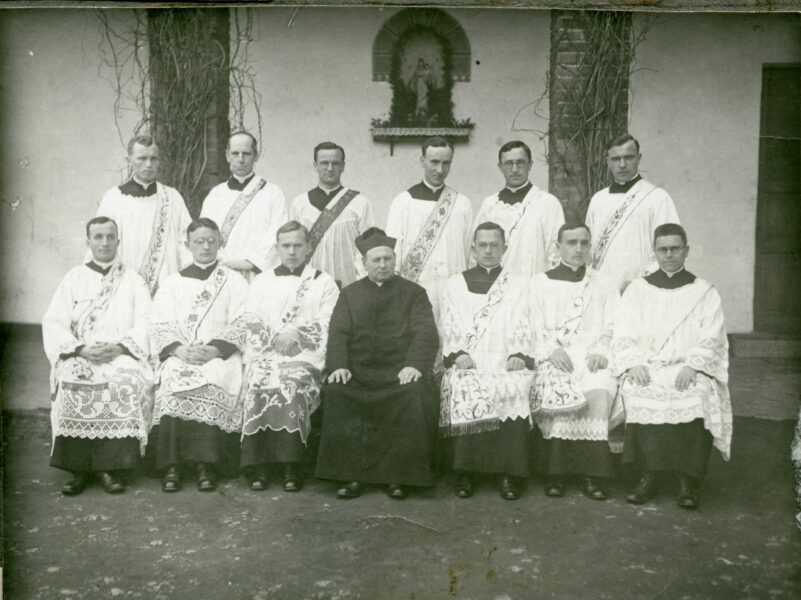
The Church will celebrate this Saturday in Krakow the beatification of nine Polish Salesian religious killed in Nazi concentration camps during the Second World War. The ceremony will take place at the Shrine of Saint John Paul II and will be presided over by the Prefect of the Dicastery for the Causes of Saints, Cardinal Marcello Semeraro.
The new blesseds were recognized as martyrs by Pope Leo XIV last October, after it was determined that they were persecuted and killed out of hatred for the faith during the German occupation of Poland.
Priests and educators persecuted for their faith
The nine religious belonged to the Salesian Congregation and were carrying out their pastoral and educational work in different regions of Poland when they were arrested by the Nazi authorities.
Father Jan Świerc and seven of his companions died in the Auschwitz extermination camp between June 1941 and September 1942. Father Franciszek Miśka died in May 1942 in the Dachau concentration camp, where thousands of priests from across Europe were interned.
The Church now officially recognizes their witness of fidelity to Christ amid persecution and proposes them as an example for the faithful.
The priest who offered himself to save a Salesian brother
Among the new blesseds, the figure of Father Włodzimierz Szembek stands out. Born in 1883 into an aristocratic family near Krakow, he studied agricultural engineering at Jagiellonian University and for years managed important family estates. However, he chose a life of simplicity and service, dedicating himself to the apostolate among the most humble and generously helping the poor, orphans, and religious communities.
He entered the Salesian Congregation in 1928 and was ordained a priest six years later by the then Archbishop of Krakow, Adam Stefan Sapieha.
His martyrdom began on July 9, 1942. When Gestapo agents stormed the Salesian house in Skawa to arrest the superior of the community, the elderly Father Walenty Kozak, aged 72, Szembek intervened to ask that he be arrested in his place. The Nazis ended up taking both religious, although the superior would be released a few weeks later.
After his arrest, he was imprisoned in Nowy Targ and Zakopane, where he suffered brutal torture. His executioners broke several of his ribs, kept him in inhumane conditions, and subjected him to continuous interrogations. Fellow prisoners later recalled that he returned from torture sessions without hatred toward his persecutors and insisted that they should pray for them.
He was finally deported to Auschwitz with severe physical injuries. Forced to perform hard labor and weakened by mistreatment, he died on September 18, 1942. He had prisoner number 60019.
A beatification linked to prayer for vocations
The Archbishop of Krakow, Monsignor Grzegorz Ryś, has sought to link the celebration to the current need for new priestly and religious vocations.
In a message released before the ceremony, the prelate explained that the Church will not only remember the sacrifice of these martyrs but will also pray that young Poles respond generously to the call to the priesthood and consecrated life.
Ryś recalled that the lack of priests during the Nazi occupation left a deep mark on the life of the Polish Church and noted that the witness of these religious continues to be a source of inspiration for new generations.
The connection with Saint John Paul II
The beatification will be celebrated at the shrine dedicated to Saint John Paul II for a particularly significant reason.
According to the Archbishop of Krakow, the young Karol Wojtyła witnessed the arrest of one of the Salesians persecuted by the Nazis. That experience was part of the spiritual context that accompanied the birth of his priestly vocation during the war years.
The future Pope also directly experienced the consequences of the persecution against the Polish clergy and witnessed firsthand the difficulties faced by Christian communities when priests were imprisoned or killed.
The Nazi persecution of the Church in Poland
The German occupation of Poland was marked by a systematic policy of repression against the Catholic Church.
According to data from the Polish Episcopal Conference, nearly 2,800 Polish priests and religious were killed by the Nazi regime during the Second World War, including six bishops.
Saint John Paul II wished to especially recognize that witness of fidelity and, during his trip to Warsaw in 1999, beatified 108 Polish martyrs who were victims of 20th-century persecutions.
The nine Salesians who will be raised to the altars this Saturday are part of a larger group of 122 Polish Catholics whose beatification process began in 2003. Leo XIV authorized the promulgation of the decree of martyrdom on October 24, 2025, culminating a long process that will allow the Church to officially honor these priests killed for remaining faithful to Christ in one of the most dramatic chapters of European history.