


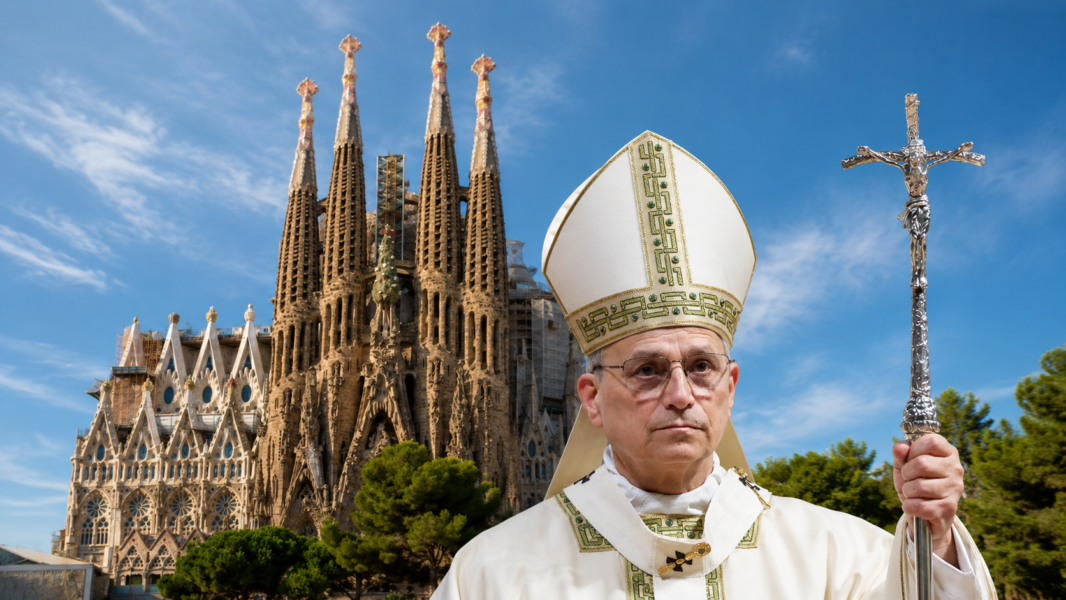
The visit of Leo XIV to Barcelona to bless the Tower of Jesus Christ at the Sagrada Família should be one of those pieces of news that transcend borders, ideologies and local interests. The Successor of Peter will come to Gaudí’s most universal temple to bless a tower dedicated to Christ. However, even before the Pope arrives, Catalan separatism has managed to reduce the event to a debate over the language of a blessing.
The publication by the Holy See of the missal for the celebration scheduled for next 10 June has, in less than twenty-four hours, opened a political front in Catalonia. The planned distribution of languages for the ceremony—with Spanish accounting for over 70 %, Catalan around 20 % and the blessing of the Tower of Jesus Christ entirely in Spanish—has run the length of the Catalan parliamentary spectrum, producing readings as predictable as they are opposed. What should have been one of the high points of the papal visit has instead become a debate about linguistic percentages, quotas of representation and identity grievances.
The controversy precedes the Pope’s arrival
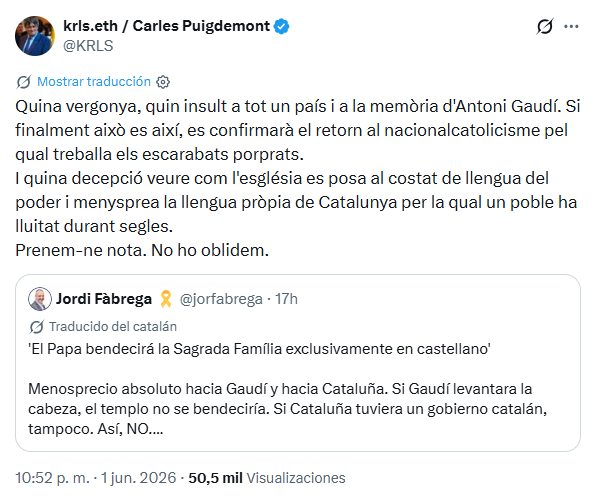
The leader of Aliança Catalana, Silvia Orriols, publicly announced that she would not attend the event. “As a deputy, I had requested to attend the blessing of the Tower of Jesus Christ at the Sagrada Família, but after learning that it will be celebrated in Spanish, I decline,” she wrote on social media. The politician justified her decision “out of respect for Gaudí and Catalonia.”
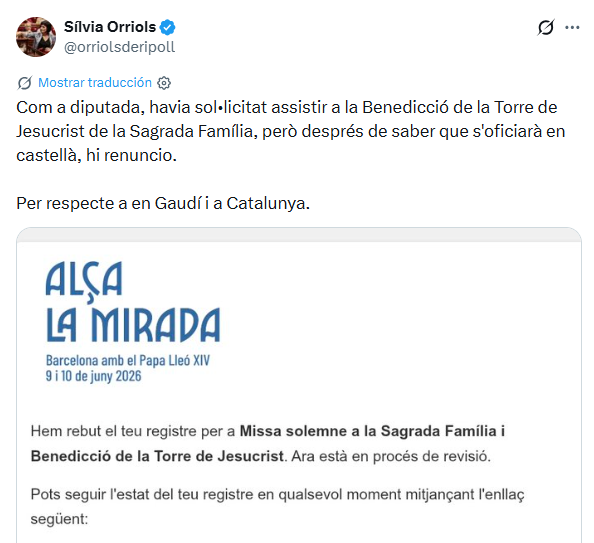
Jordi Fàbrega, Junts deputy in the Parliament of Catalonia and former mayor of La Seu d’Urgell, also criticised the decision. Fàbrega denounced an alleged “absolute disregard” for Catalonia, Antoni Gaudí and the Catalan language because the main blessing will not be delivered in Catalan.
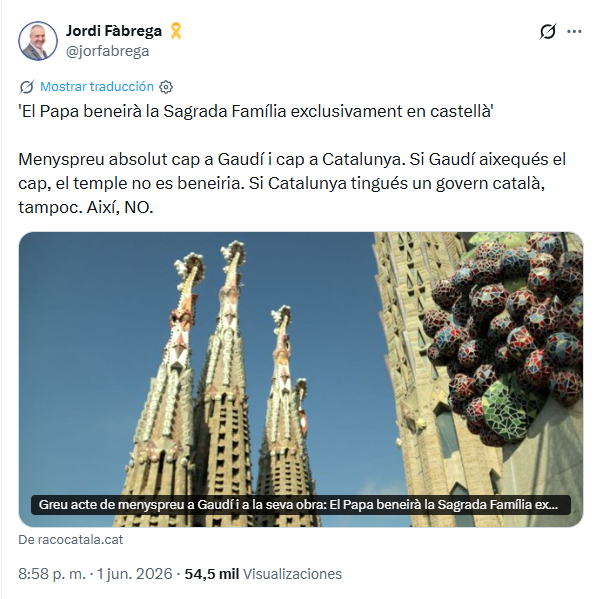
For his part, former president of the Generalitat Carles Puigdemont described the situation as “a disgrace” and maintained that it constituted an insult to Catalonia and to Gaudí’s memory. He also accused the Church of siding with “the language of power” and even linked the decision to a supposed return to National Catholicism.
The statements are striking for what they say, but even more so for what they reveal. Behind them lies a profoundly modern and artificial way of understanding reality, even though it presents itself as ancestral. Contemporary nationalism has spent decades trying to convince Europeans that the most important political identity of the human being is membership in a linguistically defined, administratively delimited community. Everything must be subjected to that criterion: history, culture, education, religion and even a papal blessing.
Political pressure reaches the Archbishopric
The Govern of the Generalitat moved in parallel, albeit with a more restrained institutional tone. Sources in the Catalan executive have indicated that they are already working with the Episcopal Conference, with the Archbishop of Barcelona, Cardinal Joan Josep Omella, and with the Holy See to increase the presence of Catalan, with the explicit aim of having the language included in the Pope’s homily and in the blessing of the tower, as well as in the rest of Leo XIV’s interventions during his stay.
From the civil Catalanist sphere, the most audible voice was that of journalist Pilar Rahola, who summed up the grievance with a phrase destined to circulate: “They slight our language in our own country.” The reproach resonates with the discontent of Catalan-sensitive Catholicism, which had already expressed its disappointment through entities such as the Fundació Joan Carrera and Joan Maluquer, a member of the Lliga Espiritual de la Mare de Déu de Montserrat, who publicly lamented the role reserved for Catalan in the ceremony and criticised the fact that the Archdiocese of Barcelona had not wanted to incorporate certain Catalan identity symbols into the organisation of the event. Parish priests who regret that the blessing will not be pronounced in Catalan—when, in their view, nothing prevented it—have also joined in.
Even the Bishop of Girona, Octavi Vilà, stated that he would have preferred a greater presence of the Catalan language during the blessing of the Tower of Jesus Christ:
“It would have been more satisfactory for the Tower of Jesus to have been in Catalan.”
Although Vilà also noted that he prefers to wait until the celebrations are fully under way to see what role Catalan will ultimately play in the various interventions.
The most sober explanation for the change was offered by the director of the Fundació Catalunya Religió, Jordi Llisterri, in statements to RAC1. Llisterri attributes the reduced weight of Catalan to a shift in the management of the trip: whereas Benedict XVI’s 2010 visit was coordinated essentially between the Archdiocese of Barcelona and the Holy See, the current one has largely passed through commissions based in Madrid and through an Episcopal Conference with a more decisive role. He adds a practical factor: Spanish is the language Leo XIV commands, and the one that, for the pontiff’s own convenience, tends to prevail in the ritual parts.
A counterpoint for the separatists
At the opposite end of the spectrum, the reaction did not even address the language distribution. The secretary general of Vox, Ignacio Garriga, responded on 2 June on X by shifting the focus from language to the very legitimacy of the protest: he described the separatist parties’ interference in a religious celebration as “absolutely unacceptable” and accused them of selective hypocrisy, recalling that they had not shown the same concern for the language used in mosques, public facilities and the squares where the Feast of the Sacrifice had just been celebrated. He concluded by urging them to devote their time to resolving the social and security crisis that, in his view, they themselves have provoked in Catalonia.
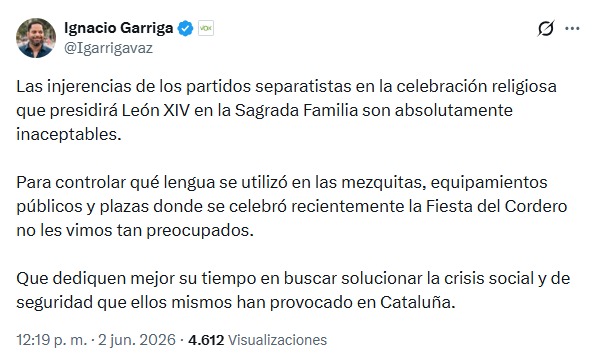
In short, it was the mirror-image response to Puigdemont: where separatism sees marginalisation of Catalan, Vox sees political intrusion in an act of worship. The conservative Madrid press followed the same line, describing the separatist reaction as a campaign of “linguistic victimhood” and highlighting the fact that Catalan nationalism tends to omit—namely, that the Pope’s first words in the temple will in fact be in Catalan—the sign of the cross and the greeting—along with the responsorial psalm, the reading from the Apocalypse and the singing of the Our Father.
The visit of Leo XIV turned into a battleground
The paradox is that this kind of nationalism presents itself as a defence of roots when in reality it is one of the most recent ideologies in history. For centuries, Catalans were Catholic, Spanish, European and members of a multitude of overlapping communities without experiencing any conflict between them. The obsession with making language the absolute axis of public life is a relatively recent political product. It is not a tradition; it is an ideological construct.
That is why the controversy is so revealing. The Sagrada Família was conceived by Gaudí as an expiatory temple for the glory of God. The Pope represents a two-thousand-year-old institution that brings together peoples, cultures and languages from every continent. The Church literally speaks every language in the world. Yet some look at such an event and can only ask how many sentences will be pronounced in Catalan and how many in Spanish.
There is something profoundly anachronistic about all of this. In an age characterised by globalisation, instant communications and permanent mobility, when new generations consume information, entertainment and culture from every corner of the planet, identitarian nationalism remains trapped in disputes that recall the nineteenth century more than the twenty-first. Its intellectual horizon remains the same: to delimit tribes, erect symbolic borders and turn any human reality into an instrument of collective affirmation.
Not even the Pope escapes that logic. Not even Christ. Not even Gaudí’s most universal work. Everything must be reduced to a local demand, a bureaucratic claim, a dispute over linguistic quotas. It is the inability to raise one’s gaze above one’s own village.
Perhaps that is why the controversy seems so small compared with the magnitude of the event. Leo XIV comes to bless a tower dedicated to Jesus Christ. Some have decided that what truly matters is the language in which the formula is pronounced. It is difficult to find a more precise image of the intellectual exhaustion of a nationalism that, claiming to speak in the name of history, increasingly resembles an ideological relic out of its time.