


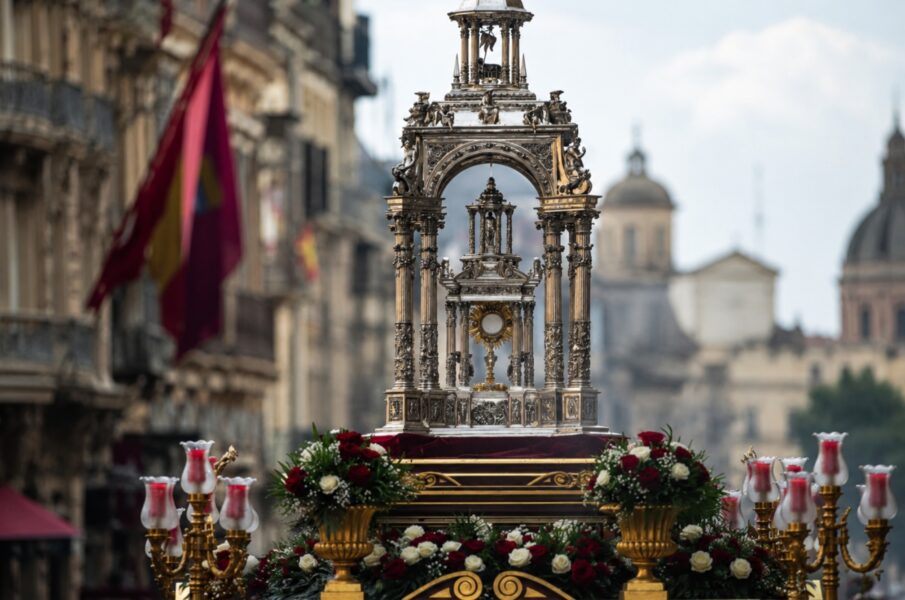
The 16th-century silver piece, owned by the City Council and not by the Church, will be the centerpiece of the Corpus Christi liturgy presided over by the Pope on June 7. It is the first time a pontiff leads this Madrid procession.
Leo XIV will process with the Blessed Sacrament after the Corpus Christi Mass he will celebrate in front of the Palacio de Cibeles, one of the central events of his visit to the Spanish capital between June 6 and 9. Although Madrid’s historic monstrance—linked to this celebration since the time of Philip II—will be present at the ceremony, the Pontiff has expressed his desire to personally carry the Sacred Host during the procession. The Renaissance piece will temporarily leave the Museum of History of Madrid to take its traditional place in the liturgical rites of Corpus Christi.
The planned proceedings will follow the classic structure of the solemnity. After Communion, the consecrated Host will be exposed on the altar and, once the prayer after Communion is concluded, the Eucharistic procession will begin. Leo XIV will walk along Calle Alcalá and part of Gran Vía personally carrying the Blessed Sacrament. At the end of the route, the Sacred Host will be placed in the Renaissance monstrance for a new incensation and the final prayer. The Pope will then impart the solemn blessing with the Blessed Sacrament from Plaza de Cibeles.
A municipal monstrance, not an ecclesiastical one
The singularity of this piece lies in its civil ownership. Unlike the vast majority of Spanish processional monstrances, Madrid’s does not belong to any church, cathedral, or religious institution, but to the City Council of the Villa. It was the Consistory itself that commissioned it from the silversmith Francisco Álvarez between 1568 and 1574, during the reign of Philip II, to provide the Corpus procession with an element befitting Madrid’s newly acquired status as capital.
The monstrance consists of three distinct elements: the platform or outer canopy, with eight Corinthian columns and the figures of the four evangelists crowned by the image of Christ the Savior; the seated monstrance, in the form of a double canopy with scenes of the Passion at its base—the Last Supper, the Washing of the Feet, the Agony in the Garden, and the Arrest; and the sun or portable monstrance, made in the 19th century by Francisco Moratilla, intended to hold the Eucharist.
The ensemble combines classical architectural forms with decoration that alternates Eucharistic motifs—ears of wheat and grapes—with figures of prophets, angels, sibyls, sages, and musicians. It is currently preserved in the chapel of the Museum of History of Madrid, after the completion in November 2024 of a restoration that cost the municipal treasury 12,700 euros.
Five centuries of procession and some mishaps
The history of the monstrance is linked to that of Madrid’s Corpus Christi. In the 16th century, the procession departed from the church of Santa María and passed through Plaza Mayor, the church of Santa Cruz, the convent of San Felipe, and the old Alcázar. It included confraternities, brotherhoods, religious communities, the clergy, the City Council, and representatives of the State, as well as popular elements such as the tarasca, the mojigón, and the giant figures. The monstrance was carried beneath a canopy held by municipal councilors.
Not everything has been solemn in the history of the piece. In 1854, a robbery at the Casa de la Villa—where it was then kept—resulted in the theft of the diamond lunette, a vase, and the armillary sphere that crowned the ensemble. The figure of one of the evangelists also disappeared, though it was later recovered.
The choice of this monstrance for a celebration presided over by the Pope also carries an aesthetic and symbolic dimension that does not go unnoticed. In contrast to certain contemporary trends that have favored increasingly minimalist liturgical designs, Madrid’s historic monstrance represents the Church’s classical tradition surrounding Eucharistic worship: iconographic richness, ornamental profusion, and an explicit intent to express through art the centrality of the Real Presence. Its use in the Corpus Christi presided over by Leo XIV therefore constitutes a reaffirmation of the monumental aesthetic inherited from the Spanish Counter-Reformation and an implicit rejection of more recent models of “hakuna” inspiration, characterized by monstrances of simplified lines, scant symbolic content, and a visual conception closer to contemporary minimalism than to the historical language of Catholic liturgy.