


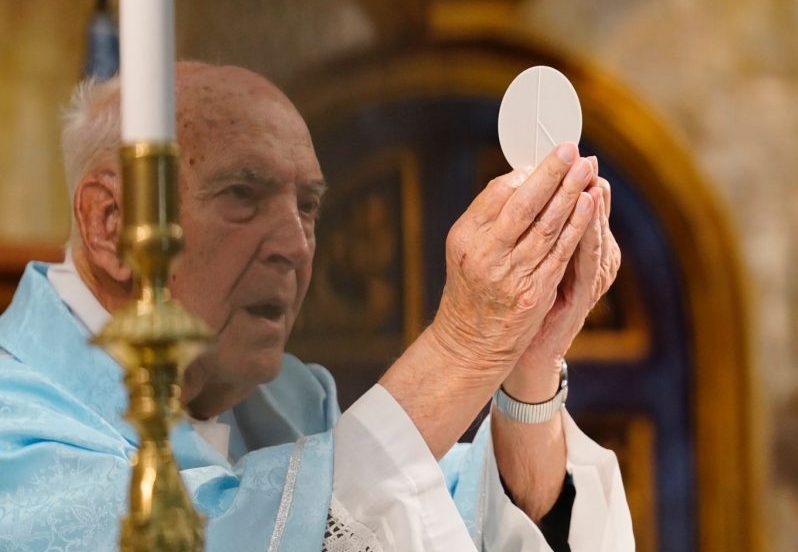
The Church in Cádiz and the Campo de Gibraltar bids farewell to Father Juan José del Junco Domenech, who passed away this Saturday at the age of 100 after an exceptional priestly life that spanned 76 years.
Prelate of Honour of His Holiness, Adoptive Son of La Línea de la Concepción and the first diocesan priest to join the Priestly Society of the Holy Cross, Father Junco leaves behind a profound mark on several generations of the faithful who found in him a close pastor, a tireless confessor and a constant spiritual reference.
The sanctuary of the Immaculate Conception, the church to which he devoted more than four decades of ministry, hosted this Sunday a large memorial service presided over by Monsignor Ramón Valdivia, apostolic administrator of the Diocese of Cádiz and Ceuta. Attendance exceeded expectations. Priests from across the deanery, civil authorities, family members and numerous residents came to accompany the man who for decades was an inseparable part of the city’s religious and social life. At the end of the ceremony, the coffin was bid farewell with a long ovation, a spontaneous expression of the affection he inspired among the people of La Línea.
Born in Tenerife on 4 March 1926, Juan José del Junco was ordained a priest on 26 June 1950 in Cádiz at just 24 years of age. Shortly afterwards he was assigned to the parish of the Sacred Heart in La Línea, beginning a lifelong connection with the city. In 1958 he began serving at the parish and sanctuary of the Immaculate Conception, where he carried out most of his ministry and served for twenty years as dean.
His pastoral work extended well beyond the parish. He taught Religion at the former Diego Salinas Institute, promoted the traditional pilgrimage of the Immaculate Conception, oversaw major improvements to the sanctuary and spiritually accompanied thousands of families across several generations. Many residents received from his hands the sacraments of baptism, marriage or the final farewell to their loved ones.
In May 1952 he joined the Priestly Society of the Holy Cross, becoming the first secular priest to belong to this institution linked to Opus Dei, dedicated to fostering the holiness and spiritual formation of the diocesan clergy. Throughout his life he carried out an intense ministry of spiritual direction for both priests and laypeople.
Father Junco personally knew St Josemaría Escrivá and maintained a close relationship with some of the first members of Opus Dei. In 1972 he was introduced to the founder of the Work by Father José Luis Múzquiz, one of the three first priests of the institution and currently in the process of beatification. According to testimonies collected by Opus Dei, St Josemaría showed him a special gesture of affection at a time when he was suffering from a throat ailment that hindered his preaching. For years he also received visits in La Línea from Múzquiz himself, who promoted the expansion of Opus Dei in the United States.
His deep Marian devotion was another hallmark of his spirituality. He promoted the construction of a chapel dedicated to Our Lady of Fatima, where he celebrated Mass every 13th of the month for many years. Even when age and illness limited his mobility, he continued to devote long hours to prayer, confession and the spiritual care of those who came to him.
Although he formally retired in 2001, he never abandoned the ministry. The bishop authorised him to celebrate the Eucharist in his home and to reserve the Blessed Sacrament. Until an extraordinarily advanced age he continued to serve as confessor and spiritual director. In fact, he kept celebrating Mass even after turning one hundred, becoming a singular example of priestly fidelity until the end of his days.
Public recognition accompanied his final years. The City Council of La Línea awarded him the title of Adoptive Son of the city, and a street near the sanctuary bears his name. In 2018 the Holy See wished to honour his career by granting him the title of Prelate of Honour of His Holiness.
The death of Father Junco marks the passing of one of the most beloved and respected priestly figures in the Campo de Gibraltar. His long presence in the same community, his constant availability to the faithful and his perseverance in ministry until the end have made his life a particularly eloquent testimony in an era marked by a shortage of vocations and the growing fragility of many parish communities. With him disappears a generation of priests for whom pastoral service knew neither retirement nor expiration date.