


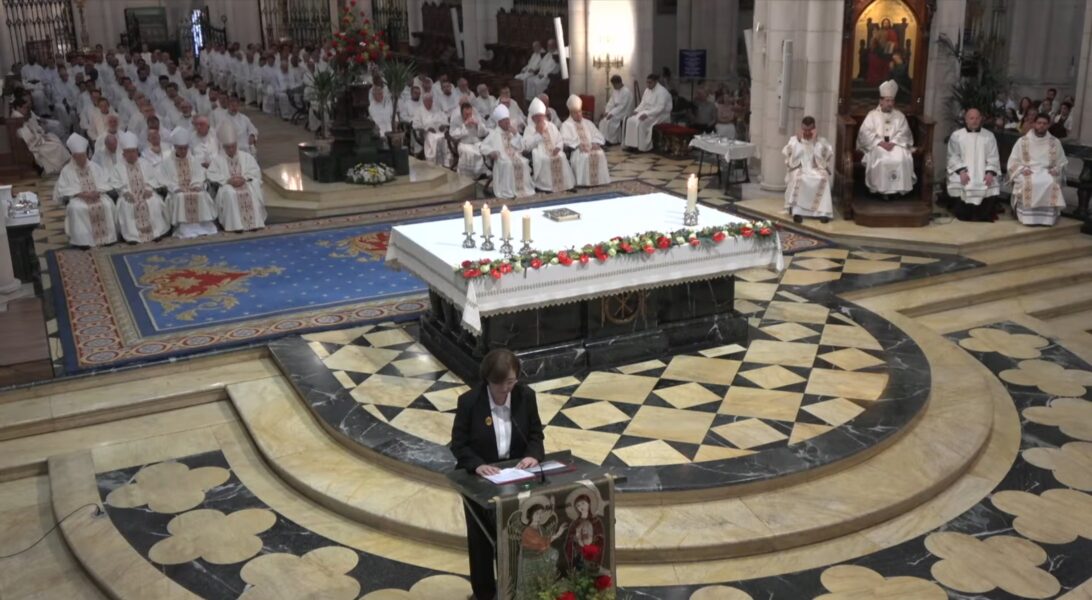
Cardinal Archbishop of Madrid José Cobo presided this Saturday at the Almudena Cathedral over the Eucharist with which the Neocatechumenal Way commemorated its sixty years of existence. The celebration, coinciding with the solemnity of the Most Holy Trinity and on the eve of the visit of Leo XIV to the capital, served the prelate to thank the evangelizing trajectory of the itinerary founded by Kiko Argüello and Carmen Hernández and to underscore ecclesial communion, diocesan integration, and respect for personal conscience.
The Eucharist was concelebrated by Cardinal Antonio María Rouco Varela, Archbishop Emeritus of Madrid, and was attended by the initiators of the Way, Kiko Argüello and Father Mario Pezzi. Before the readings, María Ascensión Romero Antón, one of the leaders, delivered a brief homily on the Word. This intervention by a layperson preaching during the celebration of Mass is part of a customary practice in the celebrations of the Way which, strictly speaking, conflicts with number 66 of the General Instruction of the Roman Missal—which reserves homiletic preaching to the ordained minister and expressly excludes entrusting it “to a layperson”—and with canon 767 §1. The letter from the Congregation for Divine Worship dated December 1, 2005, allowed brief admonitions before the readings in these communities, provided they do not take the form of a homily; on that basis, a modality has been tolerated that would not be permitted in ordinary parishes.
From the shacks of Palomeras to the cathedral
Cobo placed the origin of the Way “among the shacks of Palomeras Altas,” in Vallecas, six decades ago, and described it as “the seed of the Gospel” welcomed by the Church of Madrid “on the eve of the Council.” He did not omit mention of then-Archbishop Casimiro Morcillo, “who recognized in it a call of the Spirit for the evangelization of the whole Church,” nor the remembrance of the founders:
“It is no coincidence that it arose there: God usually sows his most fruitful works in places the world scarcely notices, and with concrete persons like Kiko, Carmen, and so many others who have come since.”
The archbishop also took the opportunity to recall that the diocese has opened the cause of canonization of Carmen Hernández, who died in 2016 and was co-founder of the Way.
The Trinity as an ecclesiological key
A large part of the homily focused on the Trinitarian mystery as the foundation of ecclesial communion. Citing Lumen gentium, Cobo recalled that “God did not will to sanctify and save men individually, but by constituting a people who would share in Trinitarian communion,” and stressed that the Church “is not simply an organization or a sum of persons; it is communion.”
From this principle the archbishop drew a practical consequence reiterated throughout the text: diocesan integration. “We need to continue taking new and creative steps toward integration in diocesan pastoral work from each of the communities, presences, and parishes,” he stated.
A call to examine attitudes, with words of Leo XIV
Cobo recalled that the anniversary invites “a continual call to renew and examine our attitudes and ways of proceeding with regard to ecclesial communion,” and in this regard quoted an address by the Pontiff to the Way, dated January 19, 2026:
“Charisms bear fruit and enrich the People of God when they are ‘in communion with the other gifts present in the life of the Church.’”
The cardinal insisted that the variety of charisms “has as its purpose the unity of the ecclesial body” and that these “are not the exclusive property of those who receive and exercise them.” Communion, he clarified, “is not homogenization or the disappearance of differences, but avoids all division, confrontation, or opposition to what is different.”
The “tabernacle” of conscience
The homily also devoted a passage to conscience and personal freedom. Commenting on Gaudium et spes 16, Cobo recalled that conscience “is man’s most secret core and sanctuary where he is alone with God”:
“Secret. Sanctuary. Alone with God. No one has the right to substitute anyone else’s conscience, nor to impose one’s own voice as the voice of God.”
The archbishop added: “Today we have a special sensitivity that obliges us to be very careful in these matters, always respecting the sacredness of each conscience and the personal path that each one must follow,” and called for “exquisite respect for the path, freedom, and conscience of each person” and for “patient listening to those who doubt.”
“Balance sheets” are not the measure of the Kingdom
In the final section, and already in view of the imminent papal visit, Cobo invited the assembly to “lift their gaze” and not to seek “refuge in safe harbors,” citing an image from Francis to La Civiltà Cattolica (2017) that, he recalled, “Pope Leo has repeated” before the Theological Faculty of Apulia on March 2. The archbishop warned against the temptation to measure evangelization by its yield:
“Our reward is not numerous responses; the effectiveness of the Kingdom does not imitate the business effectiveness of ‘balance sheets.’ Our pay is having been chosen and sent by the Lord.”
The Eucharist was celebrated on the eve of the visit of Leo XIV to Madrid, whose Corpus Christi procession will pass through the streets of the capital. The full text of the homily, released by the archdiocese, is reproduced below.
Complete homily of Cardinal Cobo
Eucharist for the 60th anniversary of the Neocatechumenal Way. Almudena Cathedral, May 30, 2026.
Sixty years ago, among the shacks of Palomeras Altas, an experience was born that sought to proclaim that Jesus Christ continues to go out to meet every person, especially those who feel forgotten. It is no coincidence that it arose there: God usually sows his most fruitful works in places the world scarcely notices, and with concrete persons like Kiko, Carmen, and so many others who have come since.
That seed, on the eve of the Council, was welcomed and discerned by the Church of Madrid, thanks to the gaze of Casimiro Morcillo, who recognized in it a call of the Spirit for the evangelization of the whole Church. Sixty years later, we give thanks for the fidelity of God, who continues to raise up new paths to proclaim the Gospel and calls the Church to face the challenges of each age from the Word of God, liturgical life, and community.
1. We celebrate this feast on the solemnity of the Most Holy Trinity; it is the solemnity that speaks to us of God himself: the mystery of three Persons who live in a communion of love and who are the center of our faith.
Faith in this mystery leads us to realize that it is God himself who has entered into communion with us. Because we have been created in the image and likeness of this triune God, a communion of love. In the end, we carry in our DNA the vocation to fraternity, to coexistence and interpersonal relationship, to communion.
2. The mystery of the Trinity is rooted in the very being of the Church.
That is why the Church can only be truly understood when we look at its origin: it is born of the love of the Father, the Son, and the Holy Spirit. It is not simply an organization or a sum of persons; it is communion. A communion that sinks its roots in the Trinity and is expressed in the richness of vocations, charisms, and ministries that the Spirit raises up for the good of all.
We are a pilgrim people who walk together, learning to live diversity as a gift. Every Christian community is called to reflect that unity whose source is God, in communion also with those who have gone before us in faith and already share in the fullness of the Kingdom.
From baptism in the name of the Father, and of the Son, and of the Holy Spirit springs our identity as the People of God. Thus you have lived it by committing yourselves to the revitalization of the baptismal journey and the importance of the laity.
There Christ clothes us with himself (cf. Gal 3:27), makes us children of God by the Spirit, from which the Church is born (cf. Synod, Final Document, 15).
As the Council recalled, God willed to sanctify and save men not individually, but by constituting a people who would share in Trinitarian communion. (LG 9)
That is why the communion of the Church is not lived in an abstract way. It takes concrete form in a specific reality: the diocese, which is a portion of the People of God entrusted to each bishop and which forms part of the one Church of Christ. (SC 26). A diocesan Church that you are called to build and to collaborate with cordially.
Today we renew this, because it is there that faith becomes community, mission, and service. With this path we have begun, we need to continue taking new and creative steps of integration in diocesan pastoral work from each of the communities, presences, and parishes.
3. Contemplating, on this anniversary, the mystery of the Trinity suggests a continual call to renew and examine our attitudes and ways of proceeding with regard to ecclesial communion in the daily life of your communities in this local Church, as the Holy Father recently reminded you (19.01.2026).
It is a call to live your own spirituality, your charism as a gift of the Spirit, far from all self-enclosure, as builders and witnesses of communion, a reflection of the Trinity in the communion of the Body of Christ which is the Church.
A communion that is not homogenization or the disappearance of differences, but that avoids all division, confrontation, or opposition to what is different; always remembering that the variety of charisms, which has its origin in the freedom of the Holy Spirit, has as its purpose the unity of the ecclesial body; they are not the exclusive property of those who receive and exercise them, but are given for “the common good” (1 Cor 12:7) of the whole body of the Church. (cf. Synod, Final Document, 57)
Charisms bear fruit and enrich the People of God when they are “in communion with the other gifts present in the life of the Church.” (Leo XIV, 19/01/2026)
The Synod has taught that walking together in the diversity of charisms and ministries is an effective sign of the presence of the love and mercy of God the Father in Christ. (cf. Synod, Final Document, 120)
4. The texts that the liturgy proposes to us today are, once again, calls from the Lord for our present. They invite us to look to the future with hope and to continue walking together in a synodal and missionary Church, which becomes concrete in each diocesan Church.
The Book of Exodus reveals to us the deepest name of God: compassionate and merciful (Ex 34:5). Jesus, walking with humanity, shows us the face of that mercy by revealing God to us as Father, a love that seeks, forgives, and always lifts up. That is why all of us have experienced that mercy which teaches us to live not from judgment or superiority, but from the humility of knowing ourselves to be sinners who are loved and saved.
The Gospel reminds us that we all live by the grace we have received. Only from that experience can we build truly evangelical communities, where each person is welcomed with the same patience, tenderness, and compassion with which God welcomes us. Faced with the temptation to judge those who think or live the faith differently, we are called to remember that mercy is the foundation of our Christian life.
You know very well that in the proclamation of the Gospel this dimension of mercy can never be lacking, as the heart and center of preaching, which fills the heart with feelings of interior freedom and hope. This is also a personal journey.
God embraces us in Christ, and asks us to respect exquisitely the path, the freedom, and the conscience of each person. In truth we know, with Saint Paul, that “where the Spirit of the Lord is, there is freedom” (2 Cor 3:17).
That holy freedom reminds us, with the Second Vatican Council, that conscience “is man’s most secret core and sanctuary where he is alone with God” (GS 16). Secret. Sanctuary. Alone with God.
No one has the right to substitute anyone else’s conscience, nor to impose one’s own voice as the voice of God.
Today we have a special sensitivity that obliges us to be very careful in these matters, always respecting the sacredness of each conscience and the personal path that each one must follow.
The centrality of mercy means that each one of us, feeling ourselves awaited and welcomed by the paternal embrace, feels worthy, because the same God restores to us the dignity of his children; we celebrate with him and allow ourselves to be given the ring of the family of the children of God, like the one the prodigal son receives.
It is a mercy that in Jesus also embraces all human suffering and misfortune; it becomes a search, a welcome, a consolation for those who have no hope: “Come to me, all you who are weary and burdened, and I will give you rest.” (Mt 11:28) His mercy welcomes the person in his or her totality. And it teaches us to look with compassion wherever there is pain and anguish, meaninglessness and searching; it teaches us who our “neighbor” is so that we may offer him welcome, listening, care.
This is central, because these attitudes and actions are also an announcement of Jesus, who defined himself by his works of charity when asked who he was: tell John what you have seen and heard: the blind see, the lepers are cleansed, the poor have the good news proclaimed to them… (cf. Lk 7:18-23).
5. The Church of Madrid and its bishop wish to thank the Neocatechumenal Way for its evangelizing journey, over these 60 years, in so many environments of this city.
In this Church you took your first humble and poor steps in the neighborhood of Palomeras in Vallecas, like the seed of the Gospel, accompanied by the Church, ever Mother and Teacher, always close to encourage and at times to correct.
We give thanks to God with you, in a particular way for the evangelization of families and of all those who have allowed themselves to be touched by the proclamation of the beauty of the Gospel.
Thank you for this path in which you have generously shared in the mission of this Church that is on pilgrimage in Madrid. Gestures of holiness have not been lacking among you, and we rejoice that we have initiated, in our diocese, the cause of canonization of Carmen.
6. On the eve of the Pope’s visit, the Word of God encourages us to welcome the invitation to “lift our gaze” in the proclamation of God’s love for the world: God sent his Son into the world, not to condemn it but to save it (cf. Jn 3:17), as we have just heard in the Gospel.
Enfolded by the whole Church, it is time to “Lift your gaze,” Duc in altum (Lk 5:4), without fear of leaving the safe shore, where we are recognized and applauded.
The Catholic should not fear the open sea, should not seek refuge in safe harbors,” as Pope Francis said (to La Civiltà Cattolica, 9/02/2017) and as Pope Leo has repeated (to the Theological Faculty of Apulia, 2/03/2026).
The missionary disciple risks taking the boat into the deep sea; he may even experience the failure of fishing all night and catching nothing; because the sending, the mission, involves proclaiming Jesus, but not remaining satisfied with an abundant catch.
Our reward is not numerous responses; the effectiveness of the Kingdom does not imitate the business effectiveness of “balance sheets.” Our pay is having been chosen and sent by the Lord.
Therefore, do not hesitate to enter into dialogue with our society in its most complex realities, from which a fruit of conversion is not always to be expected; because the proclamation aims for Jesus and his Gospel to be known, while respecting the response and the path in freedom that each person chooses to give concrete form to that response.
Spend time in patient listening to those who doubt, in welcoming those who have lost hope and only seek affection and understanding.
Lift your gaze and welcome the call that the whole Church makes to receive the Synod and to build a Church more capable of nourishing relationships with the Lord, among men and women, in families, in communities, among all Christians, in social groups, convinced that this task is decisive for the witness that the People of God is called to give in history. (cf. Final Document, 50)
Jesus does not dismiss anyone, but stops, welcomes, and listens to each person where his or her story and freedom are (cf. ibid., 51).
Sixty years after that small seed, the Church of Madrid gives thanks to God with you and encourages you to continue proclaiming, with humility and joy, that Christ is risen, that God loves every person, and that together we will renew the paths and challenges that this God, the Trinity, presents to us.