


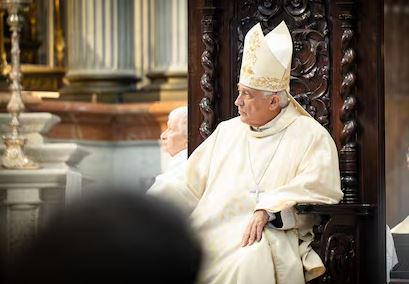
The Archbishop of Seville, José Ángel Saiz Meneses, has confirmed that the Dicastery for the Doctrine of the Faith has closed the investigation into the emeritus Bishop of Cádiz, Rafael Zornoza, after it was not possible to prove that the alleged victim was a minor at the time of the reported incidents. However, the case is not definitively closed and could be reopened by decision of Pope Leo XIV.
Saiz Meneses stated that the Archdiocese of Seville submitted all the documentation requested by the Holy See and acted in accordance with the Church’s current regulations. The archbishop added that, for the time being, there have been no further communications from Rome beyond the Dicastery for the Doctrine of the Faith’s decision to declare itself incompetent to continue the procedure.
Doctrine of the Faith closes the procedure
The case reached the Vatican following a complaint of alleged sexual abuse attributed to Rafael Zornoza in the 1990s. The investigation was placed in the hands of the Dicastery for the Doctrine of the Faith, the body responsible for examining crimes committed against minors by members of the clergy.
Nevertheless, the lack of conclusive evidence regarding the alleged victim’s minority at the time of the incidents led the dicastery to close the procedure.
Saiz Meneses defended the actions of the Archdiocese of Seville and stated that the protocols established by the Church for this type of complaint were diligently followed.
The case remains open in other areas
Despite the closure ordered by the Dicastery for the Doctrine of the Faith, experts in canon law maintain that Zornoza’s situation may not have reached its conclusion.
Furthermore, there is a relevant precedent: a report prepared within the Tribunal of the Roman Rota reportedly recommended opening a canonical penal process after analyzing the complaint filed against the emeritus Bishop of Cádiz.
Since the case involves a bishop, any subsequent action would depend directly on the Pope, who is his immediate hierarchical superior within the Church.
Leo XIV’s three options
There are three possible courses of action for the Pontiff. The first would involve personally adopting disciplinary measures without the need to open a formal judicial procedure, as occurred in the past with Scottish Cardinal Keith O’Brien.
The second option would be to instruct the Dicastery for the Doctrine of the Faith to reopen the case and examine the facts regardless of the question of the alleged victim’s age, following a similar approach to that used in other recent cases.
The third possibility would involve referring the matter to the Dicastery for Bishops, which could consider disciplinary sanctions if the credibility of the reported facts were deemed established.
Civil claims could also be made
At the same time, the alleged victim could still resort to existing redress mechanisms in Spain.
Among the possibilities mentioned are the Comprehensive Reparation Plan for Victims of Church Abuse promoted by the Spanish Episcopal Conference or the avenues opened by the Ombudsman for cases that can no longer be pursued by ordinary justice due to the statute of limitations on the offenses.
Although the closure agreed by the Dicastery for the Doctrine of the Faith represents a turning point in the case, the existence of other possible canonical and civil actions means that Rafael Zornoza’s situation remains open and pending future decisions from Rome.