


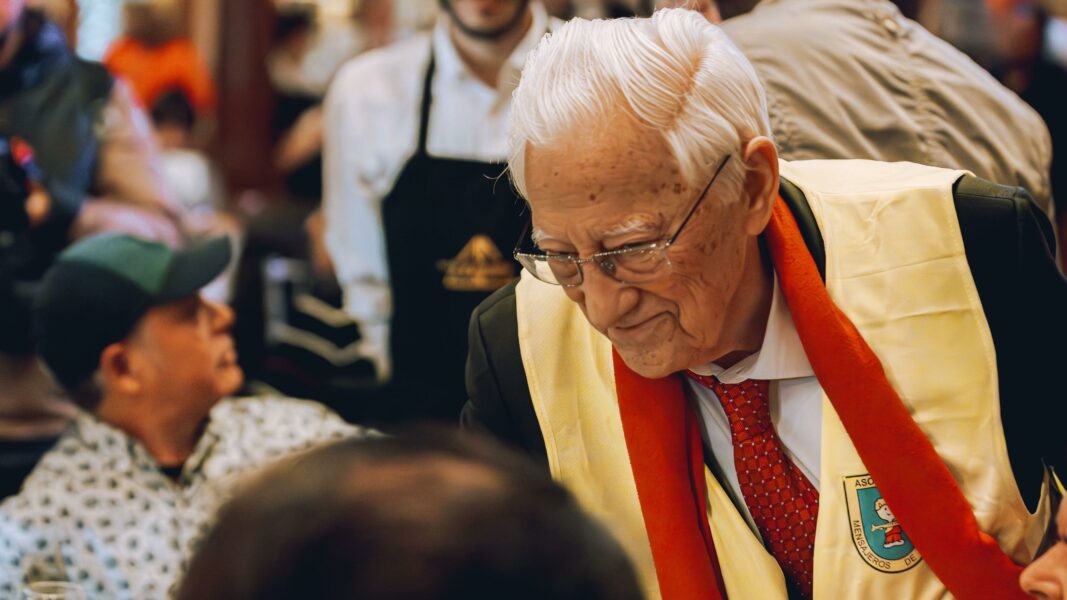
There is a kind of generosity that only flourishes where the bill never arrives. Father Ángel proclaims it this week, having set as the “global priority” of Mensajeros de la Paz “that no one be alone or sleeping on the street,” in the abstract and in the eighty countries where the organization operates. The formula is offered, as is customary in such cases, in tacit contrast with those who speak of national priority—those coarse and presumably fascist subjects who have yet to grasp that the heart, properly trained, knows neither borders nor, apparently, budgets.
It is worth pausing on the word, because the word gives everything away. Priority comes from prior: what comes first, what goes ahead because something, necessarily, must be left behind. To prioritize is to order, and to order is to exclude. A priority that encompasses everything and everyone, that puts no one first because it puts no one last, is not a more generous priority: it is, quite simply, no priority at all. It is the pleasant noise the conscience makes when asked not to decide. To say “my priority is that no one be alone anywhere on earth” is, in operational terms, to have made no priority whatsoever—with the added advantage that the phrase looks beautiful in an annual report presented, of course, at the Fundación Telefónica.
The misunderstanding is old and has a technical name. Almost a century ago, Lord Robbins defined economics as the science that studies human behavior in its relation between ends and scarce means of alternative use. The italics are his, and the italics contain the entire question. Means are scarce; ends are infinite; therefore every euro allocated to hunger in the Sahel is a euro that does not help the elderly person fading away, alone, on a third floor without an elevator in Vallecas. It is not cruelty: it is an accounting identity. Whoever denies that resources are scarce has not attained a higher moral stature. They have simply never had to pay out of their own pocket the cost of their own goodness.
And here, I fear, lies the crux of the matter. It is easier to proclaim global priority when that priority is financed, to a not insignificant degree, by the taxpayer; when a good portion of the centers being managed are public, sustained by regional and municipal budgets, and charity consists of administering, with a Franciscan gesture, money that never came from one’s own purse. Generosity at someone else’s expense has that marvelous quality: it never runs out. One can be prodigal to infinity while someone else picks up the tab. That is why those who have never had to choose between the beggar at their door and the one at the antipodes regard with a certain astonishment, even a certain pity, those who do have to make that choice. From the tower the entire horizon is visible and wonderfully flat; what cannot be seen from the tower are the steps.
What is truly comical—and the adjective is charitable—is that this universalist piety presents itself as the most Christian version of charity when it is, doctrinally, the weakest. Catholic tradition never taught that love should be distributed wholesale and without order. Saint Augustine spoke of ordinata dilectio, ordered love, and Saint Thomas devoted an entire question in the Summa to the ordo caritatis: there is an order in charity, and that order requires attending first to those closest, not out of meanness, but because an obligation that does not distinguish degrees is an obligation that, in practice, obliges nothing. Whoever claims to love all humanity equally often ends up not loving anyone in particular effectively—which, incidentally, is infinitely cheaper and looks far better in the headlines.
No one reproaches Father Ángel for helping the foreigner; far from it. What is pointed out is the alibi: wrapping in evangelical language an operation that consists of denying scarcity, externalizing the cost, and rebranding as spiritual superiority what is, more plainly, the position of someone who has never had to do the math. Vox says national priority and comes across as the miser of the piece. Mensajeros de la Paz says global priority and receives the applause, the illustrated report, and the corporate tax deduction. Both, at bottom, are debating the same thing: how to divide a loaf that is not enough for everyone. The difference is that one acknowledges it and the other has discovered that denying it, besides being free, is profitable.
That no one sleeps alone on the street is a beautiful wish. So is that it rain champagne. The problem begins when desire is confused with policy, and policy with virtue; and the role of saint is reserved for those lucky—or skilled—enough not to pay the bill.