


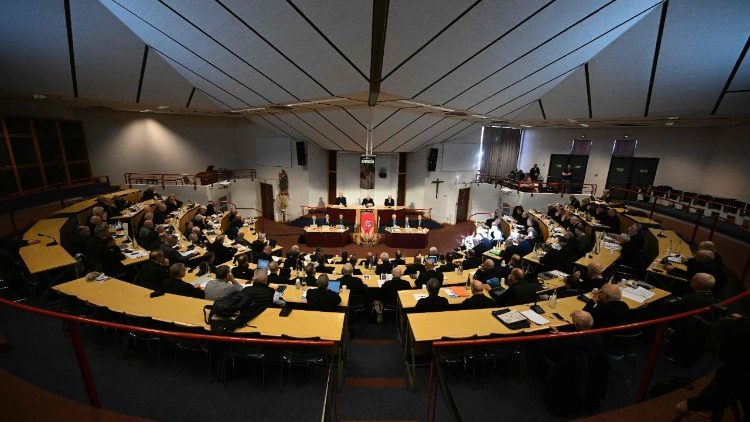
The French Episcopal Conference has raised its voice against a bill that will be debated this Monday, June 1, in the National Assembly and which, according to the bishops, could endanger both the secrecy of confession and the autonomy of Catholic education. The initiative, promoted by the parliamentary group of former Prime Minister Gabriel Attal under the argument of strengthening the protection of minors against violence in the school environment, has provoked a public reaction from the French episcopate.
According to Le Figaro, the bishops express their “great concern” over several provisions of the text, considering that they affect fundamental freedoms such as freedom of worship, freedom of conscience, and freedom of education. Although the French Church supports efforts to prevent abuse and protect minors, it warns that some articles go far beyond that objective.
The secrecy of confession in the spotlight
The bishops’ main concern centers on Article 9 of the proposed legislation. The text aims to require ministers of religion to report any case of violence against minors that comes to their knowledge, even when that information has been received in the exercise of their priestly ministry.
The proposal expressly states that no appeal to the secrecy of confession could override this obligation to report.
This issue affects one of the fundamental pillars of the sacrament of reconciliation. Sacramental secrecy is considered absolutely inviolable, and its violation carries the gravest canonical sanctions for a priest.
The bishops also recall that French law has historically recognized the protection of the professional secrecy of ministers of religion. In this regard, they refer to the case of Bishop Pierre Pican of Bayeux and Lisieux, whose situation was examined by French justice at the beginning of the century. The jurisprudence at that time confirmed the obligation of religious ministers to keep secret what they learned in the exercise of their ministry.
The Church insists that this defense of sacramental secrecy does not imply covering up crimes or obstructing the course of justice. In fact, it recalls that ecclesiastical norms require reporting and acting against abuses known outside the context of sacramental confession, a line that was reinforced during the pontificate of Francis.
New controls on Catholic education
The second major concern of the episcopate relates to education. The bill significantly expands the State’s supervisory powers over state-subsidized private schools, including Catholic schools.
Until now, inspections focused mainly on verifying compliance with official academic programs. The new regulations would allow these inspections to extend to all areas of school life, including their so-called “specific character,” that is, those elements that express their particular identity.
In practice, the measure could affect issues related to moral formation, affective-sexual education, or the transmission of Christian anthropology—areas in which Catholic schools maintain their own criteria inspired by Church teaching.
According to the bishops, the tightening of control mechanisms could even lead to administrative sanctions or the closure of schools.
Fear of greater state oversight
The proposal also includes the creation of an Academic Council for Private Education aimed at strengthening the State’s supervisory capacity over these institutions.
Various Catholic education officials interpret this measure as a further step toward increasing state oversight of state-subsidized schools, progressively reducing the margin of autonomy they have historically maintained within the French educational system.
For this reason, the French Episcopal Conference has decided to intervene publicly before the parliamentary debate to warn of what it considers a simultaneous threat to religious freedom and educational freedom.
Although the bishops acknowledge the need to combat any form of violence against minors, they maintain that the protection of children cannot become an argument for weakening fundamental rights that form part of the French democratic framework and the Republic’s own legal tradition.