


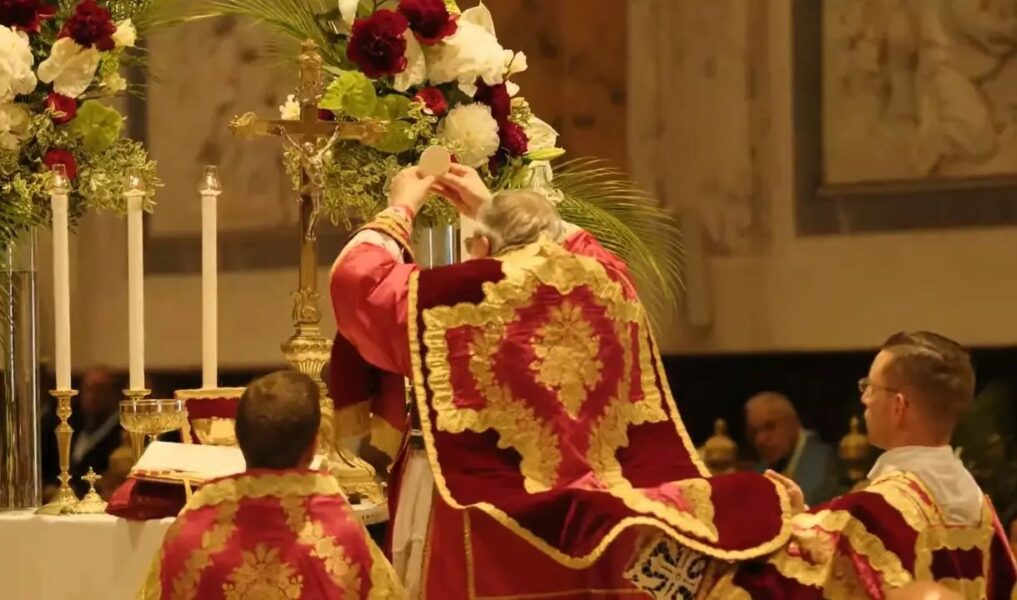
On the Monday of Pentecost, a priest who is a very close friend of mine—so close that he keeps no secrets from me—spoke to me with a mixture of joy and melancholy, in the serene tone of one who does not argue to win, but remembers with love. Throughout this entire week, he told me, while celebrating Holy Mass and praying the Divine Office of the Octave of Pentecost, he experienced an intimate gratitude difficult to explain to anyone who has never lived it.
“You cannot imagine,” he said, “what it is like to wake up each morning and feel that the Church continues to breathe Pentecost; that the Fire has not been extinguished; that the Holy Spirit did not pass fleetingly over the world like a liturgical gust lasting only one day, but that the Church, like a good mother, wishes to linger lovingly over the mystery.”
And he added, with fraternal sorrow:
“It saddens me that the vast majority of priests and nuns today deprive themselves of an incomparable spiritual treasure. It is incomprehensible to me that precisely the feast which crowns the entire liturgical year should have lost its octave! For the ancient Roman liturgy understands that the great mysteries cannot be celebrated in passing. For centuries the Church prolonged for eight days the Paschal feasts of Christmas, the Flowery Resurrection, and Pentecost, knowing that the soul needs to linger in the phase, the passing of God. There is no flower without fruit; if Pentecost is the Pomegranate Pasch, the splendid harvest of the Flowery Pasch, the octave is the gathering of the ripe fruit of that mystery.”
Eight Days beneath the Fire of the Paraclete
My friend then spoke to me of the beauty of these liturgical days. It seemed to me that I could hear the gentle murmur of the ancient monastic choirs, the silent footsteps of the monks going to the night office, the deep sound of Gregorian chant rising in the half-light.
“It is the whole Church,” he said, “living in a pneumatological key! Each day the Holy Mass retains the Gloria, the Creed, the jubilant Alleluia of Pentecost, the Te Deum in the Office. The ancient Ember Days of Pentecost—Wednesday, Friday, and Saturday—add an ascetical depth to this week, yet not with the austere and markedly penitential tone of the Ember Days of Advent or Lent. Here penance is bathed in joy. Everything breathes gratitude for the outpouring of the Holy Spirit. These are days when the Church fasts with her mouth full of Alleluias.”
He then began to bring me texts from the various days of the octave, recalling them almost from memory.
“Accéndat in nobis Dóminus ignem sui amóris et flammam ætérnæ caritátis.” “May the Lord kindle in us the fire of His love and the flame of eternal charity.”
He continued: “Factus est repente de cælo sonus, tamquam advenientis spiritus vehementis.” “Suddenly there came from heaven a sound as of a mighty rushing wind.”
Next: “Repleti sunt omnes Spiritu Sancto, alleluia: et cœperunt loqui.” “They were all filled with the Holy Spirit, alleluia, and began to speak.”
Then he opened the missal to the Ember Days and went on reading: “Caritas Dei diffusa est in cordibus nostris per inhabitantem Spiritum eius in nobis.” “The charity of God has been poured into our hearts by the Spirit who dwells in us.”
And again: “Spiritus Domini replevit orbem terrarum: alleluia.” “The Spirit of the Lord has filled the whole world: alleluia.”
Then, with genuine emotion: “Emitte Spiritum tuum et creabuntur, et renovabis faciem terræ.” “Send forth Thy Spirit, and they shall be created, and Thou shalt renew the face of the earth.”
He continued: “Dum complerentur dies Pentecostes, erant omnes pariter dicentes, alleluia.” “When the days of Pentecost were drawing to a close, they were all together saying: alleluia.”
Suddenly his voice lowered as he reached that ancient prayer: “Adsit nobis virtus Spiritus Sancti.” “May the power of the Holy Spirit be present with us.”
Without pausing, he returned to the sequence: “Dulcis hospes animæ, dulce refrigerium.” “Sweet guest of the soul, sweet refreshment.” “Lava quod est sordidum, riga quod est aridum, sana quod est saucium.” “Wash what is stained, water what is dry, heal what is wounded.”
“Do you see?” he said. “These are not superficial pious formulas. This entire liturgy, saturated with the Word of God, is full of fire, wind, tears, unction, light, combat, spiritual fruitfulness. Everything breathes the Holy Spirit for eight whole days, at every hour! It is a feast that so many do not enjoy.”
Latin, Adoration, and Vocations!
My priest friend returned again and again to certain themes that today seem to have become uncomfortable even within the Church herself: the sense of adoration, the centrality of the Cross, sacred silence, the interior orientation toward God, the beauty of Latin, Gregorian chant, the serene gravity of the sacrifice. He spoke without aggression, without bitter nostalgia, without resentment—rather like one who contemplates a most beautiful cathedral and feels sorrow that so many pass by without entering.
“Latin,” he told me, “is not a barrier; it is an atmosphere: in the liturgy I do not seek to recognize myself, but humbly to enter into something infinitely greater than myself. The traditional liturgy teaches, without speeches, the whole of theology: sacrifice, adoration, co-redemption with Christ, reverent and loving fear of God, divine transcendence, the continuity of the Church through the centuries. It forms priestly and religious souls. And families. And vocations!”
Summorum Pontificum, and the Monasteries That Missed the Opportunity
Here his voice grew especially pained…
“I cannot understand,” he said, “how so many monasteries, so many contemplative communities, so many religious houses that would have found in this liturgy a natural means of safeguarding silence, adoration, and supernatural beauty, did not more decisively take advantage of the possibility opened by Summorum Pontificum.”
He spoke especially of the nuns: of ancient monasteries, already aging, where a more contemplative, more sacred, more organic liturgy, more steeped in silence and mystery, would have attracted many young vocations.
“How many young women,” he said, “are seeking precisely that today: adoration, silence, beauty, radicality, Gregorian chant, Latin, serious choral life, liturgy lived without banalities. And sometimes they have to go far away to find it.”
He then spoke of the twenty thousand young people who each year make the pilgrimage to Chartres in France, or the hundreds who walk to Covadonga on the pilgrimage of Our Lady of Christendom in Spain, or to the Basilica of Our Lady of Luján in Argentina, or the similar initiatives beginning to appear in Portugal as well.
“Many of these young people,” he told me, “would like to find in their own countries monasteries and seminaries where the traditional liturgy is lived naturally and without complexes. And often they have to seek them far away. Or perhaps… alas, they are vocations that are lost.”
His eyes moist, my friend then recalled with immense gratitude the motu proprio Summorum Pontificum of Benedict XVI, that pacifying and profoundly ecclesial gesture by which a wise and humble Pope wished to declare that what had been holy for entire generations cannot suddenly become something suspect or proscribed. And he lamented:
“That freedom was not taken advantage of. Many monasteries could then have rediscovered an immense spiritual treasure. And today they would have grown in both quantity and quality.”
Traditionis Custodes or Tightening the Noose
Later, inevitably, the conversation turned to the motu proprio Traditionis Custodes. My friend spoke without harshness, without condemnations, without a partisan spirit.
“If the title were truly understood,” he said, “bishops would be authentic guardians of tradition. Guardians, not administrators of an imaginary rupture. It is not a matter of confrontations: the Church does not need more internal wars, but rather a good historical memory and the humility to recognize that many treasures were squandered too quickly, absurdly.”
After a moment of silence he added something that impressed me deeply:
“It is difficult to understand that precisely at a historical moment when so many young people are freely rediscovering the traditional liturgy—not out of ideology but out of hunger for God—its vital space within the Church should have been so restricted.”
He immediately explained that what he sees in these young people is not rebellion, nor political nostalgia, nor aesthetic archaeologism.
“What they seek,” he told me, “is adoration, sacrum silentium, logical, harmonious, organic continuity, like the growth of a living body. They want to feel small before God and great only by belonging to the Church of all ages.”
That is why it pained him that some viewed this phenomenon almost exclusively through disciplinary or sociological categories.
“Because when a movement leads people to go to confession, to pray the Rosary, to make Eucharistic adoration, to love the priesthood, to open seminaries, to fill penitential pilgrimages, to awaken contemplative vocations and large believing families, that spiritual current deserves to be accompanied in a fatherly way, not clumsily restrained!”
He added, with serene sadness:
“The most beautiful thing about this liturgy is precisely that it never encloses itself within itself: it always impels toward God, toward holiness, toward Catholic continuity, toward the communion of the centuries. It does not divide, as is said with ignorant or malicious levity: it unites, precisely because it makes one feel contemporary with all the saints!”
Then he smiled faintly: “Perhaps that is why some spoke, with a certain pained irony, of a motu improprio.”
There was no acrimony in his words, only the perplexity of one who contemplates how, in an age that claims to want to listen synodally to every charism, one of the most fruitful and youthful spiritual phenomena of recent decades seems to be regarded with a caution difficult to understand.
Pentecost and the East
The conversation then took an especially beautiful turn.
“Today we speak much,” my friend said, “of drawing near to Eastern spirituality, because the East has wonderfully preserved the pneumatological sense, the experience of the Holy Spirit, the mysticism of the divinization of man. But the Roman liturgy also possesses an immense richness concerning the Holy Spirit that has been allowed to fade away.”
He again cited texts…
“Factus est repente de cælo sonus, tamquam advenientis spiritus vehementis.” “Suddenly there came from heaven a sound as of a mighty rushing wind.” “Repleti sunt omnes Spiritu Sancto.” “They were all filled with the Holy Spirit.” “Spiritus Domini replevit orbem terrarum.” “The Spirit of the Lord has filled the whole world.” “Confirma hoc Deus quod operatus es in nobis.” “Confirm, O God, what Thou hast wrought in us.”
Then he opened his breviary and read me a beautiful patristic lesson from St. Gregory the Great: “Spiritus Sanctus mentem quam repleverit, hanc ad amorem invisibilium rapit.” “The Holy Spirit carries away to the love of invisible things the soul He has filled.” And another from St. Augustine of Hippo: “Ipse est Deus caritas.” “He Himself is God-Love.” And still another from St. Leo the Great: “Pentecostes initium est omnium gentium vocationis.” “Pentecost is the beginning of the vocation of all peoples.”
“Do you understand?” he said. “For eight whole days the Church lives immersed in this ocean of the Holy Spirit. How can this be abandoned without Her suffering a deficit of holiness, of apostolate, of vocations?”
The Breath of the Church as Mother
It amused me and almost moved me to hear my friend speak even of the structure of Matins.
“The Church, who is a mother, even thinks of the fatigue of priests,” he said with a smile. “That is why during the Octave of Pentecost Matins are shorter: in the Roman Breviary, the octaves of Easter and Pentecost have Matins with only one nocturn of three psalms and three lessons. That reduction is not poverty, but delicacy: that certain brevity does not mean lesser solemnity. On the contrary: it is a solemnity so high that it seems to simplify itself by excess of light. As if the Church, dazzled before the Resurrection and ablaze at Pentecost, did not wish to multiply words, but to concentrate them. In the greater octaves—Easter and Pentecost—the night prayer becomes shorter outwardly, yet denser inwardly; less discursive, but more intense; less fatiguing for the minister, yet not less charged with mystery.”
My priest friend spoke like one accustomed to the munus suavissimum of praying, for himself and for the people, the opus Dei:
“It is a liturgical mercy: the Church does not wish to exhaust the priest precisely on the days when She most wishes to gladden him. She takes away some length, but does not stint on depth; She spares fatigue, not contemplation.”
And he was right. For in those days the Office does not lose its grandeur: it retains the Te Deum, the festive tone, the solemn breathing of the mystery. In those of Easter and Pentecost, the great mystagogical octaves of the Christian year, the Church does not change the theme each day, but returns again and again to the same luminous abyss: Christ risen and the Spirit poured out.
“It is like when one stands before something too great,” my friend told me. “One does not need to speak much, but simply to remain there and contemplate.”
He did not speak as a rubricist, but as one in love, because what pained him that his brother priests had lost was not ancient ceremonies, but supernatural density: a way of remaining before the mystery with sacred slowness.
Why Did My Priest Friend Lament?
I understood that if that priest spoke with such emotion of the Octave of Pentecost, it was not out of mere aesthetic nostalgia or liturgical archaeology. Still less from a visceral rejection of the present. What pained him was something far deeper: that the contemporary Church, so much in need of the Holy Spirit, should have eliminated a week in which She learned to let herself be set ablaze by Him.
For the Octave of Pentecost teaches that the Holy Spirit is not a pious memory from twenty centuries ago, but the permanent Fire of the Church. It teaches us to live under His breath, to linger, delighting in Him, allowing ourselves to be fashioned by Him.
While my friend was speaking, I recalled those ancient words that for centuries have resounded in the Roman liturgy during eight delightful days:
“Emitte Spiritum tuum et creabuntur, et renovabis faciem terræ.” “Send forth Thy Spirit, and they shall be created, and Thou shalt renew the face of the earth.”
Perhaps, in the end, my priest friend was not lamenting only a lost octave; perhaps he was grieving, above all, that today we do not take delight in the Consoler, rejoicing for eight whole days beside the living Flame of Love.