


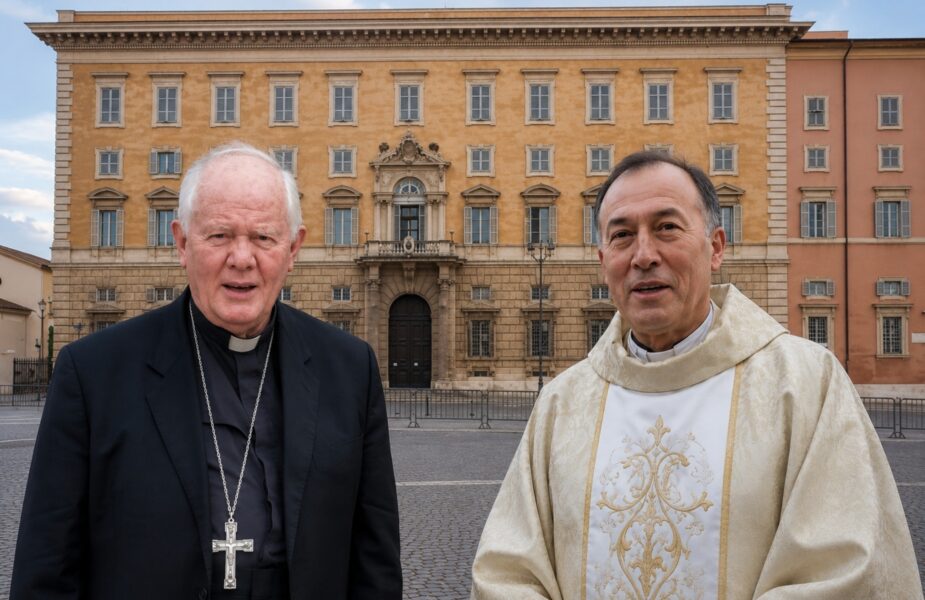
Given the image from Catacaos —two cardinals, two archbishops, and the apostolic commissioner kneeling before the families of the murdered peasants—, it is appropriate to ask the obvious question: must we wait twenty years to deliver justice to the victims who are now demanding it? There are at least two fronts in Peru where the answer must be immediate.
Santarsiero
Against Mons. Antonio Santarsiero Rosa, OSJ, until recently bishop of Huacho and secretary general of the Peruvian Episcopal Conference, there is a formal complaint for the alleged rape of a seminarian in Huacho, who was harassed when the victim was an adolescent and raped shortly after reaching the age of majority, as well as for harassment of a priest who lived with him as his personal assistant in the early years of his episcopate.
The notarial letter, dated March 26, 2026, was delivered by hand to the Apostolic Nunciature in Lima on the 31st of the same month and forwarded to the Dicastery for the Doctrine of the Faith. The complaining priest states that he had previously submitted a report in November 2024 to the then prefect of the Dicastery for Bishops, now Leo XIV; he delivered it personally in Rome in December 2025. No response is on record.
Following the publication by InfoVaticana, the Peruvian Episcopal Conference removed Santarsiero from the general secretariat on April 9, 2026. But the core of his power remains intact: he continues to be bishop of Huacho, retains governance of the diocese, the formation of seminarians, and patrimonial control. To date, no precautionary canonical measures have been adopted in accordance with Vos estis lux mundi. Until Rome acts, the events of April 9 amount to nothing more than an institutional gesture.
Chiclayo: the three victims of Father Lute
The second front is in Chiclayo. Three victims of the priest Eleuterio Vásquez González, known as “Lute,” reported in 2022 to then-bishop Robert Prevost, now Leo XIV, very serious abuses committed against them as girls —between the ages of nine and eleven— whom he took alone to a room in the mountains in front of multiple witnesses who have never even been questioned. The canonical investigation was described by the ecclesiastical delegate himself, Giampiero Gambaro, as a “joke.”
Prevost never suspended Lute from public ministry. The Dicastery for the Doctrine of the Faith archived the case citing Peruvian civil prescription, a canonically untenable argument that Gambaro himself called “most strange.” The priest, facing the imminence of an effective investigation driven by the victims in 2025, requested dispensation from the clerical state. Leo XIV granted it on September 15, 2025, communicated to the victims two months later via a dirty, folded folio, without envelope or seal, delivered by an anonymous messenger.
Nevertheless,the dispensation from the clerical state in no way exempts the obligation to investigate and provide reparation. It is a grace granted to one who consistently renounces the ministry, not a shield to extinguish an open canonical penal process. Processing it pendente lite runs counter to the very principles of the institution.
However, this fallacious reading —according to which the dispensation closes the case and frees the Church from further investigation— has been constructed and legally defended, among others, by Mons. Jordi Bertomeu himself. The same person who yesterday knelt in Catacaos.
Added to this is a decision that speaks louder than a thousand declarations. The diocese of Chiclayo, under the Augustinian Edison Farfán, responsible for covering the victims’ psychiatric treatment and medication as part of the minimum reparation required by Vos estis lux mundi, has cut off that coverage.
Three women who suffered abuse as girls, subjected to years of procedural revictimization, have been deprived of their treatment and medication. The clinical risk is atrocious, and institutional responsibility is undeniable. No possible reparation can exclude the most basic requirement: guaranteeing the psychophysical integrity of the one who has been harmed.
What is asked today
If the gesture in Catacaos means anything —and we want to believe that it does—, it must also mean this: that Santarsiero’s victims deserve the same journey, the same hearing, and the same word “forgiveness,” and that the three victims of Father Lute deserve for their case to be reopened, investigated with guarantees, and judged in accordance with Book VII of the Code of Canon Law, without the granted dispensation serving as a pretext for failing to do so.
And in the meantime, the minimum: that psychiatric treatment coverage and medication for the victims in Chiclayo be immediately restored. The minimum, we repeat. What no decent institution can deny to the one it has harmed.
Because if not, in twenty years another apostolic commissioner will have to travel again, another cardinal will have to kneel again, and another family will have to hear again, in tears, that the Church arrived too late. And to that Church that always arrives late, its faithful are already beginning not to believe it entirely.
May there be no need to ask forgiveness on one’s knees in twenty years. Let us do justice today.