


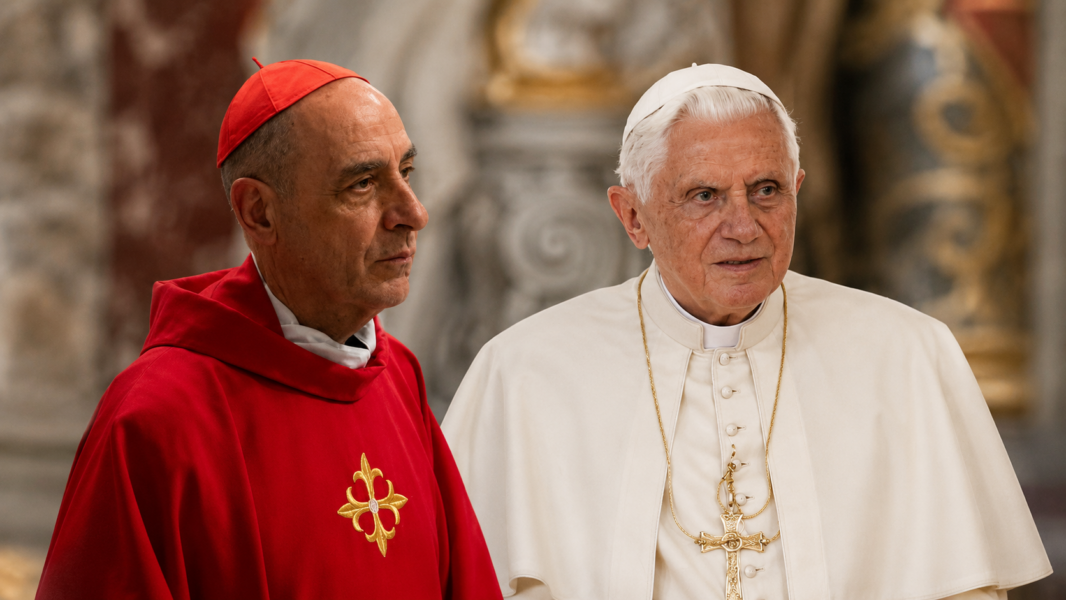
Cardinal Víctor Manuel Fernández, prefecto of the Dicasterio for the Doctrine of the Faith, has publicly questioned a doctrinal notification issued in 2006 against the Jesuit Jon Sobrino, one of the best-known names in liberation theology.
Fernández made these statements on May 12 at the Pontifical Urbaniana University in Rome, during a study day dedicated to so-called “contextual theology”.
A critique of Benedict XVI’s Congregation for the Doctrine of the Faith
The notification against Sobrino was published by the then Congregation for the Doctrine of the Faith, under Cardinal William Levada, and approved by Benedict XVI.
The document examined two works by the Spanish Jesuit theologian and concluded that they contained “notable discrepancies with the faith of the Church,” especially regarding Christology, the divinity of Christ, and the methodological foundations of theological reflection.
One of the central points of the Vatican critique was Sobrino’s assertion that “the poor” constituted a privileged theological locus for Latin American theology. The Congregation responded at the time that the ecclesial foundation of Christology could not be identified with “the Church of the poor,” but rather with the apostolic faith transmitted by the Church.
Fernández defends “contextual theology”
In his intervention, Fernández maintained that many Latin American theologians had difficulty understanding certain aspects of that notification.
In the Argentine cardinal’s view, the problem with the document was that it excessively restricted theology’s point of departure to ecclesial tradition, casting suspicion on expressions such as “thinking from pastoral experience,” “thinking from motherhood,” or “thinking from the suffering of the poor.”
“What we call contextual theology would always be viewed with suspicion,” Fernández stated.
The prefect even said that the notification seemed to indicate that theology elaborated “in the context of the poor” was “inadequate and dangerous.”
The prefect reveals his own problems with the former Holy Office
Fernández also recalled that his defense of contextual theology caused him difficulties with the Congregation for the Doctrine of the Faith more than a decade ago.
He explained that in 2007 he published an article before the Latin American bishops’ conference in Aparecida, arguing that although the faith of the Church remained the fundamental point of departure, there could be other “complementary points of departure” linked to concrete historical situations.
That text was examined again in 2010, when the Argentine episcopate proposed him as rector of the Pontifical Catholic University of Argentina. Fernández stated that the Congregation delayed granting the nihil obstat and asked him to publish a correction.
The cardinal affirmed that, instead of retracting, he published a second article in 2011 in which he reaffirmed his theses, while emphasizing that it is precisely the faith of the Church that allows one to look at the poor as God looks at them.
Continuity with Francis’s thought
Fernández linked his positions to the pontificate of Francis, whom he presented as a defender of the idea that reality is better understood from the peripheries and from the experience of the poor.
The cardinal cited Evangelii gaudium to warn against abstract thought disconnected from reality.
The prefect also sought to support his argument with texts from John Paul II, Benedict XVI, and earlier documents of the Congregation for the Doctrine of the Faith, especially the instruction Libertatis conscientia, published in 1986 under Cardinal Joseph Ratzinger.
An indirect rehabilitation of liberation theology
Although Fernández insisted that contextual theology must remain linked to Revelation and the faith of the Church, his words represent a direct critique of a doctrinal intervention approved during Benedict XVI’s pontificate.
The episode once again highlights the shift taking place in the Dicasterio for the Doctrine of the Faith under the Argentine cardinal’s leadership, more concerned with opening spaces for theological approaches tied to the “peripheries” than with reiterating traditional warnings against the deviations of liberation theology.
The notification against Sobrino occurred in a context of doctrinal vigilance over Latin American currents that, under the legitimate concern for the poor, had been questioned for their risks of Marxist inspiration and ambiguous formulations regarding Christ, salvation, and the Church.
Source: Advaticanum