


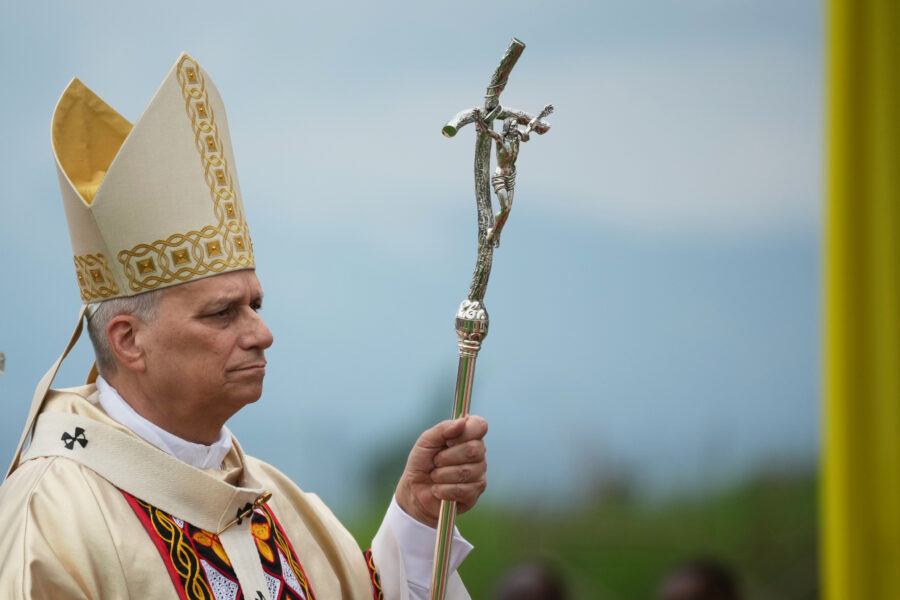
Pope Leo XIV traveled this Saturday to Acerra, in the Italian region of Campania, to meet with the populations of the so-called “Land of Fires,” one of the areas in Italy most severely affected by environmental pollution and the illegal dumping of toxic waste linked for decades to organized crime and networks of corruption.
During his speech in the Cathedral of Santa Maria Assunta, the Pontiff harshly denounced the “dark interests” and the “indifference toward the common good” that, he stated, have “poisoned the natural and social environment.”
“The cry of creation and of the poor among you has been heard here in a more dramatic way, because of a deadly concentration of dark interests and indifference to the common good,” the Pope affirmed.
Read also: Leo XIV travels to the “Land of Fires” to relaunch Francis’s ecological agenda
Leo XIV revives a visit desired by Francis
The Pope recalled that Francis had already expressed his desire to visit this area of southern Italy, although he was ultimately unable to do so. Leo XIV explained that with this trip he wanted to take up that witness and also reclaim the legacy of the encyclical Laudato si’.
“Today we want to fulfill his desire,” he stated, emphasizing that the environmental and social crisis of the “Land of Fires” represents an urgent call to conversion.
The expression “Land of Fires” refers to large areas between Naples and Caserta where, for years, toxic waste was illegally buried and burned, causing serious health and environmental consequences.
“No more fire that destroys”
Leo XIV structured much of his speech around the biblical vision of the prophet Ezekiel and the valley of dry bones. He compared the environmental devastation of Campania to a land turned into death by corruption, crime, and indifference.
“It seems that death is everywhere, that injustice has triumphed,” the Pontiff stated.
However, the Pope insisted that the Christian response cannot be resignation. He praised the work of ecclesial communities that have denounced the situation and accompany affected families.
“You have chosen responsibility,” he noted, encouraging them to continue working for justice and social regeneration.
In one of the most significant moments of the speech, Leo XIV called for the destructive fire to be replaced by “the fire of the Spirit.”
“No more fire that destroys, but fire that revives and warms,” he said.
A call against the culture of privilege and corruption
The Pontiff also directed particularly strong words against what he defined as a “culture of privilege, of arrogance, and of unaccountability.”
“That culture has done immense harm to this land,” he stated.
He urged priests, religious, and ecclesial leaders to exercise authority based on service and closeness, while encouraging families affected by the environmental tragedy not to fall into resentment and to pass on to new generations a sense of responsibility and care for the common good.
The Pope calls for rebuilding from the heart
Leo XIV insisted that social and environmental regeneration begins with the inner conversion of individuals. Citing the prophet Ezekiel again, he recalled the biblical promise of a “new heart.”
“Change in the world always begins in the heart,” he affirmed.
The Pontiff will conclude his visit in Piazza Calipari, where he will meet with mayors and the faithful from various municipalities of the “Land of Fires,” an area that for years has symbolized in Italy the link between environmental degradation, political corruption, and organized crime.
Below we provide the full message of Leo XIV:
Your Eminences, Your Excellencies,
dear brothers and sisters, good morning and thank you for your welcome!
I thank the Lord for the opportunity to meet with you, returning to Campania just a few days after my visit to the Shrine of Pompeii and the city of Naples. You know that Pope Francis had already wished to come here, to this land that has sadly been given the name “Land of Fires,” but it was not possible for him to do so. Today we want to fulfill his desire, recognizing the great gift that the encyclical Laudato si’ has represented for the Church’s mission in this land. Indeed, the cry of creation and of the poor among you has been heard here in an especially dramatic way, because of a deadly concentration of dark interests and indifference toward the common good, which has poisoned the natural and social environment. It is a cry that calls for conversion!
In this cathedral we are living a first moment, the ecclesial one, and I would dare to say, the most familial of my visit. Later, in the square, we will ideally encounter the whole of society. I have come above all to gather the tears of those who have lost loved ones, who died because of environmental pollution caused by unscrupulous individuals and organizations that for too long have been able to act with impunity. But I am also here to thank those who have responded to evil with good, especially a Church that has dared to denounce and to prophesy, gathering the people in hope. Thus, knowing that I was visiting you on the eve of Pentecost, I sought in Sacred Scripture a page that could interpret and inspire your journey. I found it in a magnificent vision of the prophet Ezekiel, taken by the Lord to live an experience that was to become for the exiled people a powerful message of resurrection. Ezekiel recounts: “The hand of the Lord came upon me, and the Lord brought me out in spirit and set me in the middle of a plain full of bones. He made me pass among them in every direction. I saw that there were very many on the surface of the valley, and they were completely dry” (Ez 37:1-2).
Dear brothers, God had placed man and woman in a garden to cultivate and care for it. Everything was life, beauty, and fertility. This land too was once called Campania felix, because it was able to amaze with its fertility, its products, and its culture, like a hymn to life. And yet, here is death—death of the land and of men. We can identify with the prophet’s bewilderment before that expanse of dry bones. We suffer for the devastation that has compromised a wonderful ecosystem, places, histories, and memories. Before this reality, there are only two possible attitudes: indifference or responsibility. You have chosen responsibility, and with God’s help, you have begun a path of commitment and the pursuit of justice.
The Lord then poses a question to Ezekiel: “He said to me: ‘Son of man, can these bones come back to life?’ I answered: ‘Lord God, you alone know’” (Ez 37:3). Dear brothers and sisters, God has new questions for us, questions that broaden our horizon. He knows that we have a heart that seeks life and longs for eternity, but that too easily postpones it to an indefinite and distant time, to a different world that does not yet exist. Ezekiel, instead, must serve his people, the real people, in the concrete situation in which they find themselves. Likewise, our Churches have the mission of making God’s Word resound here and now. This Word asks us whether we believe in its very power: it is a Word of life. If today we are gathered, it is to respond to that Word. And we respond thus: Lord, death seems to be everywhere; injustice seems to have triumphed; crime, corruption, and indifference continue to kill; good seems to have dried up. But if You ask us: “Can these bones come back to life?”, we believe and say: “Lord God, You alone know!” You know that we can rise because You Yourself take us by the hand. You know that our desert can bloom. You know how to turn mourning into joy.
Brothers and sisters, all of this is very concrete: it is a promise that is already beginning to be fulfilled. Pope Francis, in the encyclical Laudato si’, while denouncing a paradigm of death, clearly announced the silent irruption of new life. After listing situations in which people are already starting over together and giving new shape to social and environmental justice, he wrote: “Authentic humanity, which invites a new synthesis, seems to dwell in the midst of our technological civilization, almost unnoticed […]. Will it be a lasting promise, despite everything, that springs forth like the stubborn resistance of what is authentic?” (Laudato si’, 112). Dear brothers, be witnesses of this “stubborn resistance” that becomes rebirth wherever the Gospel illuminates and transforms life. This was taught to us by the Second Vatican Council, especially in the constitution Gaudium et spes. The Lord poses new questions to us about how we live in our neighborhoods, about the willingness to work together among people and institutions, about our educational passion, about honesty in work, about the just distribution of power and wealth, about respect for persons and for all creatures. Can these lands come back to life? Be yourselves the answer: a community united in faith and commitment. Then life will multiply.
And the Lord’s command comes to His prophet: “Prophesy over these bones and say to them: ‘Dry bones, hear the word of the Lord. Thus says the Lord God to these bones: I will cause breath to enter you, and you shall live’” (Ez 37:4-5). Ezekiel obeys and observes: “I prophesied as I had been commanded. While I was prophesying, there was a noise, and I saw a movement among the bones as they came together. I looked, and there were sinews on them, flesh had grown, and skin covered them, but there was no breath in them” (Ez 37:7-8). Thus we understand that the miracle does not happen all at once. The prophet is certainly amazed by what he sees and hears, but it is still not enough; something is still missing. It is the same for us: we must continue to trust, continue to listen, continue to believe. The decisions you have made, the ecclesial journey you have walked, the small and great new beginnings with which you have faced the pain—these are not yet everything. If one stops, one falls back. Indeed, the Lord speaks again to Ezekiel: “Prophesy to the breath, prophesy, son of man, and say to the breath: ‘Thus says the Lord God: Come, breath, from the four winds, and breathe upon these slain, that they may live.’ I prophesied as He commanded me, and the breath came into them, and they came to life and stood on their feet, an exceedingly great army” (Ez 37:9-10).
Brothers and sisters, may the Holy Spirit grant you to see an “army” of peace that rises up and heals the wounds of this land and its communities. No longer the fire that destroys, but the fire that revives and warms: the fire of the Spirit, which kindles the hearts and minds of thousands and thousands of men and women, of children and the elderly, and inspires care, consolation, attention, and true love. You, families struck by death, generate new life by passing on to sons, daughters, grandchildren, and neighbors that sense of responsibility that has too often been lacking until now. Let resentment die, practice yourselves the justice you demand, bear witness to life, educate in care.
And you, ordained ministers, religious sisters and brothers, be living members of this people: manifest each day the authority of service, which lowers itself and draws near, which takes the first step and forgives. A culture of privilege, of arrogance, and of lack of accountability must be dismantled—a culture that has done so much harm to this land, as to many other regions of Italy and the world. May the Spirit blow from the four winds and inspire new forms of proclamation, cooperation, and environmental and social regeneration. There is a spirituality of places, but it depends entirely on the spirituality of persons. Change in the world always begins in the heart. Ezekiel himself, before this prophecy of death and resurrection, announced the renewal of which only God is capable: “Thus says the Lord God […] I will give you a new heart, and a new spirit I will put within you. I will remove from your body the heart of stone and give you a heart of flesh. I will put my spirit within you and make you walk in my statutes and be careful to observe my ordinances. You shall dwell in the land that I gave to your fathers; you shall be my people, and I will be your God” (Ez 36:22, 27-28).
May the risen Jesus grant us to dwell together in this way, capable of welcoming and putting into practice the Word of God, pilgrims here below and citizens of His eternity.