


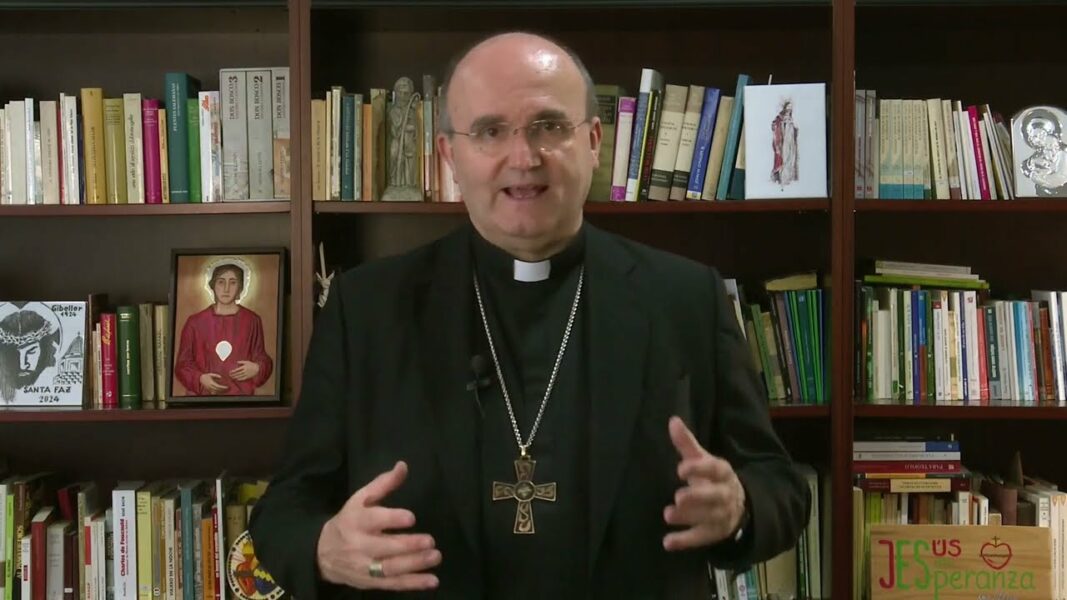
There is a rhetorical figure that deserves a name of its own, because its effectiveness consists precisely in never being finished: the unfinished sentence. Don José Ignacio Munilla wields it with the skill of an old preacher when, on his morning program on the eve of Pentecost, he alludes to those “media outlets that call themselves Catholic” and leaves, with the naturalness of one who knows the listener will complete what he prefers not to sign, the ellipsis suspended in the air. There is no need to finish the sentence. We all understand what follows: media outlets that call themselves Catholic but are in reality Pharisees, violent, racist, instrumentalizers of the faith, agitators who revel in the blood of the adversary. The bishop does not say it; he leaves it said, which is a more comfortable and considerably less costly way of saying it, for it allows him the accusation without the burden of sustaining it and the condemnation without the discomfort of arguing it. Talleyrand, who knew a thing or two about ellipses, would have appreciated the economy.
It is fitting, therefore, to return to the bishop a courtesy he does not grant himself, which is to finish the sentences. If he is going to accuse us—and he is fully within his rights, of course, for that is what microphones, dioceses, and the robust certainty of never doubting that one is on the right side are for—let him accuse us completely. Let him say who, let him say what, let him say when. Because insinuation has an inestimable advantage over assertion: what has not been stated cannot be refuted, and the one who insinuates always keeps the escape route of “I did not say that” while collecting intact the dividends of having suggested it. It is calumny with a built-in alibi, the favorite literary genre of those who have discovered that charity, properly understood, begins at home.
But there is something more interesting than the grammatical cowardice of the half-finished sentence, and that is the asymmetry that sustains it. Let us imagine for a moment that one of those media outlets that call themselves Catholic—let us say, hypothetically, any one of them—were to refer to Munilla himself, or to any other prelate of his stripe, with the formula “bishops who call themselves Catholic.” Let us imagine the scandal. Let us imagine the invocations to ecclesial communion, to the respect due to the successor of the apostles, to prudence, to unity, to the evangelical meekness that a resentful little newspaper will never understand. And yet the formula would be exactly the same, with the same structure, the same venom, and the same ellipsis: bishops who call themselves Catholic, but who in reality. The difference is not in the sentence. The difference lies in who is allowed to utter it. The bishop arrogates to himself the faculty of determining who remains within the margins of Catholicity and who has already been cordially expelled from them—always, of course, those who disagree with him, in such a perfect coincidence between orthodoxy and his own opinion that one begins to suspect that both are conflated in his mind—while those expelled are not even granted the right to return the ball. Here there is an implicit theology worthy of study: that of a magisterium exercised downward and never admitting reciprocity, because judging another’s conscience is an intolerable abuse when others do it and pastoral discernment when one practices it oneself.
The “Raise Your Gaze” video and the straw man
Let us now turn to the substance, because the bishop has the elegance to provide us, in the same program, with two splendid examples of how a straw man is constructed in order to have the pleasure of knocking it down afterward.
The first is the video. The Episcopal Conference has launched a campaign—“Raise Your Gaze”—whose flagship piece shows a subway car full of individuals absorbed in their screens until a voice invites them to lift their eyes and look at one another, to discover that the man with the briefcase and the student, the girl with the polka dots and the boy across the way, share weariness, doubts, and dreams. It is, technically, an impeccable piece. It is also, and this matters more, an advertisement that could serve equally well for a telephone company, a bank with social aspirations, or the Christmas lottery, and which only a final caption hastily attached reveals as a prelude to the visit of the Successor of Peter.
In those ninety seconds of therapeutic feel-goodism, Christ does not appear. His Mother does not appear. The Cross does not appear, nor salvation, nor conversion, nor sin, nor grace, nor a single one of the words that distinguish the Gospel from a course in emotional intelligence. What does appear, to be sure, is empathy. A great deal of empathy. Empathy is the only transcendence the algorithm tolerates without protest, and it is no coincidence that the campaign itself is presented to advertisers as an initiative “against polarization” that “transcends the religious to situate itself in the social debate”: they confess it, not us.
That is the criticism. That, and no other. That the Church presents itself before Spain, on the eve of receiving the Pope, transformed into an agency of indefinite philanthropy that has decided to dispense with the only name that justifies its existence.
Well then: the bishop takes that criticism, folds it carefully, puts it away in a drawer, and pulls out in its place an entirely different one, manufactured by himself to suit his convenience. According to his account, those who criticize the video do so because they desire polarization, because tension suits them, because they need confrontation among Spaniards for their murky political ends; and then, with a sense of timing that would deserve a better cause, he unearths Zapatero’s open microphone from 2008—“it suits us for there to be tension,” “I am going to start dramatizing”—to insinuate that the video’s critics are the spiritual heirs of that strategy, only from the opposite shore.
The maneuver is as flashy as it is dishonest. No one, absolutely no one, has criticized the campaign for a lack of stridency. No one has thought to reproach the Episcopal Conference for the video being insufficiently combative. What is reproached is exactly the opposite of what the bishop pretends to refute: that the announcement of the Gospel has been dissolved in a broth of generic fraternity where Christ is superfluous.
But against that objection he has no answer, and so he does what the polemicist does when the truth becomes uncomfortable: he changes the question. He vigorously combats a position that no one holds in order not to have to defend his own, which is indefensible. To the red and black ants of his parable one would have to add a third species: the one that shakes the jar and then preaches serenity.
The false moral equivalence
And the second example, the gravest, because it no longer concerns strategy but doctrine. The bishop says, with that air of a tightrope walker who has confused equidistance with prudence, that today in Spain there is no party fully identifiable with the Gospel, that all have serious inconsistencies, all of them, and then proceeds to the enumeration: some clash with the defense of life, the family, Christian anthropology; others stray on questions of social justice, migration, or “the dignity of the poor”; others have embraced warmongering discourses; and practically all subordinate the common good to their power strategies.
The sentence has the reassuring appearance of obvious truths—naturally no party is the City of God, of course—and hides beneath that appearance an error that the very Church the bishop claims to serve has condemned in the clearest terms. Because to place in the same enumeration, with the same cadence and the same “all,” abortion and migration policy is to have failed to understand—or to have decided to forget for rhetorical convenience—the difference between what moral theology calls an intrinsic evil and what belongs to the order of prudential judgment.
Abortion is the deliberate suppression of an innocent: an intrinsece malum, an act that no circumstance, no weighing, no further good can render licit. This is taught by Evangelium vitae, recalled by the Congregation for the Doctrine of the Faith in its 2002 note on the political commitment of Catholics, and clarified by Benedict XVI when he distinguished between non-negotiable values and contingent options.
Migration policy, by contrast—how many to welcome, at what pace, under what conditions, in what balance between the duty of hospitality and the real capacity for integration which the Catechism itself subjects to the common good of the host community—belongs to the terrain where legitimately opposed Catholic positions are possible, where the faithful may disagree with the bishop without departing one millimeter from orthodoxy, and where the pastor who seeks to impose his prudential preference as if it were dogma commits precisely the abuse that so indignates him when he believes he detects it in others.
To equate both things, to align them in the same list of “serious inconsistencies,” to distribute reproach with the symmetrical equanimity of one who wishes to please everyone, is not prudence: it is moral relativism in a cassock. It is leveling the mountain and the grain of sand in order to be able to say, satisfied, that after all they are both mere mounds. And the ultimate effect—whether the bishop says it or not, whether he intends it or not—is the perfect alibi for the voter who prefers not to hierarchize anything because to hierarchize obliges, and to oblige is uncomfortable.
Clerical condescension
It turns out, then, that the prelate who so severely reproaches the rest of us for instrumentalizing the Church has, in a single morning of radio, instrumentalized the words of Acquaviva to clothe his convenience in meekness, the anecdote of Zapatero to combat a nonexistent adversary, and the elliptical insinuation to excommunicate without signing the sentence.
All of this, naturally, in a tone he judges charitable and which in reality is the most refined form of pride: that of one who has assigned himself the role of the amiable, the loving, the serene, those who raise their gaze, and has assigned to whoever contradicts him the role of the resentful who revel in blood.
There is no aggression in his voice, it is true. There is something worse: that clerical condescension, soft as the silk glove of the Jesuit maxim, with which he pats the dissenter on the head before leaving him, with infinite pastoral tenderness, outside the walls of Catholicity.
Raise your gaze, the bishop asks of us. Very well. Let us raise it. But let us raise it all the way, up to the heights, up to the Cross, where the only name his campaign forgot to mention is written; and let us not stop it, for charity’s sake, at the comfortable height of his own opinion.