


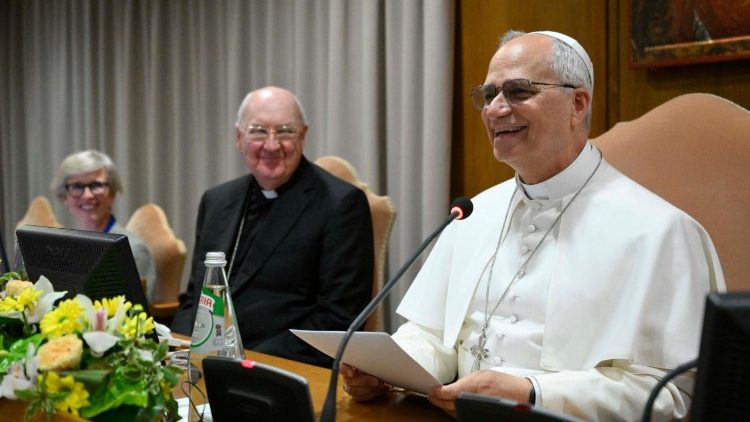
Pope Leo XIV received the international leaders of associations of the faithful, ecclesial movements, and new communities this Thursday in the New Synod Hall. They had gathered in Rome at the initiative of the Dicastery for the Laity, the Family and Life. In a speech with strong ecclesiological content, the Pope defended the value of charisms and movements as “an invaluable gift for the Church,” while at the same time warning against self-referential dynamics, personality cults, and tensions with bishops.
The Pontiff especially insisted that no movement can consider itself “the only Church” or live isolated from the rest of the ecclesial body. Pope Leo XIV also underlined that authority within communities must never become a form of worldly power and recalled the importance of communion with pastors and with the entire universal Church.
We now provide the full message of Pope Leo XIV:
In the name of the Father, and of the Son, and of the Holy Spirit.
Peace be with you!
Dear brothers and sisters, good morning to all!
It is a pleasure to meet with you this morning, to share a few words, some reflections, but above all to reflect on the importance of the charisms of the Holy Spirit, especially in these days leading up to Pentecost.
I am also pleased to welcome you again this year, at the beginning of your gathering. You are international leaders of various lay realities, and you have been convened by the Dicastery for the Laity, the Family and Life to strengthen communion among you and to reflect together on the theme of governing an ecclesial community.
In every social entity there is a need for suitable persons and structures to guide and coordinate common life. At its root, the term “governing” refers to the action of “holding the helm,” of “piloting a ship.” It is therefore a matter of charting a safe course, so that the community becomes a place of growth for the people who belong to it. Likewise, in the Church there are those entrusted with governance.
However, in the Church governance does not arise merely from the need to coordinate the religious needs of its members. The Church was instituted by Christ as a perpetual sign of his universal saving will and is the place, willed by God, where all human beings, in every age, can receive the fruits of the Redemption and experience the new life that Christ has given us. In this sense, the nature of the Church is sacramental: it certainly has an external and institutional dimension with its structures, and at the same time it is an effective sign of the communion through which we share in the very life of the Trinity.
These distinctive characteristics of the Church are necessarily present also in its governance, which is never merely technical; on the contrary, it has within itself a salvific orientation, that is, it must tend toward the spiritual good of the faithful. In fact, Saint Paul includes it among the charisms: “There are miracles,” he writes, “then the gift of healing, of assisting, of governing, of speaking in various languages” (1 Cor 12:28).
With these premises in mind, let us now turn our gaze to associations of the faithful and ecclesial movements. Here governance is generally entrusted to the laity and expresses participation in Christ’s munus regale received in Baptism. It is placed at the service of the other faithful and of associative life, and is the result of free choices, which must be understood as the expression of a common discernment: allowing the voice of all to be freely expressed.
If, as we have said, governance is a particular gift of the Holy Spirit, which the members of a community recognize as present in some of their brothers and sisters in the faith, at least three consequences follow. The first is that it must be for the good of all (cf. 1 Cor 12:7), that is, to promote the good of the community, of the association and of the entire Church. Governance, therefore, never can be used for personal interests or worldly forms of prestige and power. The second consequence is that it never can be imposed from above, but must be a gift recognizable in the community and freely accepted; hence the importance of free elections to make it effective. The third consequence is that, as with every charism, the governance of an association is also subject to the discernment of the Pastors, who watch over the authenticity and the reasonable exercise of the charisms (cf. Lumen gentium, 12; Iuvenescit Ecclesia, 9 and 17).
There are some characteristics that must always be present in governance: mutual listening, co-responsibility, transparency, fraternal closeness, and communal discernment (cf. Address to the participants in the General Chapter of the Legionaries of Christ, 19 February 2026). In addition, I would like to remind you that “good governance, instead of concentrating everything in itself, promotes subsidiarity and responsible participation of all members of the community” (ibid.). These are simple indications, but they must always be kept in mind in the exercise of authority.
Dear friends, your associations and movements have diverse origins and possess a well-defined history, identity and ideals. Those who lead them, therefore, assume a delicate task: on the one hand, they are called to guard and value the memory of a living heritage; on the other, they have a “prophetic” role, which involves being attentive to current pastoral urgencies to understand how to respond to new challenges and to the cultural, social and spiritual sensitivities of our time. Only thus, in fact, can one be a Christian, disciple and missionary in today’s society and Church. A part of the prophetic task of those who govern is therefore to favor the opening of the association or movement, and of each of its members, to historical situations. Belonging, in fact, is authentic and fruitful when it is not exhausted in participation in internal activities of the group, but interprets the signs of the times and projects itself outward, reaching out to all, to the culture of the time and to mission fields still unexplored.
Another element of vital importance is communion. Those who govern are called to have a particular sensitivity for the preservation, growth and consolidation of communion. This applies both to the internal life of the association or movement, as well as to communion with other ecclesial realities and with the Church as a whole. Those who exercise a mission of governance in the Church must learn to listen and accept diverse opinions, different cultural and spiritual orientations, and distinct personal temperaments, always striving to preserve, especially in necessary and often difficult decisions, the higher good of communion. This requires a witness of gentleness, detachment, and selfless love toward the brothers and sisters and the community, which serves as an example for all. Here I would like to underline the importance of this dimension of communion with the entire Church. Sometimes we find groups that close themselves off and think that their specific reality is the only one or is the Church, but the Church is all of us, it is much more! Therefore, our movements must truly seek how to live in communion with the entire Church, at the diocesan level. And for this reason the bishop is a very important reference figure, and if a group says: “No, with that bishop we are not in communion, we want another,” that is not right. We must try to live in communion with the entire Church, both at the diocesan level and at the universal level.
From this perspective we can better understand the meaning of fidelity to the foundational charism, which constitutes an indispensable reference for the governance of an ecclesial reality. Every authentic charism already includes within itself fidelity and openness to the Church. To govern faithfully to the foundational charism means, therefore, to find in it the inspiration to open up to the path that the Church goes in the present, not merely limiting oneself to the models, however positive they may be, of the past, but letting oneself be challenged by new realities and challenges, in dialogue with all other components of the ecclesial body.
Dear friends, I thank you for all that you are and all that you do. Associations of the faithful and ecclesial movements are an invaluable gift for the Church. There is great wealth among you, many well-formed people and many good evangelizers; many young people and diverse vocations to the priestly and married life. The variety of charisms, gifts and methods of apostolary developed over the years allows you to be present in the fields of culture, art, the social sphere and work, bringing the light of the Gospel everywhere. Take care of and, with the grace of God, grow all these gifts! The Church supports and accompanies you.
I bless you from the heart, invoking for all of you the intercession of the Virgin Mary, Mother of the Church. Thanks.