


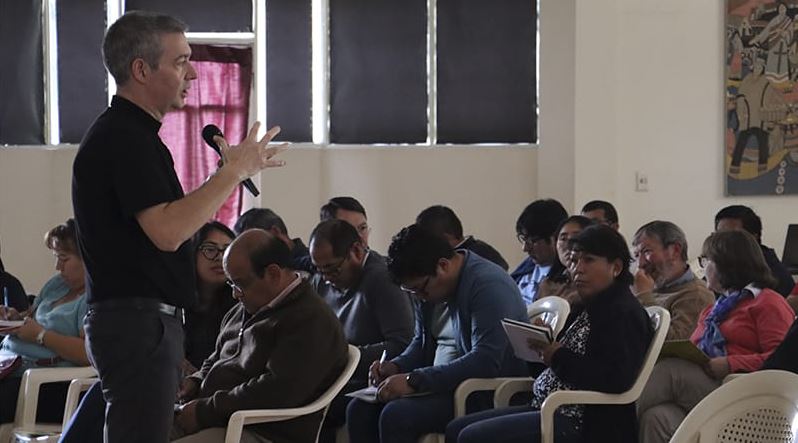
InfoVaticana has had exclusive access to another audio in which Mons. Jordi Bertomeu Farnós, official of the Dicastery for the Doctrine of the Faith and apostolic commissioner for the liquidation of the Sodalicio de Vida Cristiana, describes Peru —the country in which he operates under a pontifical mandate— as “a jungle” where one has to “make do as best one can.” The words, spoken in a casual and relaxed tone, portray with unusual frankness the mindset with which the Tortosa-born official approaches a mission that, by now, no one in the Curia dares to defend without reservations.
The literal transcription of the fragment is as follows:
«Imagine now in Peru. What do you do in Peru. Well, it’s very easy to criticize with first-world eyes, I already know that this is totally incorrect, politically incorrect… but that’s how it is, what happens in a country like Peru, where that is a forest, it is a jungle, and make do as best you can. Then you say: hey Jor, that you want to justify everything… but it is true that there are mistakes that could have been avoided, but it’s not so easy».
It is the logical continuation of a discursive pattern in which Bertomeu, as soon as he moves away from the institutional microphone, allows himself to speak of the country that hosts him with a supremacism improper of any diplomatic official and, much more so, of a priest sent in the name of the Pope to repair the damage caused to some Peruvian victims of ecclesiastical abuses.
A papal emissary who despises the country he investigates
That the pontifical commissioner for a case in Peru considers Peru “a jungle” where each person “makes do as best they can” is not a private opinion that can be separated from his function. Bertomeu is not these days in Lima as a tourist. He is in Lima in virtue of an explicit pontifical mandate, granted first by Pope Francis and confirmed later by Leo XIV, to canonically liquidate the Sodalicio, its branches (Fraternity of the Marian Reconciliation, Servants of the Plan of God, Movement of Christian Life) and, especially, to listen to the victims and articulate their repair.
That is: the priest who calls Peru “a jungle” is the same person to whom the Peruvian victims must recount, one by one, the worst moments of their lives. It is the same person who decides, in the final instance, which complaints are raised to Rome, which files are archived, which economic reparations are proposed and which names are made public. It is difficult to ask a victim to trust their injured privacy to a foreign official who, outside the camera, describes their country as a lawless jungle.
And, however, not is the first time. On April 14, 2025, in an interview on the Catalan radio station RAC1, Bertomeu already had referred to Peru as a country where “the 80% of the economy is submerged,” with “much illegal mining, much drug, much black money that is washed,” a country “tending to corrupt” in which even without firm judicial proof a Prosecutor of the Nation was accused of being “sold” to a lawyer of the Sodalicio. Declarations for which the Civil Association San Juan Bautista —one of the affected by the operation of Bertomeu— formally demanded proofs that the commissioner never provided.
From canonical judge to bar-room geopolitical commentator
The audio to which InfoVaticana has accessed reveals something more than a slip-up. It reveals the mental framework with which Bertomeu operates: that of a European official who feels legitimized to speak of a sovereign country as if it were a tribal zone to domesticate. The phrase “make do as best you can” spoken about an entire country is, literally, the negation of the principle of subsidiarity that the own Bertomeu invoked against the press days ago to justify his model of intervention.
A pattern already documented: arbitrariness, media exposure and conflicts of interest
These declarations arrive in the worst possible moment for Bertomeu. As InfoVaticana has been documenting for months, the model of the pontifical commissioner is under growing questioning:
Structural conflict of interests. Bertomeu was, successively, instructor of the special mission Scicluna-Bertomeu in July 2023, redactor of the report that recommended the expulsions, material redactor of the press notes of the Nunciature on those expulsions, de facto judge of the Dicastery for the Institutes of Life Consacrata and, finally, liquidating commissioner of the institution that he himself investigated. Prosecutor, judge, executioner and notary of his own work, filled with gaps, of excessive media protagonism and of arbitrariness.
Instrumental attempt of excommunication. Bertomeu obtained, according to documented evidence, the signature of a Pope Francis already very deteriorated physically for a penal precept with threat of excommunication against two lay Peruvian journalists —Giuliana Caccia and Sebastián Blanco— whose only “delight” had been to denounce him criminally for alleged violation of professional secret. The own Pope, two months later, declared to the affected not to remember having signed such a precept and it revoked.
A simple question for the Dicastery
The problem is not already Bertomeu. The problem is the model Bertomeu. A system in which an officer of the second rank of the Dicastery for the Doctrine of the Faith accumulates competencies that the Code of Canon Law and Vos Estis Lux Mundi distribute between distinct and controlled instances; in which personal relations in Rome substitute for universal procedures; and in which a whole country, sovereign and Catholic, can be dispatched in private as “a jungle where one makes do as best one can.”
Leo XIV, who knows Peru better than any Pope of recent history —twenty years of pastoral, bishopric in Chiclayo included—, has in his hands a simple decision: or he allows that the model Bertomeu continues to be consolidated as a precedent for future Vatican interventions in Latin America, or he restores once and for all the institutional dignity of the process, returning it to its ordinary channels, blinding the equality of treatment between victims and eliminating the hybrid figures that confuse investigation, judgment, execution and media portavo