


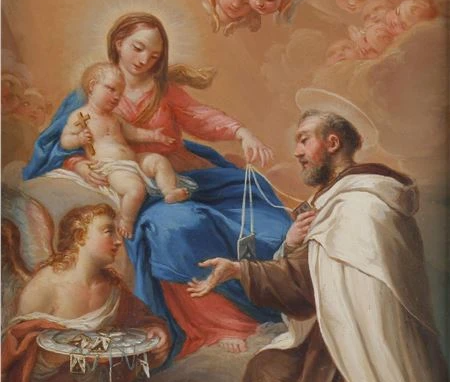
Here is another saint whom modern historians view with a skeptical eye; they weigh documents, debate dates, refine manuscripts, suspect interpolations, and dissect legends with the cold scalpel of criticism. But after all that dissection, the Christian people continue to kneel in exactly the same place as always. This is what happens with Saint Simon Stock. For years, some scholars have relativized or even denied his concrete historicity and that of the Virgin of Mount Carmel’s appearance to him, handing him the scapular. But thousands of Catholics still kiss the scapular with a filial confidence that spans the centuries.
Because if the scapular tradition cannot emerge from a documentary laboratory, it has so thoroughly permeated the prayer, liturgy, iconography, and spiritual life of the Church that it is impossible to uproot it from the Catholic soul.
The Boy in the Hollow Trunk
Simon was a most singular boy. At twelve years old—according to the pious medieval narrative—he withdrew to live inside the hollow of a tree, devoted to prayer and penance. From this came the nickname Stock, meaning trunk. The image has something profoundly biblical and profoundly English at the same time: an adolescent hidden in a tree like a small prophet of the damp forest and gray sky.
Did it happen exactly like that? Let the historians continue debating it: the truth is that the tradition saw in him a man radically in love with God and the Virgin, a contemplative and strong soul, shaped by silence and austerity. Something that fits admirably with the spirit of the nascent Carmelites.
The scapular does not fall from the sky as if it had floated down alone, without history, without hands, without face, without human context. God never works on that way: He uses concrete men, real biographies, and souls prepared over years.
The Virgin came to give the scapular to a man, a strong man in love with Mary, a passionate son of the Lady of Carmel. A religious capable of receiving that gift and transmitting it afterward to entire generations was needed. And here appears Simon Stock. Although some want to blur him into documentary mists, the Carmelite tradition has venerated him for centuries as the great receiver of that maternal confidence of Mary.
“Receive, Most Beloved Son…”
We are commemorating the 775th anniversary (Jubilee Year), because the tradition places the appearance on July 16, 1251. The Virgin would have given the scapular to Simon, distressed by the drift of the Order, both nascent and moribund, saying: «Receive, most beloved son, this scapular of your Order; a sign of my confraternity, a privilege for you and for all the Carmelites. Whoever dies with it will not suffer eternal fire».
Naturally, the theologians have always explained that this promise must not be understood in a magical or superstitious way. The scapular is not an amulet. It is a sign of consecration, of belonging, of Christian life, of filial trust in Mary lived seriously. One cannot empty of supernatural content a tradition embraced for centuries by so many saints, popes, and faithful.
The Popes have spoken of the scapular with immense respect and deep devotion; not as someone who tolerates a medieval naïveté, but as someone who recognizes a true Marian spiritual path.
John XXII disseminated the so-called “Sabbatine Privilege,” which states that the Virgin will take to heaven, the Saturday following his death, those who devoutly wear the scapular and have lived Christianly.
Much later, Pius XII wrote beautifully about the scapular in his letter “Neminem profecto latet” (1950), the most beautiful pontifical text on this Carmelite devotion. There he calls the scapular “a sign of consecration to the Immaculate Heart of Maria” and classifies it as the first among all Marian devotions.
Is it Only a Piece of Cloth?
There is something touchingly Catholic in the scapular. Two small pieces of brown cloth: nothing spectacular or dazzling. Nothing modern. And, yet, behind it, centuries of processions, accompanied agonies, silent conversions, mariners, old women, soldiers, children, entire convents, seminarians, peasants, and the dying.
How many times the scapular was the last object kissed before dying! How many mothers hung it on the necks of their children! How many priests imposed it on the neophyte, trembling a little, aware of giving something infinitely more than a simple external devotion! Because the scapular admirably summarizes the style of Mary: discreet, silent, humble, protective.
I will continue celebrating every 16th of July Saint Simon Stock. And I will continue doing it even if some specialist assures me one day, with a doctoral gesture and impeccable footnote, that he may not have existed exactly as we have imagined. Frankly, I do not care. Because if he did not exist, we would have to invent that old English Carmelite who looks to the Virgin with eyes of an enamored son. We would have to invent that silent man who receives on his shoulders a habit of mercy for millions of souls. We would have to invent that austere friar who appears in the pictures holding the scapular as someone who holds a promise.
But es not necessary to invent him: Simon survives historical criticism by the spiritual force of what he transmits. And the Christian people possess a mysterious instinct of authenticity that does not fit in the notes of an academic edition.
Perhaps the ultimate secret of the Carmelite scapular lies in that: it does not dazzle with the humble brown wool of Mary. It is not a gold crown; it is a small piece of coarse cloth: poor, monastic, homey, maternal cloth.
The Virgin of Carmel did not want to leave her children a jewel, but a garment; not a symbol of power, but of shelter; something placed on the chest, next to the heart. So the scapular still spans the centuries with a force that bewilders the moderns. And it is that the contemporary man, even if he does not confess it, still needs the same that Simon Stock needed: to feel covered by the embrace of a Mother.