


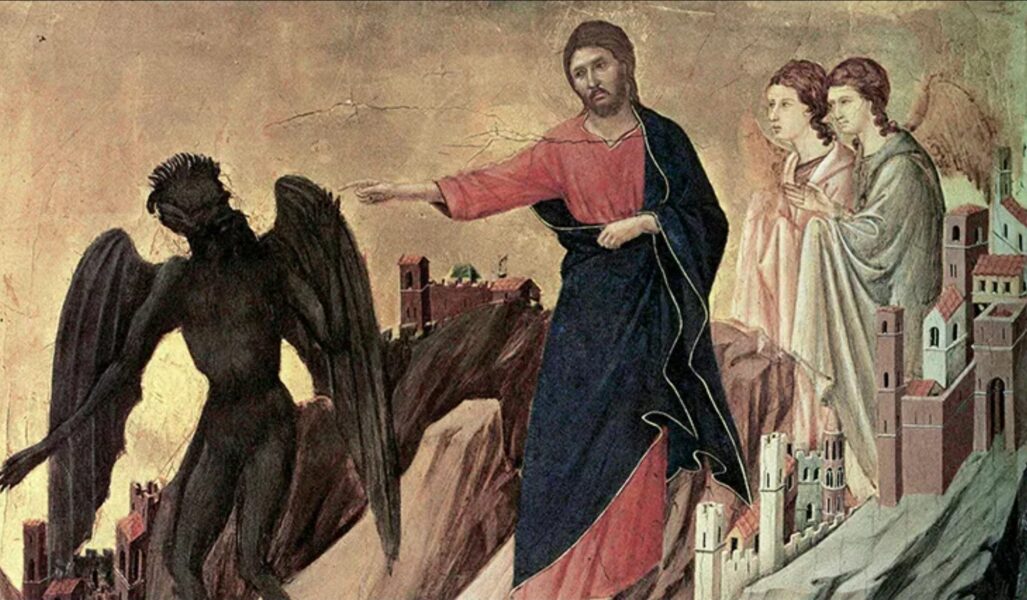
Cardinal Fernández’s note against the FSSPX opens a more serious question than that of selective schism: if Satan tempted Christ and asked to sift Peter, why would he stay away from the dicasteries, the seminaries, and the offices where the faith is guarded, or disfigured?
Yesterday, Cardinal Fernández issued his note again. In it, he «formally» reminded that the episcopal ordinations of the FSSPX constitute a schismatic act, and that schism entails excommunication.
The first thing that catches the eye is seeing such heavy words coming from such a fine pen. Schism! That ancient word, with the metallic sound of Roman warnings, in the mouth of such a youthful cardinal; that grave concept, which retains the ancient weight of ultimate and sacred things, in the mind of a lighthearted cardinal, a lover of modernity and all its trappings.
The brief note must be taken seriously. Apostolic succession is certainly not a private inheritance, and consecrating bishops without a pontifical mandate wounds the visible unity of the Church. But one must ask why Rome pronounces the word «schism» with such solemnity when looking toward Écône and keeps it inside when witnessing the entire colorful and painterly panoply of doctrinal, liturgical, moral, and sacramental ruptures that for decades have entered through the grand door of the official Church.
From that showy procession of chromaticism turned into a program, we have just had a snapshot that is hard to surpass with the recent visit of Sarah Mullally. The Archbishop of Canterbury was received in the Vatican with the forms proper to an ecclesiastical dignity and introduced into a common prayer under the apostolic roof. No brief note has bothered to recall that Leo XIII declared in Apostolicae curae the nullity of Anglican ordinations, and that to this nullity is now added, in a kind of theatrical challenge, the fact that it is a woman. With the utmost naturalness, to a figure that Catholic doctrine cannot consider a bishop under any concept, Rome treats her publicly as if she were, and the amiable choreography of the scene transmits urbi et orbe as much approval as disapproval the dry brief note of Fernández.
It is a «selective» schism: for Pachamama there was inculturation; for Luther, reconciled memory; for equivocal blessings, pastoral discernment; for episcopal appointments under the shadow of the Chinese Communist Party, diplomatic realism; for the cooling of Mariology, ecumenical sensitivity; for fairground liturgies, community creativity. For Tradition, on the other hand, the Code miraculously returns. Suddenly, from the cheerful face of the synodal, liquid, dialoguing, ecumenical Church, hospitable to all oddities and understanding to exhaustion with any deviation, emerges the severe grimace of condemnation: the Dicastery for the Doctrine of the Faith led by the ineffable cardinal recovers the solemnity of the old Holy Office to warn of schism those who preserve the Roman liturgy, Catholic morality, and the doctrine that entire generations of the faithful learned.
But let us leave Victor Manuel Fernández behind, because the novelist cardinal, deviant censor of deviations, is only the suppuration of an internal disease. His permanence at the head of the Doctrine of the Faith expresses one of the most wounding inversions of the post-conciliar period: a renewed Holy Office now consecrated to persecuting Tradition. Who watches the guardians when they lose the elementary discernment to distinguish the friend from the enemy of the faith?
Vargas Llosa put in Zavalita’s mouth that famous «At what moment did Peru get screwed?», a question similar to the one that the Catholic of our time is beginning to ask: at what moment did Rome start to feel more uncomfortable with Tradition than with heresy? The answer does not have a single date, though it does have a foundational word, the shibboleth of an era: aggiornamento. Vatican II presents a historical anomaly that is rarely looked at squarely: while the great councils were born to define the faith in the face of errors that threatened its integrity—Nicaea against Arius; Trent against the Protestant revolution; Vatican I against the siege of rationalism, liberalism, and the new forms of modern impugnment—Vatican II ended up adapting to the world that heresy had already colonized. Modernism reigned in the universities, in the seminaries, in exegesis, in moral theology, in the pastoral imagination of so many clerics who dreamed of a Church «reconciled with the age,» and from then on it also reigned in the Vatican.
It happens that modernism, despite the amiability of the word, of its positive connotations, is what St. Pius X had identified as the synthesis of all heresies. That is, something very serious. So serious that Pope Paul VI, after having opened the doors and windows of the Vatican to it himself, realized that with modernism «the smoke of Satan» had slipped into his Holy See.
And we are not talking about Satan as a metaphor. We are talking about Satan as a personal, intelligent, active reality, enemy of God and souls. The Catholic faith loses its nerve when it reduces the devil to a psychological symbol or a literary remnant of credulous eras. Christ was tempted by Satan in the desert; Judas, seated at the Lord’s table, received his influence until consummating the betrayal; Peter heard from Christ’s lips that terrible «get behind me, Satan» when he tried to divert the Lord from the path of the Cross; and the same Peter was warned that Satan had claimed him to sift him like wheat. Scripture does not place diabolical action on the picturesque margins of religion, but at the very center of the drama of salvation, where fidelity or betrayal is decided.
The spontaneous objection goes like this: how could the Enemy infiltrate the Church, Bride of Christ? The thoughtful response begins by distinguishing what God has promised from what He never promised. Christ promised that the gates of hell would not prevail against His Church; that promise assures the indefectibility of the Bride, the permanence of the faith, the efficacy of the sacraments, the final victory of Christ over the adverse powers. Christ did not promise impeccable pastors, immune dicasteries, incorruptible seminaries, inspired liturgists, docile theologians, or edifying cardinals. The indefectible holiness of the Church coexists, from Judas onward, with the tremendous possibility of betrayal situated within the visible enclosure.
In fact, Christ’s promise presupposes the assault: if the gates of hell do not prevail, it is because they will try to prevail. The image would lack sense if the Church were situated in a glass bell, preserved from all infiltration, from all internal corruption. St. Paul spoke of the mysterium iniquitatis, warned against false apostles, and alerted the presbyters of Ephesus that, after his departure, ravenous wolves would enter and men would arise from among themselves to drag away disciples. «From among you yourselves,» says the Apostle.
The history of the Church confirms that teaching. Arius was a presbyter; Nestorius was patriarch of Constantinople; Honorius was pope; Renaissance prelates turned the curia into a worldly court, and modern Church officials have undone from their cathedras what martyrs and confessors sustained with blood. None of this destroys the Church, but it shows the real field of battle. The Bride remains holy by her Head, who is none other than Christ, not His vicar, by the assistance of the Holy Spirit and by the fidelity of those who, often from humble places, continue believing what the Church received. Her visible members can stain her before men, make her unrecognizable for a time, turn her structures into instruments of confusion and her most venerable words into alibis for practical apostasy.
Yes, diabolical infiltration in the Church is more than possible, expected for anyone who truly believes in the Church. Satan does not waste time where nothing decisive is at stake. His natural interest points to the altar, the confessional, the seminary, the episcopate, the liturgy, the doctrine, the formation of children, the appointment of pastors, the language with which sin and grace are named. If a haberdashery makes a mistake, it will sell bad buttons. If Rome makes a mistake, it can disorient souls. The Enemy knows the difference.