


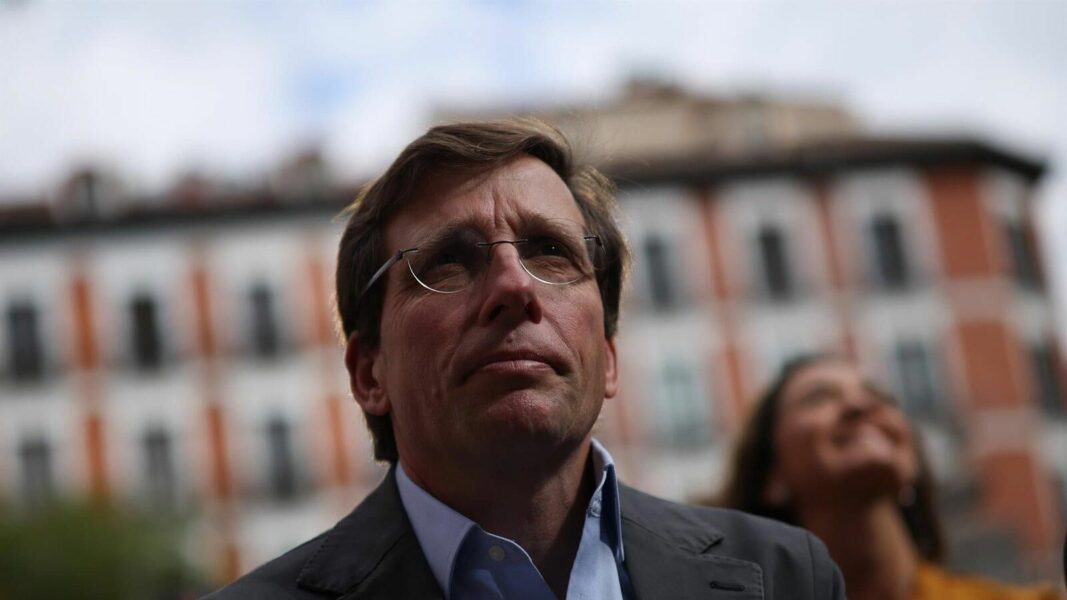
The mayor confesses in a clerical podcast and no one asks him about the rainbow flag, abortion, or the corruption of minors in municipal daycare centers
I. The Interview
The podcast is called Rebeldes and is hosted by a priest, Father Ignacio, along with Pablo Velasco, dean of Humanities at the CEU. The header makes it clear from the first sentence: being a rebel today is following Christ. The idea is attractive, almost heroic. The question is whether it fits the guest.
The guest is José Luis Martínez-Almeida, mayor of Madrid for the Partido Popular. He arrives at the CEU studio with the position, a recent wife, a newborn son, and a solid intention not to disappoint anyone. And he doesn’t disappoint. For over an hour, Almeida unfolds his declared Catholicism with the fluency of someone who has done his homework: large family, Retamar, ICADE, practicing parents, an apostolic mother in CAEC and at the Sagrado Corazón, an Emaús in 2018, daily Gospel reading, devotion to San José, favorite Ave María, private audience with León XIV on the day of the Holy Family. When one of the interviewers asks what he conveys to his son, he replies with the predictable and beautiful: faith first, then values.
He quotes La fiesta del chivo by Vargas Llosa. He has a book on the Nuremberg trials on his nightstand. He makes jokes about Atleti and the meek of heart. He recalls Ángel Herrera Oria with the competence of the civil servant he once was. And in the key moment, the one about the program’s direction, he unfolds his civic creed: «I have never denied that I am Catholic and practicing, because I’m sure many of those who vote for me are not, I’m convinced, but they prefer me to be identifiable and recognizable and to know my values rather than for me to sweeten what I am or what I am not.» Canonical phrase, quasi-confessional: the politician who doesn’t sweeten things.
He also recounts that the Pope gave him three pieces of advice in that audience: be brave, don’t renounce principles, and always respect life and the dignity of the person. Almeida concludes, with the smile of a good boy, that he has no excuse left. The Pope told me, so I can’t make any excuses.
On the Pope’s pastoral visit to Madrid from June 6 to 9, the mayor gives himself fully: logistical challenge, historic opportunity, Madrid’s window to the world, grace poured out over the city. On the Congress, where León XIV will address the parliamentary groups, he defends that the Church must be a sign of contradiction and that he doesn’t feel challenged when the Church opines on what doesn’t suit his party. On immigration, he distinguishes: it doesn’t bother him that the Church defends the dignity of the migrant; what bothers him is how things have been done. On abortion, on marriage, on euthanasia, on gender ideology in public schools, on Cibeles dyed rainbow every June, not a word. Not a question.
And here begins the other thing.
II. The Stick
There is a genre within Spanish religious journalism that consists of whitewashing PP politicians by turning them into exemplary penitents. It has worked for decades. The procedure is always the same: the official is invited, asked about childhood, about the mother, about the rosary, about the favorite saint. He is allowed to confess, without contradiction, that the Gospel impels him, that faith is everything, that God affects every dimension of his public life. And meanwhile, not a single question about what that same official does, votes, signs, illuminates, or consents to from his office. The priest smiles, the dean nods, the official leaves satisfied. Everyone happy, no one uncomfortable. Catholics upon leaving the studio, prudent upon entering the council of ministers, the Vallecas assembly, or the balcony of Cibeles.
This established genre includes the Rebeldes Podcast interview with José Luis Martínez-Almeida. That this is called Rebeldes and is presented, without visible irony, as an exercise in countercultural faith, against the world, against the easy, is the first, and perhaps the greatest, joke of the entire recording. Because rebel, truly rebel, against the world, against the easy, is not exactly the trajectory of the guest.
Let’s review. Almeida is the mayor of the city whose City Hall, headquartered in the Palacio de Cibeles, illuminates the 2,800 square meters of facade with the colors of the LGTBI flag during Pride celebrations; the mayor who, for Pride 2025, has accepted for the first time in three years a municipal poster with a rainbow background emanating from the Palacio de Cibeles itself under the slogan «Freedom and diversity»; the mayor whose municipal government, in the words of the Family delegate, considers that «nothing better than illuminating everyone’s building with the colors of the flag and the fountain of the goddess of Cibeles»; the mayor who, in the face of criticism, dismisses the debate with a disdainful «this is not about flags, this is not about fights and confrontations, this is about policies.» If the problem is the flag, says Almeida, then there is no problem.
Fine. Let’s accept the mayor’s logic for a moment and look at the policies. Almeida belongs to a party whose president, Alberto Núñez Feijóo, has declared that the abortion time-limit law, the one that in 2010 introduced free abortion up to the fourteenth week, seems «correct» and «well constructed» to him. He belongs to a party that in October 2025 closed off to its deputies any possibility of voting in conscience on the constitutional reform that enshrines abortion, not because it has another proposal more respectful of life, but because it considers the debate to be another one. He belongs to a party whose main regional leader, Isabel Díaz Ayuso, president of the community where Almeida is mayor, replied from the Assembly plenary, in response to the government’s demand to prepare the register of objectors: «Go abort in another community,» in the same community where more than 99% of pregnancy interruptions are performed in private clinics, that is, where City Hall, Community, and central Government, in perfect institutional harmony, ensure that the business runs without hitches.
None of this is asked of the mayor. Nor about same-sex marriage, which the PP challenged before the Constitutional Court and to which it later accommodated itself with the naturalness of a lamb settling into the shearing. Nor about trans laws, which Ayuso’s PP applies in Madrid with scrupulous administrative zeal. Nor about Citizenship Education classes, renamed today, expanded tomorrow, which the PP manages in its departments without removing a comma from the ideological frameworks it claims to combat in rallies. Nor about the City Hall that Almeida himself presides over when it authorizes parades, subsidies, concerts, and MADO advertising campaigns with the same signature with which he later signs his attendance at the Corpus procession.
This, it must be said, is not hypocrisy. Hypocrisy requires awareness of the mismatch. What there is here is something else: a perfectly comfortable mental architecture in which personal Catholicism and political management inhabit two different floors of the same building without either bothering the other. The mayor prays the Ave María. The mayor illuminates Cibeles with rainbows. The mayor listens to the first reading of the day. The mayor pays for the Pride parade. The mayor receives advice from the Pope on respecting life and the dignity of the person. The mayor militates in a party that assumes as its own, in parliamentary headquarters, the legislation that denies life and the dignity of the person in its first weeks. There is no tearing. There isn’t even tension. There is peaceful coexistence, lubricated by the spiritual language of lifting one’s gaze and Madrid’s passion for Real Madrid.
That a politician acts this way is legitimate in a democracy. That he presents himself as a model of public Catholicism is debatable. That a program called Rebeldes Podcast, directed by a priest and broadcast on a Church faculty, presents him as such, without posing any of the elementary questions, no longer belongs to the genre of religious reporting: it belongs to that of propaganda. And propaganda in cassock is an old Spanish problem, old enough to deserve a technical name. It has one: clericalism. The historical function of clericalism consists precisely in that: in sanctifying power in exchange for not asking it for anything that power doesn’t want to give.
Let’s go into detail, because it matters. The mayor says, in a notable passage, that the Church has to be a sign of contradiction. He says it elegantly too: that the Church opine even if it bothers him, that it not identify with any party, that it exercise its role. It sounds splendid. The problem is that he says it in a podcast where the Church, embodied in a priest and a Catholic dean, has decided to voluntarily renounce, for an hour and a half, being a sign of contradiction of absolutely nothing. The Church, there, has been a sign of applause. And a sign of applause is not a sign of contradiction: it’s the opposite.
Imagine, as an exercise, the interview that wasn’t done with Almeida. Imagine that after the confession about Lucas, about Teresa, about the deceased parents, about Thomas More’s prayer for good humor, someone had asked: mayor, what will you do with the Cibeles fountain on the next June 28? Will you defend before your party the repeal of the time-limit law, or do you assume, like Feijóo, that it is a correct law? Will you ask Ayuso to withdraw the «go abort in another community» or does it seem to you, as a Catholic mayor, an expression compatible with the dignity of the person that the Pope asked you to defend? Do you consider the Corpus procession through the streets of Madrid compatible with the MADO parade sponsored by the City Hall you preside over? If it is, why? If not, what are you going to change?
None of these questions is offensive, partisan, or sectarian. They are the questions that any priest, in a pastoral setting, would pose to an adult faithful who voluntarily presents himself as a practicing Catholic in a public broadcast. They weren’t asked. They weren’t asked because the program’s genre, Rebeldes Podcast, doesn’t contemplate them. It doesn’t contemplate them because the implicit contract with the guest excludes them. And because the host faculty doesn’t seem willing to discomfort a mayor who attends its events, awards its prizes, recalls Herrera Oria with affection, and signs the institutional agreements the university needs with speed. There are things in which the rock of Peter founds less firmly than the brick of Cibeles.
An additional observation, almost marginal, on the detail of Be brave. The mayor recounts that the Pope, in a private audience, asked him to be brave, not to renounce principles, and to respect life. It is admirable the fidelity with which Almeida transmits the advice. It is regrettable the fidelity with which he then applies it. Courage, in its Christian sense, does not consist of confessing faith before friendly priests and in friendly faculties; it consists of confessing it before enemies, in adverse forums, in plenaries where it costs votes. Courage is not going to Rebeldes Podcast. Courage would be removing the rainbow lighting from the facade of the Palacio de Cibeles and explaining it, without legal excuses and without the shield of the Supreme Court ruling, to progressive voters who also vote for him. That would be a countercultural act. That would be rebellion. The other is the safe routine of someone who already knows that the applause is guaranteed before opening his mouth.
Third observation, and this one about the podcast itself and not the guest. The program closes with a lyrical question: what would you put on a blanket in the sky for everyone to read? The mayor responds opportunely, God’s love is love for one’s neighbor. Good. Let’s remember then where the neighbor is, in the ecclesial order. The neighbor is the migrant that Almeida’s PP criticizes when the Government regularizes, and whom Cáritas, funded by alms and subsidies, attends when the system leaves him on the street. The neighbor is the fetus that the time-limit law, which the PP accepts as correct, leaves unprotected until the fourteenth week. The neighbor is the woman in a street situation for whom the missionaries of Charity in Carabanchel, to whom the mayor says he owes his conversion, interceded before he was anyone. The neighbor is also the taxpayer who is made to pay, via municipal budget, for an LGTBI campaign that his parish priest condemns on Sunday in the homily. All those are the neighbor. Which of them takes priority in each concrete decision is not a spiritual question: it is a political one. And politics, that which the mayor says is the shortest path to the common good, is not resolved with the Ave María. It is resolved by voting, signing, illuminating, budgeting, contracting, authorizing. And it is resolved, above all, by choosing whom to discomfort.
Almeida has chosen. And, it must be said, he has chosen coherently for years: never to discomfort the majority voter in his electoral district, who is not Catholic, nor the media sector of his government partner, nor the president of his community, nor his national boss. Discomforting, on the other hand, the Catholic voter who still trusts his party out of inertia, fear of the left, or lack of alternative, comes free: that voter is not going anywhere because he has nowhere to go. It is captive clientele, satisfied with podcasts, papal audiences, and books on Nuremberg on the nightstand. The calculation is impeccable.
The only thing missing, to close the circle, is for the Spanish Church, its parishes, its seminaries, its universities, its podcasts, to stop providing Almeida with the net on which that calculation is sustained. As long as the Church continues producing Rebeldes Podcast of the type we just heard, the mayor doesn’t need to modify absolutely anything. It suffices for him to continue reading the Gospel in the mornings, turn on the rainbow lights in June, and pray the Ave María in August.
Let each one judge whether that, according to the dictionary, is called rebellion or something else.