


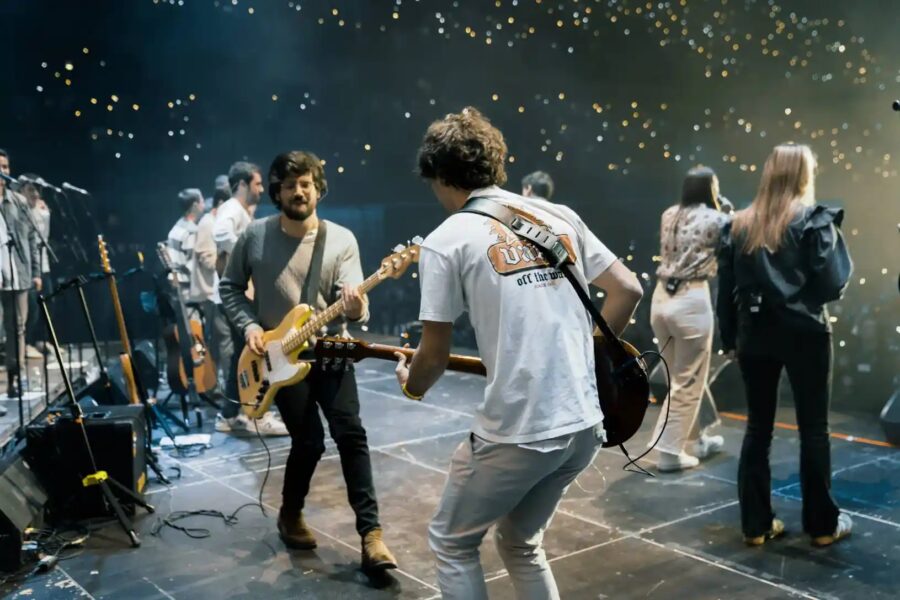
WiZink full, seventeen thousand young praying people on Three Kings’ Day, presence in seventy cities across three continents, Pope Francis blessing, and virality rates that most of the Spanish pop industry would sign without blinking. Hakuna’s figures disrupt the narrative of Catholic discredit in Spain and, for that very reason, deserve to be taken seriously. What is being discussed here is not its success—which is real—nor the affection of its members for the Eucharist—which is also evident—but something more subtle: what Christianity is being preached when what ultimately circulates, what millions of teenagers tattoo on their Spotify, are the lyrics.
It is advisable to start by recovering a technical term, not an insult. Emotivism is the term that Alasdair MacIntyre, following Charles Stevenson, fixed in After Virtue to designate the doctrine—or rather the climate—according to which moral statements are nothing more than expressions of preferences and feelings. Applied to religious language, the operation is analogous: dogmatic truths cease to affirm something about the order of reality to become intimate exclamations. God ceases to be who He Is; He becomes who makes me feel what I feel. Emotivist Christianity does not deny; it sublimates.
Let the reader take the song that best embodies the group’s public charisma, Baila y déjate de historias. Its central command is to renounce control and let oneself be carried away; its guiding image, dance, in which God literally offers Himself as a ballroom partner. There is a particularly revealing verse, in which it is affirmed that it is God the Father who shouts to the faithful to accompany him «in whatever you choose.» The theological distance from the tradition could not be greater. God accompanies man, yes, but He accompanies his effort to discern the divine will; He does not endorse human freedom turned into absolute self-referentiality. Grace comes to rectify what is crooked, not to sign what was already decided in the living room. Another verse advises, with surprising literalness, that if one carries the cross «there’s no need to make it noticeable.» Christ, however, did not hide the wood: He carried it up to Jerusalem in view of everyone, and Paul gloried in nothing else. Turning the cross into a modest contrariety, an intimate nuisance that is best disguised so as not to spoil the atmosphere, is exactly the opposite of Pauline theology. The song closes with a motivational aphorism: «not putting a signature» would be «the best way to sign.» The meaning, if there is one, escapes us; the effect, on the other hand, is clear: the phrase sounds profound. And sounding profound, not being it, is enough.
Huracán, its most viral track, replicates the scheme with more muscle. The voice of the believer confesses questions, abysses, leaps and falls; what finally breaks the sky is a hurricane of emotion that ascends from the throat to shout at God for His absence. The gesture is understandable—the Psalms also cry out—but the center of gravity has shifted. Where the psalmist questions Yahweh’s fidelity in terms of covenant and judgment, here the subject interrogates God about affective dryness. It is the metaphysics of mood. It is worth noting the redeeming detail: the song also includes an eucharistic declaration—»I am this piece of bread»—that reintroduces Christ as Real Presence. If the piece stopped there, it would be something else. But the material that the listener takes home is the hurricane, not the bread.
Ruah is the pure exercise of invocation to the Spirit, and its intention is better understood than its content. What is repeatedly asked is for God to «pour out» His Spirit and «fill» a «void» and a «pain.» The grammar is that of therapeutic consumption: there is an inner deficit, an affective lack, and supply is requested. The Holy Spirit—that in the tradition is sanctifier, person, bond of love between Father and Son, spirit of truth and judgment—is functionally reduced to that refueling of fullness. Nor is the objection of doctrinal imprecision entirely improper: if the Christian is a temple of the Spirit from baptism, asking for it in outpourings—as if it had not already come, as if its action depended on the fervor of prayer—brings spirituality close to a Pentecostal mysticism that is not that of the Latin Church.
¿Para quién soy yo? poses, on the other hand, the vocational question, and here the emotivist drift becomes structural. Vocation is described as a path in the dark that consists of trusting, of leaving the calendar blank and letting God fill it. It sounds spiritual; it is, in reality, deeply modern. Catholic vocation has never been a blank calendar: it has been a concrete call to a concrete state of life, with objective obligations, discerning ecclesial authority, and duties that do not vary with the subject’s disposition. The Christian discovers his vocation by reading the commandments and the evangelical counsels, not by waiting for agenda inspirations. When the song equates vocational search with «finding happiness,» the turn is complete. Thomas, Bernard, Ignatius: none would have written that.
And here justice imposes a stop, because denying the reverse would be falsifying the file. There exists in the catalog a Hakuna song that says, literally, the opposite of the group’s general climate. It is titled Sencillamente, it has lyrics by Manglano himself, and its thesis is exactly the one that any critic of emotivist fashions would sign without hesitation: one must «unlink believing from feeling,» believe «feeling doubts,» love «being cold,» hope «feeling fear.» It is St. John of the Cross dressed in pop, and it is magnificent. That the same group capable of writing this produces the rest of the catalog raises an interesting question: do they know how to do something else and choose not to? The probable answer is yes. Sencillamente is not viral. Huracán is. The economy of mass fervor imposes its conditions, and what is sung between tears in a WiZink are not the paradoxes of Carmel but the hymns of outpouring. The existence of the good song does not rescue the whole; it aggravates it, because it demonstrates that it could be done.
What is diluted, in sum, when Christianity is sung like this? First, sin in its ontological density. In Hakuna’s lyrics sin appears occasionally, almost always as an inherited liturgical expression—»crucified for your sins» in the song about the Magdalene—but not as a living problem in the listener’s heart. Second, judgment. Christ does not judge, recalls another of its themes: He came to save and not to judge. It is true that in His first coming He came to save; but to pretend that this is the complete word on the Christ of the Gospels requires forgetting several entire chapters, including the second coming and the discourses on the two paths. Third, the objectivity of the sacrifice. The Mass becomes, in this register, an affective encounter and a moment of emotional communion, and not the unbloody updating of Calvary. Fourth, doctrine. The Trinity, the Incarnation, the last things, the sacraments as effective signs ex opere operato: none of this needs to be explained to sustain a Hakuna Holy Hour. And finally, the scandal. Christianity, in its core, is offensive to reason before being useful to it. Apostolic preaching began with a resurrected corpse and believers willing to martyrdom. Hakuna preaching begins with a dance.
Manglano himself—and this is the detail that most respects his intelligence—publicly acknowledges the criticism. In recent interviews he has admitted that sentimentalism is «a recurring criticism» and has defended feeling as a «starting point» that must be «accompanied.» He provides the metaphor himself: if the spirit is emotionally emptied and not filled afterward with the centrality of Christ, the expelled demon returns with seven worse. The evangelical quote is exact. The problem is that the model described by its author—initial emotion followed by robust formation—is not followed by the product that massively goes to market. The concert sells; the retreats, theology classes, personal accompaniments, reach a committed minority. The machinery, understood as a system, distributes disproportionately the first step—the song—over the following ones—the catechism. And the first step, by its very nature, contains everything that has been put into it. If what was put was emotivism, emotivism is what will spread, even if in the back room there is a solid dogmatic treatise waiting for those who want to go up to the first floor. The majority stays at the dance.
It is not necessary, to conclude, any rash judgment on individual consciences. There will be Hakuna listeners whose faith has matured through these songs to firm dogma and demanding morality; there will be others, and they will probably be more, whose religion has stabilized in an ambient, pleasant, therapeutic spirituality, as compatible with deep Catholicism as with its liquid version. The examination, therefore, does not refer to people but to a certain tone. And that tone, read calmly in the lyrics, is the one that Charles Taylor described decades ago: the secular age is not characterized by the absence of God but by His affective domestication, by His transformation into one more option among the many that the expressive self administers. Hakuna does not save Christianity from that drift; it puts a soundtrack to it. That that soundtrack fills stadiums only proves how well it knows its time. Whether it will be able to transmit it intact to the next generation is something that will not be decided by streaming platforms, but by the children that its listeners today take—or not—to Mass.