


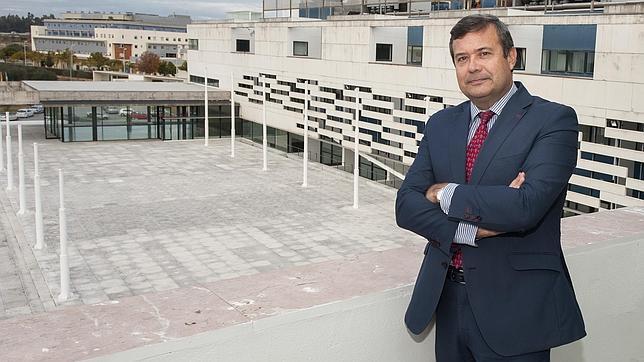
The succession of Alfonso Bullón de Mendoza at the head of the Catholic Association of Propagandists will not have three candidates, but four. To the already known names of José Masip, Rafael Rodríguez-Ponga, and Raúl Mayoral is now added that of Juan Carlos Hernández Boades, former general director of the CEU in Andalucía, whose emergence adds an internal reading that is difficult to disguise: his candidacy does not precisely arise from the peaceful continuity of a stage, but from a broken relationship with the current management.
The election will be held on July 18, 2026, at the V Extraordinary General Assembly of the ACdP, convened at the Colegio Mayor Universitario de San Pablo in Madrid. According to the call signed by Bullón de Mendoza himself, the session will begin with a mass at 11:00 a.m., the electoral board will be constituted at 11:45, and the election of the president will take place at 12:00. The proclamation is scheduled for 1:30 p.m. The deadline to submit candidacies ends on June 18, 2026, at 7:00 p.m.
Bullón cannot run again. The handover is mandatory and, therefore, the internal battle no longer revolves solely around who will occupy the presidential office, but around which bloc will take control of the real direction of the Association and its works. In the ACdP, as is well known, the president does not preside over a decorative association. He presides over a structure with universities, schools, foundations, public presence, networks of influence, and a media project, El Debate, whose continuity as it is currently structured concerns several internal sectors.
Until now, the map seemed relatively orderly. José Masip appeared as the continuity candidate. Rafael Rodríguez-Ponga represented a more political, more institutional profile, and closer to the PP world. Raúl Mayoral had entered the scene with a candidacy of spiritual and associative tone, accompanied by documents in which he presents himself as a lawyer, businessman, former CEU official, and propagandist since 1992. His profile highlights that he was secretary general, deputy general director, director of CEU Media, general director of the Fundación Universitaria San Pablo CEU, and deputy to the presidency of that foundation, as well as managing director of the Fundación Cultural Ángel Herrera Oria and patron of the Colegio Mayor de San Pablo.
However, Mayoral’s candidacy has not cleared up the main unknowns about the future of the works. In the document titled Los Propagandistas y el Espíritu Sobrenatural, the aspirant speaks of inner renewal, unity, supernatural spirit, life of prayer, fidelity to the founding charism, and overcoming a “conventional Catholicism” with a “Catholicism of conviction.” The text is abundant in spiritual appeals, but it does not specify what he would do with the CEU, with the internal balances, or with El Debate.
The entry of Hernández Boades changes the board because it introduces a candidacy with its own biographical and institutional weight. Juan Carlos Hernández Boades was the general director of the CEU in Andalucía, and his departure from that position, internally attributed to Bullón’s decision, inevitably weighs on the reading of his move. In an institution accustomed to interpreting gestures as much as documents, his candidacy is read in some sectors as more than a presidential aspiration: a way to return to the board, gauge support, settle political scores, and demonstrate that he has not been sidelined.
It is not a neutral candidacy. None is at this moment. But Hernández Boades’s has a particularly significant component because it stems from a specific fracture. His entry allows for articulating, or at least representing, a vote of discontent with the outgoing management, especially among those who consider that Bullón’s tenure has accumulated power, controversial decisions, and internal casualties. The question is whether that discontent has enough substance to become an alternative or if it will only serve to further fragment the vote against continuity.
The multiplication of candidates may paradoxically favor continuity. If Masip retains the most organic bloc of the current management and the other candidates split the critical vote, the succession could be resolved without a real break. Rodríguez-Ponga would compete from a political-institutional profile. Mayoral from the language of associative life, spiritual reform, and availability for “all.” Hernández Boades from a position more marked by internal grievance and the need to make himself present after his departure from Andalucía.
The underlying question is who is playing to win and who is playing to negotiate. In elections of this type, not all candidates need to reach the presidency to achieve their goal. Sometimes it is enough to demonstrate strength, gather endorsements, condition the second round, group the discontented, or become a necessary piece in the future distribution. That is the key that is beginning to circulate in the ACdP: not only who will be president, but who will be secretary general, who will control the works, who will influence the appointments, and who will decide the course of El Debate.
Mayoral’s case is the most evident. His own document states that he puts himself “at the disposal of all,” a phrase that can be read as a gesture of associative fraternity, but also as a message for the day after. If he does not win, he wants to be there. If he does not preside, he wants to have weight. In an association where executive positions and the works matter as much as the formal presidency, that availability can have an organic translation.
With Hernández Boades, the reading is different. His candidacy does not seem designed only to adorn internal pluralism. His Andalusian background introduces a personal and institutional tension that forces a look toward the decisions made during Bullón’s tenure. That a former general director removed from a relevant responsibility decides to run for the presidency is not a minor detail. It is a message. And in the ACdP, messages are rarely sent without an addressee.
The succession is thus open in four directions. Masip represents continuity. Rodríguez-Ponga, a possible reorientation toward a more political and institutional profile. Mayoral, an internal-rooted candidacy that mixes CEU curriculum, spiritual appeal, and will for influence. Hernández Boades, the expression of an internal wound that seeks electoral translation.
El Debate remains one of the great unknowns. The headline is one of Bullón’s most visible legacies and one of the Association’s most important tools for public presence. That is why the election is not reduced to names. What will be voted on July 18 is also whether the ACdP maintains the course of recent years, modulates it, politicizes it in another direction, or opens a stage of internal readjustment in which old grievances, territorial balances, and personal ambitions weigh as much as discourses on the founding charism.