


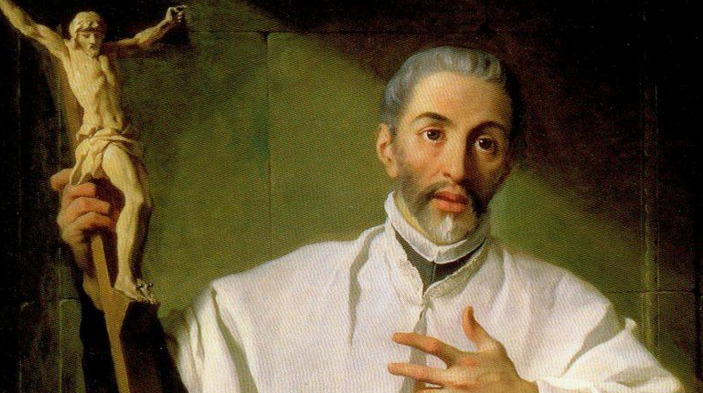
An Ancient Fire for a Weary Time
There are saints whose memory produces devotion and historical admiration; there are others who continue to unsettle centuries later, because in them there was an intensity of God so absorbing and total, that even today it unsettles, discomforts, and compels inward self-examination for anyone who approaches them without the comfortable recourse of turning them into ornamental pieces in a spiritual museum. Saint John of Ávila belongs to that dangerous breed: in him everything is tremendously serious, because God is serious. And serious is the salvation of souls, and preaching and the Holy Mass. How serious was the priesthood in Master Ávila! In him there was nothing theatrical or personalistic, nothing strained or artificially severe; that is why his word continues to produce today a sensation like that experienced by one who ascends to the open and silent heights, to the clean wind of the mountains.
When approaching his talks to priests or his letters, it is inevitable to feel the painful impression of having descended in level, as if between that priesthood and certain contemporary forms of ministry a much greater distance had opened up than we dare to recognize. Today, around the priesthood, encounters, congresses, synods, pastoral plans, itineraries, dynamics, reflections, endless documents are organized, but does so much verbiage serve so that the trembling before the mystery of having been chosen to touch Christ, to offer Him, to speak and absolve in His Name does not evaporate; so that the priest does not get used to what should keep him inwardly kneeling? Master Ávila continues to remind clerics today:
«I know no other thing more effective with which to persuade your graces what they ought to do than by bringing to their memory the height of the benefit that God has done us in calling us to the height of the priestly office. And if choosing priests then was a great benefit, what will it be in the New Testament, in which we priests of it are like the sun compared to night and like truth compared to figure?»
Father Ávila would never have understood a priesthood lived in the key of bourgeois installation or simple ecclesiastical functionality. All his language is traversed by the consciousness of a terrible and glorious election, of a dignity that shakes and demands a life completely given, totally vigilant, absolutely burned from within.
«Let us look at ourselves, fathers, from head to toe, soul and body, and we will see ourselves made similar to the most holy Virgin Mary, who with her words brought God to her womb, and similar to the gate of Bethlehem and the manger where He was laid, and to the cross where He died, and to the tomb where He was buried. And all these are holy things, because Christ touched them; and from distant lands they go to see them, and shed many tears of devotion, and change their lives moved by the great holiness of those places. Why are priests not holy, since it is a place where God comes glorious, immortal, ineffable, as He did not come in the other places? And the priest brings Him with the words of consecration, and the other places did not bring Him, except the Virgin. We are reliquaries of God, house of God and, so to speak, nurturers of God; to which names great holiness is fitting».
They are phrases – let us be sincere – that today we do not dare to pronounce: perhaps they seem excessive, immoderate or improper to an era accustomed to lowering all ideals to make them psychologically bearable. However, for centuries they nourished the priestly spirituality of the Church without producing strangeness, because the priest knew himself segregated from the world precisely to remind the world that God exists. In the homily of his canonization, Paul VI pointed out:
«He deeply warns of what today some priests and many seminarians no longer consider a corroborating duty and a specific title of the ministerial qualification in the Church, his own definition —let us call it if we wish sociological— that comes to him from being a servant of Jesus Christ and as the apostle Saint Paul said of himself: «Segregated to announce the Gospel of God» (Rm 1, 1). This segregation, this specification, which is also that of a distinct and indispensable organ for the good of an entire living body (cf. 1 Co 12, 16 ss.), is today the first characteristic of the Catholic priesthood that is discussed and even «challenged» for reasons, often noble in themselves and, under certain aspects, admissible; but when these reasons tend to cancel this «segregation», to assimilate the ecclesiastical state to the lay and profane and to justify in the chosen one the experience of worldly life under the pretext that he should not be less than any other man, they easily lead the chosen one off his path and easily make the priest an ordinary man, a salt without savor, unfit for interior sacrifice and lacking in power of judgment, word and example proper to one who is a strong, pure and free follower of Christ. The sharp and demanding word of the Lord: «No one who looks back while he has his hand on the plow is fit for the kingdom of heaven» (Lc 9, 62), had penetrated deeply into this exemplary priest who in the totality of his donation to Christ found his energies centupled».
The Tragedy of Getting Used to God
The current ecclesial drama is not precisely inactivity: never have there been so many meetings, structures, initiatives and words; never so many means, speeches and projects. The problem seems deeper and more serious: habituation. The boring and atonic routine of talking about God without trembling, of touching the holy without shuddering, of living next to the altar without the altar burning the soul anymore, of pronouncing eternal words daily with a distracted heart and an interior life eroded by noise, dispersion and spiritual weariness.
In Saint John of Ávila everything is impregnated with supernatural consciousness. He does not say that the priest “presides over an assembly” but that he sacramentally represents Christ. And that completely changes the interior atmosphere of an existence that does not belong to itself. The priest can no longer organize himself solely according to personal taste, comfort or the search for installation; he is incorporated into a higher and more painful logic: that of Christ Priest and Victim, Shepherd and Lamb who saves by immolating Himself for souls. And the priest, with and as He:
«This, fathers, is to be priests: to appease God when He is, alas!, angry with His people; to have experience that God hears their prayers and gives them what they ask, and to have such familiarity with Him; to have virtues more than men and to put admiration in those who see them: heavenly men or earthly angels; and even, if it can be, better than them, since they have a higher office than them».
In Avilan spirituality the Holy Mass occupies an absolutely central place, not only as a liturgical obligation or as the doctrinal axis of Christian life, but as the great configuring Act of the priestly soul. The Holy Master knew that a people may forget many preachings, but rarely forgets the impression produced by a priest who truly celebrates as one who believes what he is doing. In recent decades, meanwhile, as a commonplace that provokes a crushing laziness, it is crowed that we live “an ecclesial spring”, we have witnessed a progressive disappearance of the sense of visible adoration, of sacred gravity and of contemplative recollection that for centuries the traditional Roman liturgy spontaneously imprinted on the priest and on the faithful people. Father Ávila always celebrated according to the venerable ancient rite of the Latin Church that had molded entire generations of priests for centuries, a rite where everything —the ornaments, the prominence of the cross, the silence, the inclinations, the kisses to the altar, the repeated genuflections, the whispered canon, the common orientation toward God, the gravity of the gestures, the Latin— contributes to reminding the priest that he is not the protagonist of anything, but barely a trembling instrument of a Mystery infinitely greater than himself: «In the Mass we place ourselves on the altar in the person of Christ to do the office of the same Redeemer». It is no coincidence that from that liturgy men like John of Ávila were born, capable of spending hours before the Tabernacle, of ascending to the altar with holy fear and of treating with God familiarly. Because the people learn much more from how the priest celebrates than from what he may explain afterward about the Eucharist. They learn by seeing if the celebrant hurries or adores; if he exposes himself or disappears; if he seems to be managing something routine or truly entering the Holy Sacrifice of Christ, which the Holy Master presents as the constitutive reality of priestly identity, and thus it is inconceivable for him to separate the ministry from holiness, pastoral action from interior life, the altar from the cross:
«Say Mass every day, even if he does not feel devotion, and… this Most Holy Sacrament will be great sweetness and consolation to him. If some person importunes him much to confess her, let him do it with that preparation as when he goes to say Mass; and I would not want it to be women, nor to many, but to some particular thing that seems to be commanded by God».
On this particular he says in another letter to another priest, with prudent realism:
«Do not give himself much to confessions of women, especially young ones, which is a very dangerous negotiation, unless there is a very particular gift from God, that makes the flesh as if insensible. And generally put more eyes on the advancement of men, because if he begins to look at them, he will not want to understand anything else, as they make spend time on things of little profit».
No One Gives What They Do Not Have
Saint John of Ávila teaches the absolute centrality of prayer. Not as an intimist refuge, pious feeling or spiritual therapy, but as a matter of life or death for the priest, who can maintain for years an apparently fruitful external activity while interiorly he has been drying up; he can continue preaching, organizing, accompanying and working, even when the real and silent dealings with God have dangerously weakened, and then the dichotomy begins to occur of continuing to speak of God after having almost stopped dealing with Him: «They tell me that Your Grace works a lot: I would like him to moderate…, because certainly we are of flesh, which is weak although the spirit is strong… This is as for the body, in which I commend that neither be pampered nor excessively work it… As for the soul, I commend him that in such a way he profit others that he never lose his mental prayer and recollection; and in this look very much, because I have seen some who have given all they had and remained poor for themselves and for others… Harder and more profitable is what goes little by little, and more impresses a word after having been in prayer, than ten without it: not in much speaking, but in devoutly praying and well acting is the profit: and therefore we must maintain others in such a way, as never to depart from our manger, and never lack the fire of God on our altar. Therefore, let him not be too continuous excessively in giving himself to others, but have his good appointed times for himself». Because it is not enough to study to preach, without prayer. Study without prayer makes presumptuous, and prayer without study easily errs. God wants «to speak, being God, through a tongue of flesh, and to raise man to be an organ of the divine voice and oracle of the Holy Spirit».
Such a concept of the priestly ministry is at an infinite distance from the contemporary trivialization of preaching, turned so many times into sociological commentary, sentimental improvisation or amiable conversation without supernatural density, as if human closeness were enough where before the fire of God, solid doctrine, penitential life and words born of contemplation were expected. John of Ávila could not conceive that a priest ascend to the pulpit without having remained much time on his knees, letting the Word first pierce his own life before that of others. And the true Catholic perceives when a homily is born of silence, tears, penance, adoration and interior life: in the midst of the confusion of our time, it is recognized if a priest speaks only of God or also from God.
Master Ávila united holiness and study, against the temptation to oppose spiritual depth and intellectual formation, as if love for God dispensed from the serious effort of thinking and certain pastoral spontaneity sufficed to replace years of rigorous study, reading, theological contemplation and mental discipline. John of Ávila considers that an pastoral irresponsibility and a true lack of charity toward souls. Paul VI recalled in the homily of the canonization of the Holy Master:
«His word as a preacher became powerful and resounded renewing. Saint John of Ávila can still today be a master of preaching, all the more worthy of being heard and imitated, the less indulgent he was with the artificial and literary orators of his time, and the more overflowing he presented himself with wisdom impregnated in the biblical and patristic sources. His personality manifests itself and magnifies in the ministry of preaching».
The priest must study if he loves souls. He must prepare himself because he will have to answer to God for every word pronounced in His name, and because he knows that a self-satisfied ignorance can do a great deal of harm precisely when it is clothed in religious language and presents itself as pastoral closeness. Here is another poverty of our time: a certain self-satisfied intellectual superficiality, where sometimes theology is replaced by opinions, doctrine by impressions and thought by pastoral occurrences, as if doctrinal clarity were a secondary luxury and not a concrete form of love for simple souls, who have the right to receive from the lips of the priest not his moods, nor his personal intuitions, nor his psychological improvisations, but the luminous and demanding truth of the Gospel. In Saint John of Ávila there is fire in the heart and gravity in the intelligence, both things, that is why his words continue to have weight five centuries later, while so many contemporary words, pronounced with enormous apparatus and quickly disseminated, age in a matter of months because they lack what sustains truly priestly words: prayer and sacrifice.
There is in Master Ávila another aspect that today we need to rediscover with special urgency: his immense work of spiritual direction.
«He knew – said Paul VI – the exercise of the personal and interior word, proper to the ministry of the sacrament of penance and spiritual direction. And perhaps even more in this patient and silent ministry, extremely delicate and prudent, his personality stands out above that of an orator».
He was not only a great popular preacher nor a reformer of the clergy; he was, above all, a father of souls, a man to whom priests, religious, nobles, university students, restless young people and disciples of every condition came seeking light, correction, consolation and truth. His spiritual authority did not arise from psychological techniques or learned relational skills, but from holiness, from prayer and from interior experience of God. For John of Ávila the priest is not called solely to administer sacraments or coordinate activities, but also to supernaturally accompany souls, discern them, correct them, encourage them and patiently lead them toward God, as a true physician of the spirit. That is why his disciples did not seek in him simply human understanding, but orientation. They did not come to see themselves confirmed in themselves, but to be helped to convert. True spiritual direction cannot be replaced by vaguely therapeutic accompaniments where almost never is corrected, nor demanded, nor truly led toward holiness. The Holy Master knew that to love a soul also means helping it to come out of itself.
May the People See God Again in Their Priests
Reading the Master, the spiritual strength that he takes for granted in a priest also impresses. Without a trace of sentimental softness, he continually speaks of interior combat, of renunciation, of the cross, of mortification, of vigilance over himself, of hidden perseverance and of loving acceptance of priestly wear and tear, since one who has been sacramentally configured with Christ cannot afterward pretend an existence carefully protected from suffering, contradiction and painful surrender. A minister of the Crucified cannot marvel at temptations and labors, for there is no surer way to profit than to suffer. Gifts and delights are not for the soldiers of Christ: God does not want weak hearts in His ministers, who must be men crucified to the world.
For the priest to care for his external bearing, his attire, his composure and his manner of presenting himself before the people is not superficial aestheticism nor worldly clericalism, but understanding that he visibly belongs to God and that his external presence too must transparently show gravity, recollection and consecration, honesty and example. The priest is not an indistinguishable man from the world, carefully disguised among it so as not to bother anyone, but a visible sign of another reality: his way of dressing, speaking, walking and behaving must remind of the existence of the supernatural. Reading Master Ávila, one cannot help asking if, with so much Ratio formationis, we have not formed generations incapable of bearing solitude, silence, sacrifice, frustration or hidden perseverance; taught many pastoral strategies, but very little about the austere and virile joy of remaining beside the cross without fleeing from it, without continually narcotizing oneself with distractions and without turning “I feel like it” into the supreme criterion of discernment.
That the ministry slowly wears down the entire life of the contemporary priest, consuming his strength and leading him to a real configuration with the crucified Christ is very beautiful, not because suffering has value in itself, but because there exists a mysterious priestly fruitfulness that springs when life stops being selfishly reserved and begins to be silently spent for God and for souls, without need of applause, without yearnings for recognition, without the permanent concern to protect oneself.
Master Ávila was not a pale ascetic enclosed in his ivory tower. Quite the contrary: he burned with love for souls, spent hours confessing, preached until exhaustion, wrote immense letters of spiritual direction, wept seeing the religious ignorance of the people, suffered for lukewarm priests. And precisely because he loved souls so passionately, he never lowered the priestly ideal, for he knew that the people can bear the poverty, simplicity and even certain human limitations of their priests, but end up dying slowly when they stop finding in them men truly possessed by God. «Let your grace enlarge his small heart in that immensity of love with which the Father gave us His Son, and with Him gave us Himself, and the Holy Spirit and all things». «Your neighbors are a thing that touches Jesus Christ», therefore, «the proof of the perfect love of our Lord is the perfect love of neighbor»
The Christian people continue to have an immense need —although they do not always know how to express it— to encounter priests who truly live as men of God. Priests whose way of celebrating the Holy Mass reminds that something supernatural happens there; whose word is born of prayer; whose gaze is not constantly turned toward themselves; whose poverty, purity, charity and interior gravity return to the world the nostalgia for God; whose presence introduces a little supernatural silence in the midst of this civilization exhausted by noise, banality and permanent exhibitionism. That it suffices to see them to remember God.
Such is the great question that Saint John of Ávila would ask us today, not with bitterness or nostalgia for other times, but with his mixture of priestly tenderness and interior fire that makes it difficult to defend oneself from his words. Not whether the priest is sympathetic, whether he is modern, communicates well or knows how to adapt to all languages, but something infinitely more serious, more priestly and more urgent: whether, upon looking at him, it is still possible to remember God.