


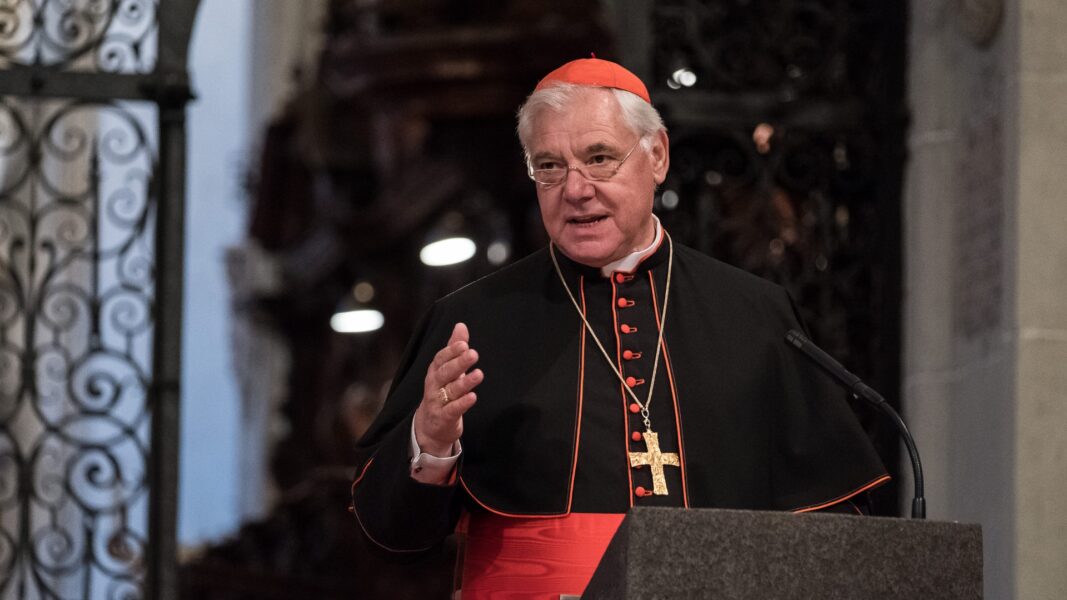
Cardinal Gerhard Müller has spoken out on the Synod on Synodality report referring to the so-called «emerging issues,» denouncing that certain ecclesial sectors are using the synodal process to introduce gender ideology into the Church and to relativize Catholic doctrine on marriage.
In an extensive text disseminated by his office and published by Per Mariam, the former prefect of the Congregation for the Doctrine of the Faith accuses some bishops, theologians, and pastoral leaders of promoting a «world-accommodated Christianization» and of replacing divine revelation with contemporary ideological categories.
“The relativization of marriage is no longer hidden”
According to the cardinal, the report reflects a theological drift that seeks to progressively weaken Catholic teaching on marriage and sexuality. In his view, the issue is no longer presented indirectly or ambiguously, but openly.
“The heretical relativization of natural and sacramental marriage is publicly welcomed,” states Müller, who considers that some ecclesial sectors are using pastoral language to erode fundamental doctrines of the Church.
In that line, he argues that the promotion of blessings for homosexual couples or irregular unions does not constitute a merely disciplinary matter, but a profound alteration of Christian anthropology and the Catholic understanding of marriage.
“All this is presented as the first step toward the recognition of LGBT ideology,” he writes, denouncing that said ideology proposes “a materialistic view of the human being without God, creator and redeemer”.
Criticism of the new pastoral language
Müller directs much of his criticism at the way certain synodal documents or ecclesial discourses frame the relationship between doctrine and mercy. As he explains, an artificial opposition is being constructed between doctrinal fidelity and pastoral closeness, as if the Church’s moral teaching were incompatible with compassion for people.
In his view, some sectors portray those who defend Catholic doctrine as “rigid” or “legalistic,” while exalting a pastoral model based solely on unconditional acceptance and adaptation to the spirit of the times.
However, the cardinal reminds us that the Christian tradition has never understood mercy as a justification for sin. Christ died for all men, he states, precisely to offer the possibility of conversion and a new life in accordance with the Gospel.
For this reason, he considers the ambiguous use of concepts such as “discernment” or “listening to the Spirit” particularly dangerous when they serve to avoid calling sin what objectively contradicts God’s law.
“The blessing cannot approve a life contrary to the Gospel”
Müller insists that no ecclesial authority has the power to bless what contradicts God’s design for man and woman. “There is no blessing in Sacred Scripture or in the entire tradition of the Church for adulterous relationships,” he states.
The cardinal explains that the Christian blessing can never be understood as a moral approval of an objectively disordered situation. “The liturgical or private blessing is a prayer of the Church that asks for God’s help to promote the good; it can never become the confirmation of a life contrary to God,” he writes.
In this context, he also recalls that human weakness does not eliminate the call to conversion nor annul the action of grace. Quoting St. Paul, he insists that God does not deny his help to those who sincerely ask for it.
A frontal denunciation against “woke” ideology
Beyond the issue of blessings, Müller expands his reflection into a general critique of gender ideology and the so-called “woke” culture, whose influence he considers increasingly visible within some ecclesial circles.
“Woke thinking, originally derived from atheistic materialism, has penetrated the Church as a destructive heresy and a force of division”
The cardinal even goes so far as to compare this situation to ancient doctrinal crises that threatened the unity of the Church, such as Pelagianism or Manichaeism. In the face of this, he recalls that the Church overcame those heresies thanks to the doctrinal firmness of the popes, councils, and great doctors like St. Augustine or St. Thomas Aquinas.
“The Church will not save the world by imitating it”
Finally, the former prefect of the Congregation for the Doctrine of the Faith warns of the risk of transforming the Church into a merely philanthropic organization obsessed with obtaining cultural and media approval.
Christianity will not recover the secularized societies of the West by diluting its doctrine or adapting to dominant ideological currents. The Church’s mission, he insists, remains to lead men to Jesus Christ and to proclaim the Gospel in its entirety.
“It is not the false blessings of the powerful of this world that the Church needs,” Müller concludes, recalling that the true blessing comes solely from God and fidelity to Christ.