


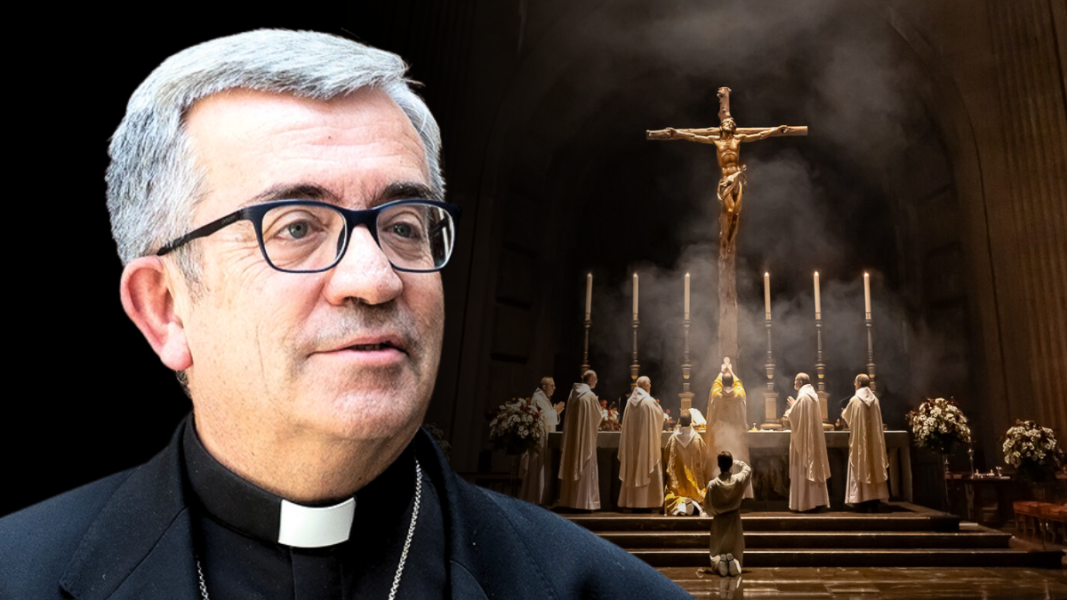
When two ecclesiastical voices of maximum authority describe the same fact in an incompatible way, the normal—reasonable—thing is to expect a clarification. When that clarification does not arrive, the normal thing is to start asking why. That is exactly what has been happening for weeks in the matter of the Valley of the Fallen, where the public position of the Benedictine community and that of the president of the Spanish Episcopal Conference do not fit. They do not fit at all.
The issue, at bottom, is of an almost uncomfortable simplicity: does the winning project of the resignification contest affect the interior of the Basilica of the Holy Cross or not? For the monks who guard the temple, yes—and gravely so. For Monsignor Luis Argüello, no. The project, he maintains, respects the basilica. The two things cannot both be true at the same time. And when one opens the plans published by the Ministry of Housing and Urban Agenda itself, the doubt disappears: the reason is not on the more reassuring side of the narrative.
What the monks wrote:
On Tuesday, April 28, the Abbey of the Holy Cross of the Valley of the Fallen published a Third in ABC. It was not an improvised comment, nor testimony heard from third parties, or an anonymous leak. It was a signed and deliberate text, aware of its scope. The gravity of the matter demanded precisely that: public exposition and responsibility for what was said, regardless of third-party opinions on its content.
In that text, the representative of the Abbey argued from various angles, some of which are nuanced from a philosophical point of view. However, it recalled something so elementary that it is almost uncomfortable to have to explain it again. For the Catholic Church, a temple is not a fragmentable building to the taste of the political juncture. It is not an adaptable container. It is the house of God. And its sacrality—wrote—»is not limited to the altar nor to the moment of the liturgical celebration par excellence—the Holy Mass—, but extends to the entirety of the floor plan and the spaces of the temple—door, atrium, vestibule, naves, altar, dome, chapels and crypts.»
The ecclesiastical problem—warned the Benedictines—is not what the Government wants to do outside the basilica, which corresponds to the political sphere. The problem arises when «one contemplates extending said actions to the consecrated spaces of the temple, imposing a non-independent access subordinated to the prior passage through a center for historical and political interpretation.» And they concluded without leaving room for ambiguity: «said affectation includes, in addition to that conditioned access, the occupation of the atrium, the vestibule and other spaces of the temple, according to the project selected by the Government.»
Translated into plain language, without technicalities: Pedro Sánchez’s Executive does not limit itself to intervening in the surroundings of the Valley. It intends for the faithful to pass through a narrative—a center for historical and political interpretation—before being able to enter the basilica. It intends to occupy the atrium. It intends to transform the vestibule. It intends, without any ambiguity, to intervene in consecrated spaces. And all this, beyond the sacrality—emphasized the monks—compromises the principles of state neutrality and proportionality, as well as the constitutional right of the faithful to religious freedom and worship.
It is not just another opinion. It is the position of those who have the legal and spiritual responsibility for the temple.
What the president of the Spanish bishops said:
Five days later, on Sunday, May 3, the same newspaper published an interview with the president of the Spanish Episcopal Conference. And the version that Monsignor Argüello offered on that same project—already knowing the public position of the Benedictines—simply sounded different.
«The contest has come out and there is a winning project, but an appeal has been filed—said—. At this moment, the possibility of reaching an agreement passes through the monks… and the Government… I believe there is the possibility of reaching an agreement that respects the abbey, the basilica and independent access. The current winning project respects the first two points and not independent access, but I think it is easy to resolve the matter if there is good will.»
It is worth pausing. Reading it slowly. Word by word. For the president of the Spanish bishops, the winning project «respects the basilica.» The problem—if any—would be independent access. A loose end. A technical detail. Something solvable with good will.
But five days earlier, the monks—the same ones who, as he recognizes, have the custody of the basilica—had affirmed exactly the opposite. That the project enters consecrated spaces. That it occupies the door. That it occupies the atrium. That it transforms the vestibule. That it conditions access to prior passage through a political interpretation center. That it raises fundamental problems, not nuances.
It is not a difference in approach. It is not a matter of language. It is a divergence of fact. They are not describing the same thing. They are not talking about the same project. They are not transmitting the same reality to the faithful.
What the plans say:
And then comes the uncomfortable fact, the verifiable one. The one that does not depend on interpretations or nuances. It is enough to open the public documentation from the Ministry of Housing and Urban Agenda, and look at the plans. And the plans are stubborn.
The planned intervention is not limited to the exterior nor does it stop at the surroundings, nor is it exhausted in access. It affects the basilica’s door, affects the atrium, and the interior vestibule. And it projects interventions in the entry sequence to the temple that alter its functional and symbolic configuration.
Unless the Government has silently changed its project—something it has not communicated—what appears in the official documents coincides with what the monks denounce. Not with the more reassuring version.
The contradiction, therefore, is not interpretive. It is factual. One of the two public descriptions does not fit what is written in the plans. And it is not the Benedictines’.
The due transparency
That is where the matter stops being a crossing of statements and acquires an institutional relief. Because Catholic faithful are not informational minors. They have the right to know what is at stake in a pontifical Basilica, what the Government intends to do in the interior of a consecrated temple, and what position their pastors hold.
When two ecclesiastical voices of that level offer incompatible versions, someone has to clarify it. Not to polemicize. Out of respect.
Did Monsignor Argüello know the content of the Third published by the Abbey five days before his interview? If he knew—and it is hard to think otherwise—, why did he affirm that the project «respects the basilica»? Has he examined the plans published by the Government? What version should the faithful consider truthful?
They are not rhetorical questions. They are the questions that are already circulating—increasingly with less caution—in discreet conversations, in ecclesiastical circles, in sacristies and outside them.
Transparency, at this point, is not an optional virtue. When what is at stake is a consecrated temple and the religious freedom of the faithful, it is a minimum requirement.
Recommended articles:
- What is at stake for the Spanish and universal Church with the Valley of the Fallen (I)
- What is at stake for the Spanish and universal Church with the Valley of the Fallen (II)
- What is at stake for the Spanish and universal Church with the Valley of the Fallen (and III)
- Plans of the project «The base and the Cross»