


I. What is character?
Does it occur in the soul of the ordained, in a real, stable, irreversible way, a sacramental configuration with Christ? That this happens in the presbyterate is something that the Church teaches as an essential truth. The Council of Trent, in Session VII, declares that there are sacraments that imprint an indelible character on the soul and that cannot be repeated, among them Holy Orders (Sess. VII, can. 9). And later, when dealing directly with that sacrament, it reaffirms that through sacred ordination the Holy Spirit is conferred and character is imprinted (Sess. XXIII, can. 4). It is an indelible seal, an ontological mark, a new belonging, a consecration that is not erased.
But what about the deacon? Is he a layperson to whom tasks are entrusted, a qualified collaborator, a merely pedagogical intermediate degree, or… a man marked by the sacrament of Holy Orders? Because he too is configured with Christ in a real and permanent way. And this already introduces a new density into his existence, orienting it irreversibly toward the mystery of God.
In the traditional rite of the Pontificale Romanum, when the bishop is about to confer the diaconate, he addresses God supplicating the outpouring of the Spirit:
Emitte in eos, quaesumus, Domine, Spiritum Sanctum, quo in opus ministerii fideliter exsequendi septiformis gratiae tuae munere roborentur.
It implores that the Holy Spirit be sent upon the ordinands to strengthen them with the gift of grace for their ministry.
II. The architecture of Holy Orders and its eucharistic keystone
To understand the proper quality of character, it is necessary to penetrate the internal logic of the sacrament of Holy Orders. And here the teaching of St. Thomas Aquinas remains decisive, for whom Holy Orders is defined by its relation to the Eucharist. It is not an autonomous structure or a system of independent powers, but a reality organically oriented toward the eucharistic Sacrifice: Holy Orders is ordered to the consecration of the Body of Christ, and the distinction of its degrees proceeds from the diverse relation that each one has with that central act (cf. Summa Theologiae, Suppl., q. 37, a. 2).
The priest is such in order to consecrate: that is his proper act, his vital center, that which gives meaning to all his power (cf. Suppl., q. 40, a. 2). In contrast, the deacon does not receive that power, but is ordained to serve in the sacred mysteries, assisting the priest in the celebration and in the dispensation of the holy (cf. Suppl., q. 37, a. 2, ad 1).
It is not an accidental difference, but a structural one. Holy Orders is not an accumulation of functions, but a living hierarchy, a harmonious architecture where each degree participates in the same mystery of Christ according to a proper form. The deacon belongs to that architecture, but does not occupy its sacrificial center; he is in real relation with the altar, but does not yet act in the act of consecration.
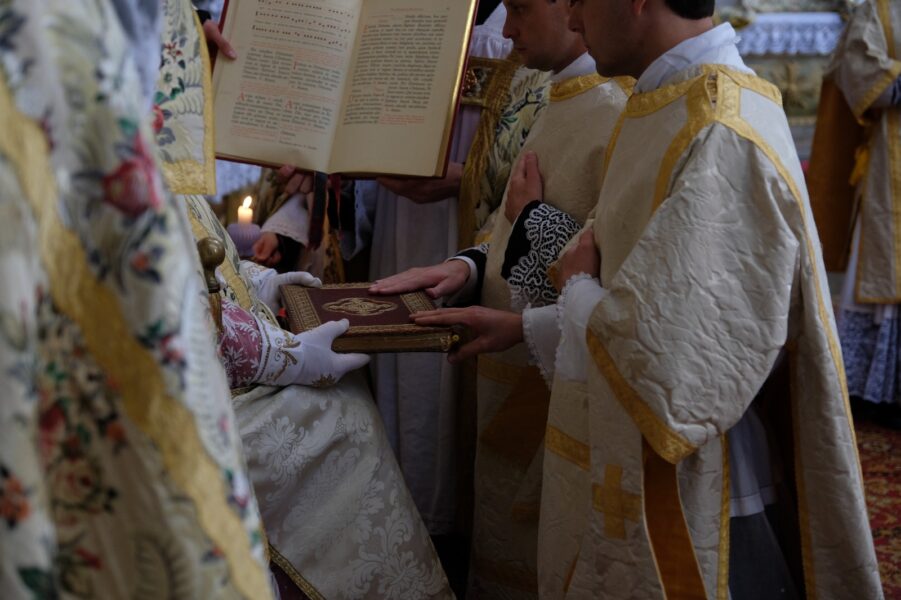
Such a structure is reflected in the rite itself of the Pontificale Romanum. When the bishop instructs the candidates, he reminds them that they have been chosen ad ministerium altaris, for the service of the altar, and not for the sacrifice itself. And in the delivery of the book of the Gospels—one of the most eloquent gestures of the rite—it is said to them:
Accipe potestatem legendi Evangelium in Ecclesia Dei, tam pro vivis quam pro defunctis.
That is, their proper power is that of proclaiming the Gospel in the Church of God. The liturgy thus translates into gesture and word what theology expresses conceptually: a true participation, but not full, in the mystery of Holy Orders.
III. The “inchoative”: real beginning, fullness not yet attained
Theology speaks of the “inchoative character” of the diaconate. It is not a terminological invention, but a conceptual necessity to express precisely what occurs.
“Inchoative” means begun, truly initiated, but not yet brought to its perfection. It does not indicate an apparent or incomplete reality in a negative sense, but an authentic presence in a state of beginning.
The deacon has been truly introduced into the sacrament of Holy Orders, has received an indelible character, has been configured with Christ; but he has not yet been constituted in the fullness of the ministerial priesthood, because he has not received the power to consecrate or to act sacrificially in persona Christi.
That is why his character is real and, at the same time, inchoative. Real, because it transforms the being; inchoative, because it does not reach the full form of the priesthood. It could be said that in him the priesthood has begun sacramentally, but has not yet arrived at its culminating expression.
Without contradicting Lumen gentium, 29, the Catechism of the Catholic Church teaches that deacons receive the sacrament of Holy Orders and are marked with an indelible character that configures them with Christ the servant (CCC 1570). Although they are not ordained to the priesthood in the strict sense, they do receive Holy Orders; they do not perform the sacrifice, but they belong sacramentally to its economy, introduced forever into the sacred orbit of the altar.
In the consecratory prayer of the Pontificale Romanum, the Church asks for the deacons the virtues proper to those who are to live on that sacred threshold:
abundet in eis omnis forma virtutum, auctoritas modesta, pudor constans, innocentiae puritas et spiritualis observantia disciplinae.
The power to offer the Sacrifice is not yet requested, but rather the interior conformation with a style of life that serves the mysteries. It is the grace of the real beginning, demanding and irreversible.
IV. Christ the Servant: proper form of the diaconate
The deacon sacramentally expresses an essential dimension of the mystery of Christ: his condition as Servant, who not only offers the sacrifice, but delivers himself, bends down, washes feet, places himself in the midst as one who serves.
To that form of Christ the deacon is configured; he is configured with Christ who became “deacon,” that is, servant of all (CCC 1570). It is not a spiritual addition, but the sacramental form itself of his identity: his ministry is not a simple external help, but the visible expression of that dimension of Christ that sustains and accompanies the entire life of the Church.
He proclaims the Gospel, prepares the Sacrifice, assists the priest, distributes Communion, serves the poor. Everything in him is oriented toward the Eucharist, in the form of service.
And precisely for that reason his character is inchoative: because he really participates in the mystery, but under the modality of one who disposes and serves, not of one who consecrates.
This service form appears in the rite when the new deacon is vested with the dalmatic, the liturgical sign of joyful service. He is not yet given the chalice to consecrate, but the Gospel to proclaim; he is not constituted as an offerer of the Sacrifice, but as a minister of the word and of the altar.
Everything in the rite speaks of a real configuration with Christ in the humble form of service.
V. The dawn of the priesthood
It is not a simple step within a formative itinerary, but the sacramental beginning of a configuration. The diaconate is the dawn of the priesthood.
It is not night, because there is already light; it is not yet noon, because fullness has not arrived. It is the first clarity of the altar in the soul of a man. It is Christ who begins to imprint in him his form, his seal, his belonging.
That is why the expression “inchoative character” does not impoverish the diaconate, but situates it in its exact truth and saves it from two opposing reductions: that of turning it into a merely pastoral function and that of confusing it with the full priesthood.
It is character, because it is an indelible seal; it is inchoative, because it is a real beginning that tends toward its fullness.
When the rite concludes and the new deacon withdraws with the dalmatic and the Gospel received, he knows that everything has already begun forever. Because in the priestly Order, when God begins, He is not rehearsing: He consecrates, seals, transforms.